Clear Sky Science · en
Resting state EEG mediates the association between physical activity and cognitive function in cognitively impaired elderly
Why Moving Your Body Matters for Your Mind
As people live longer, more families are watching older relatives struggle with memory lapses, slower thinking, or early dementia. Many wonder: can everyday habits like walking or light exercise really help protect the brain? This study followed over 200 older adults in China who already had some level of cognitive impairment and used brainwave recordings to explore how physical activity might support clearer thinking in later life.
Who Took Part and What Was Measured
The researchers recruited 232 community-dwelling seniors aged 60 and older, ultimately including 209 who met strict criteria and produced usable brain recordings. All had below-normal scores on a standard thinking test called the Montreal Cognitive Assessment (MoCA), which checks memory, attention, language, and problem-solving skills. Participants answered questions about their usual physical activity—how often, how hard, and how long they were active—and completed a detailed background survey covering age, education, marital status, former job, diet, and where they lived. The team then recorded five minutes of resting brain activity using an electroencephalogram (EEG), a cap with sensors that picks up tiny electrical signals from different parts of the scalp. 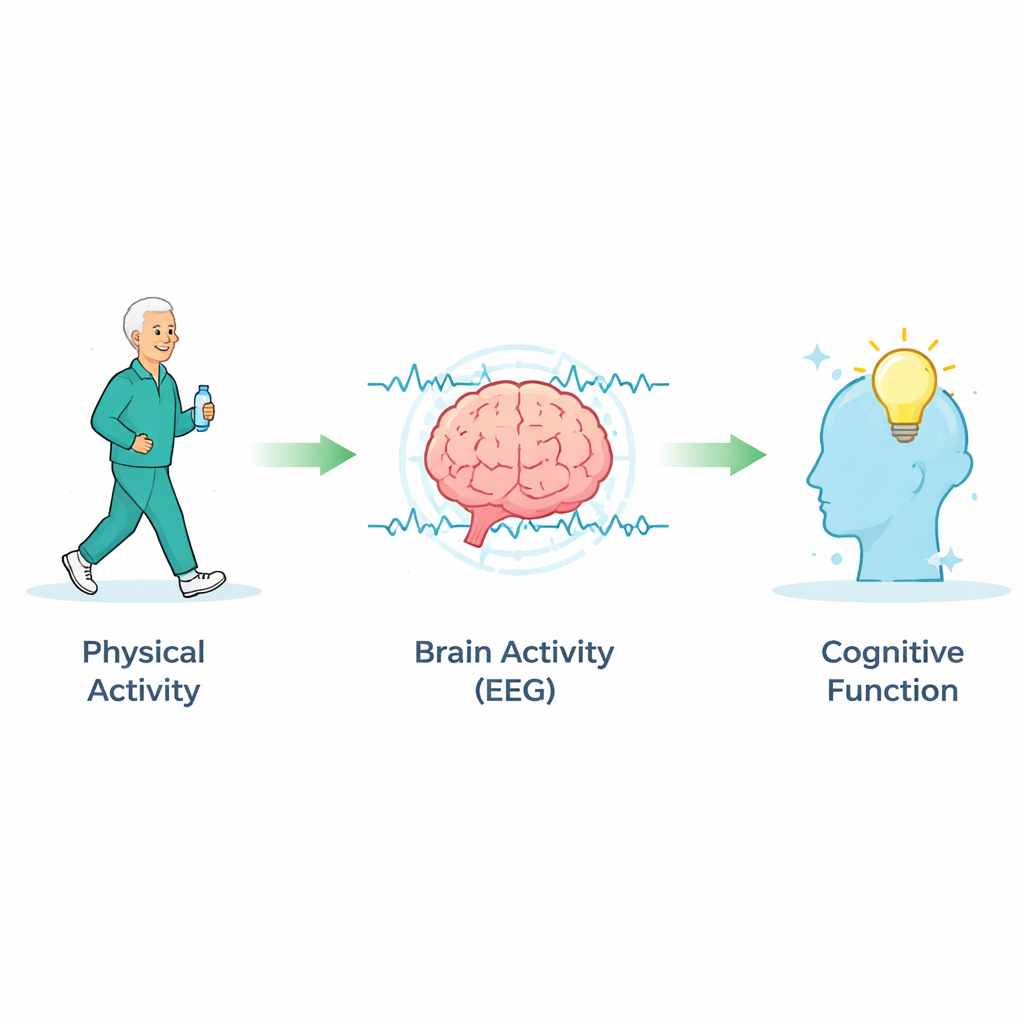
Everyday Life Factors and Brain Health
When the researchers compared people with milder versus more serious cognitive problems, clear social patterns emerged. Those with milder impairment tended to be younger, better educated, more often married, and less likely to have spent their working lives in low-skilled jobs such as farming. They were also more likely to have non-plant-only diets and to live in urban rather than rural areas. These differences suggest that lifelong learning, mentally demanding work, social support from a spouse, and richer access to health and social resources may help build a kind of “reserve” that delays or softens age-related cognitive decline.
What the Brainwaves Revealed
EEG breaks brain activity into different rhythms, or “bands,” such as theta, alpha, and beta waves. After accounting for age and other background factors, the team found that better MoCA scores were linked to lower power in certain brain rhythms during rest—especially theta waves in the frontal and central regions, and specific alpha and beta bands in several areas. In simple terms, older adults who performed better on thinking tests tended to show a calmer, more efficient-looking resting brain pattern, rather than overactive or noisy rhythms. This supports the idea of “neural efficiency”: a healthy brain does not need to work as hard in the background to be ready for mental tasks.
How Physical Activity Fits In
Physical activity showed a strong positive relationship with cognitive scores: more active participants generally thought and remembered better. At the same time, higher activity levels were tied to lower power in key brainwave bands, particularly theta waves in frontal, central, and occipital regions and beta waves at select sites. Importantly, several EEG measures were linked to both exercise and cognition. This allowed the researchers to build a statistical model testing whether changes in brainwaves might explain part of the exercise–thinking connection. 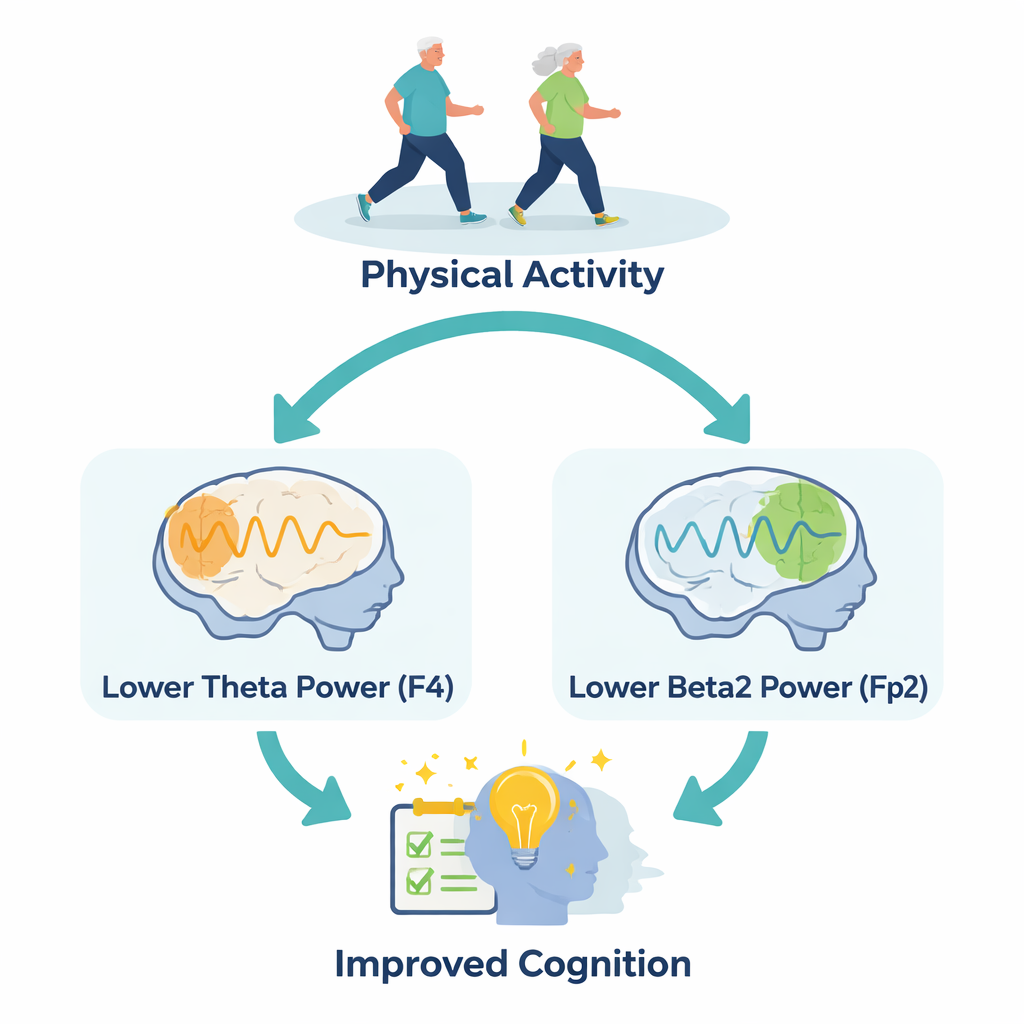
Brainwaves as the Missing Link
The model highlighted two specific EEG markers: theta power at one frontal site (F4) and beta2 power at another frontal site (Fp2). Greater physical activity was associated with lower power in these markers, and in turn, lower power in these bands was associated with better cognitive scores. In other words, the data suggest that exercise may improve thinking partly by nudging resting brain activity toward a more energy-efficient state—less idle over-activation in key frontal regions involved in planning, attention, and self-control. Although the effects were modest and the study was observational (so it cannot prove cause and effect), the results point to these brainwave signatures as promising, noninvasive clues to how lifestyle habits shape brain health in vulnerable older adults.
What This Means for Older Adults and Families
For lay readers and caregivers, the takeaway is encouraging: in this group of cognitively impaired seniors, those who moved more tended to think more clearly, and their brainwaves showed patterns consistent with smoother, more efficient functioning. The study also underscores that education, social ties, diet, and living environment all matter for brain aging. While we still need long-term trials to confirm that increasing physical activity can directly slow decline, this work suggests that even simple, regular movement may help the aging brain conserve energy and stay sharper for longer—offering a practical, low-cost strategy to support cognitive health alongside medical care.
Citation: Xie, B., Qiu, C., Wei, C. et al. Resting state EEG mediates the association between physical activity and cognitive function in cognitively impaired elderly. Sci Rep 16, 7421 (2026). https://doi.org/10.1038/s41598-026-37705-6
Keywords: physical activity, cognitive impairment, EEG, aging brain, dementia prevention