Clear Sky Science · en
Assessment of thyroid iodine accumulation following repeated iodinated contrast media administration using dual-energy computed tomography in a rabbit model
Why this matters for everyday medical scans
Millions of people receive iodine-based contrast dye during CT scans each year. This dye helps doctors see organs and blood vessels more clearly, but it also delivers a large dose of iodine to the body, which raises questions about possible effects on the thyroid gland, the small organ in the neck that controls metabolism. Parents and patients alike may wonder: does repeated contrast exposure quietly damage the thyroid? This study in rabbits set out to measure how much iodine actually builds up in the thyroid after many contrast injections, and whether that build-up translates into hormone or tissue changes.
How the experiment was set up
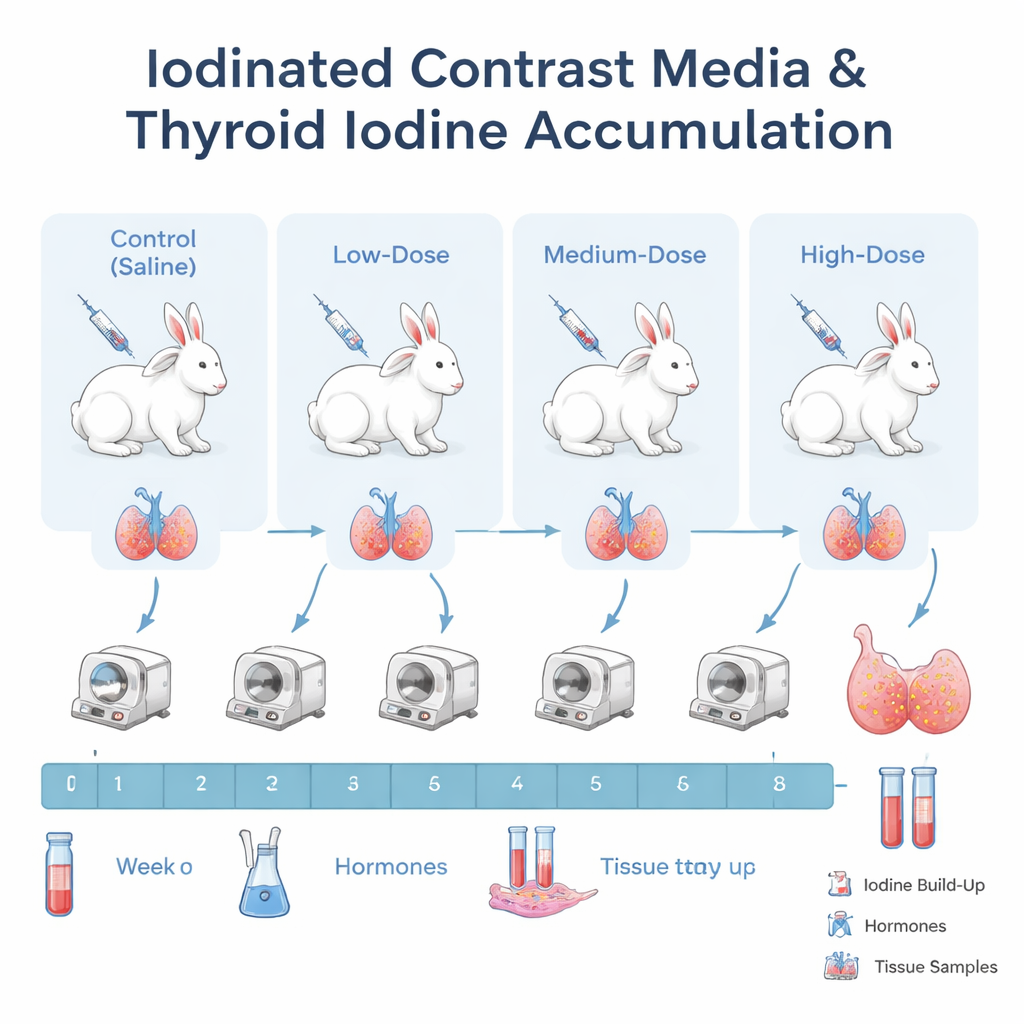
Researchers worked with 30 male rabbits and divided them into four groups. One group received simple saltwater injections and served as the control. The other three groups received an iodine-based contrast dye at a dose similar to that used in human CT scans, or at three and seven times that amount. All injections were given into a vein three times a week for eight weeks to mimic frequent medical imaging. Throughout the study, the team took blood samples to check thyroid hormone levels and used a specialized CT technique to track iodine inside the thyroid without giving any additional contrast.
New imaging to “see” trapped iodine
The study relied on dual-energy computed tomography, an advanced form of CT that can distinguish iodine from surrounding tissues. Using this method, the scientists created iodine maps of the rabbits’ necks and calculated a “thyroid enhancement ratio,” which compared how much iodine-like signal the thyroid showed relative to nearby muscles. Scans were performed every week before that week’s injections, giving a running picture of how iodine build-up changed over time in each dosing group.
What happened inside the thyroid
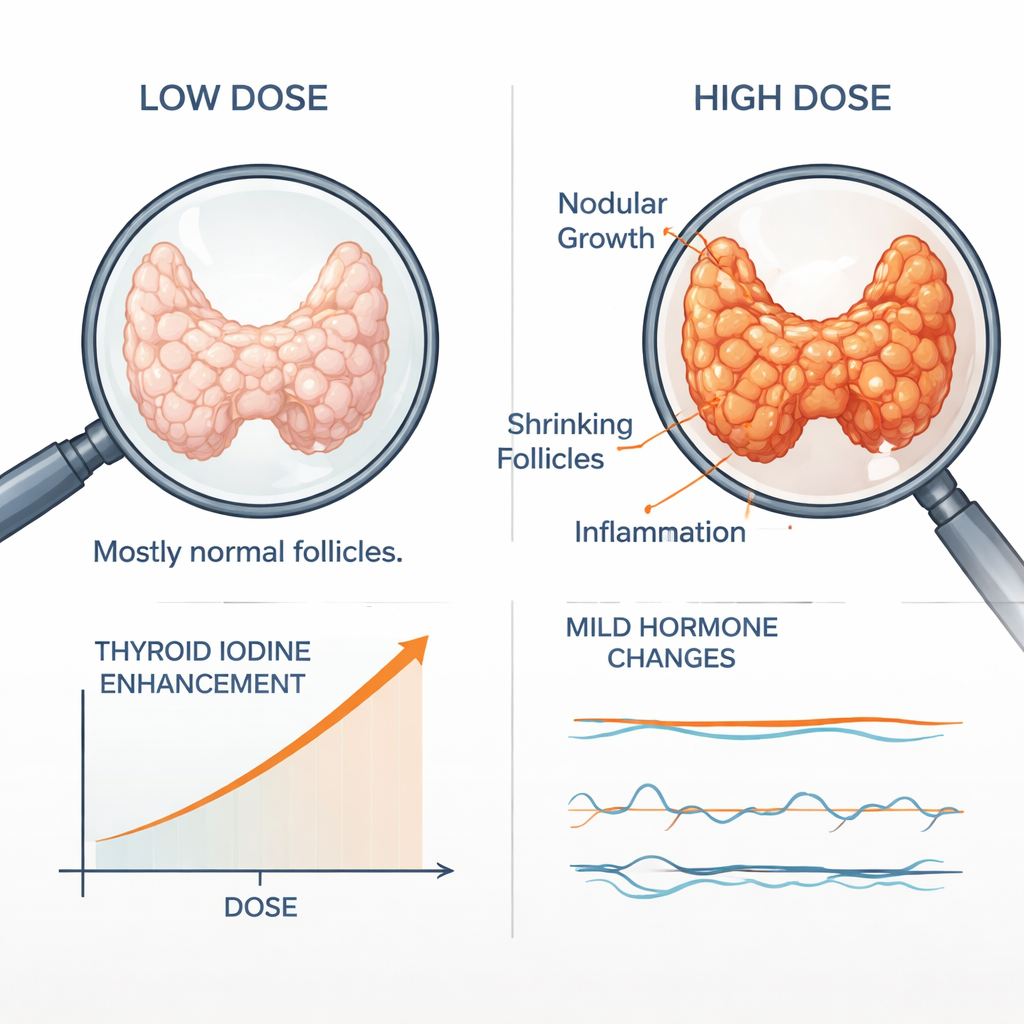
By the end of eight weeks, rabbits that had received the medium and high contrast doses showed clearly higher iodine-related signals in the thyroid compared with both the control animals and those given the clinical-dose level. Their thyroid enhancement ratio was roughly twice that of the control group, confirming that repeated high-dose exposure can lead to measurable iodine accumulation in the gland. In contrast, the group that received a clinical-dose amount of contrast did not differ meaningfully from the control group, suggesting that ordinary dosing did not cause obvious iodine build-up in this model.
Hormones and tissue changes told a subtler story
Blood tests focused on the main thyroid hormones, free thyroxine (fT4) and free triiodothyronine (fT3). In the higher-dose groups, these hormones rose modestly around week four and then drifted back toward baseline by week eight. A few individual rabbits temporarily exceeded the normal upper range, but overall the changes were small and did not reach statistical significance when compared across all groups. At the end of the study, the thyroids were removed and examined under the microscope. Rabbits given higher contrast doses more often showed structural changes such as tiny nodules, shrinking of hormone-producing follicles, and mild inflammation. However, because the number of animals was limited, these trends also did not meet strict statistical cutoffs.
What this means for patients and parents
In plain terms, this rabbit study shows that very frequent, high-dose use of iodine-based contrast can make iodine accumulate in the thyroid and is associated with early structural changes in the gland. Yet, within the study period, these changes did not reliably translate into clear-cut thyroid hormone problems. For typical medical imaging doses, the rabbits’ thyroids looked and behaved much like those of untreated animals. While animals are not people, and vulnerable patients such as very young children may still warrant careful monitoring, the findings support current views that standard contrast-enhanced CT scans are unlikely to cause major thyroid damage on their own, even though extremely heavy, repeated exposure deserves caution and further research.
Citation: Rhee, C., Lee, S., Koh, J. et al. Assessment of thyroid iodine accumulation following repeated iodinated contrast media administration using dual-energy computed tomography in a rabbit model. Sci Rep 16, 6532 (2026). https://doi.org/10.1038/s41598-026-37701-w
Keywords: iodinated contrast, thyroid function, dual-energy CT, iodine accumulation, rabbit model