Clear Sky Science · en
Dynamic community detection using class preserving time series generation with Fourier Markov diffusion
Why smarter synthetic data matters
Behind every heart monitor, fitness tracker, or industrial sensor lies a river of data that changes over time. To train reliable AI systems on these signals, researchers increasingly rely on “synthetic” time series—artificial data that mimics the real thing without exposing sensitive information or requiring costly new measurements. But most existing tools either capture the overall look of a signal while muddling its meaning, or preserve labels such as “healthy heartbeat” versus “abnormal” while losing fine detail. This paper introduces FMD-GAN, a method designed to generate time-series data that is both realistic in shape and faithful to its labeled category, with potential benefits for medicine, manufacturing, and tiny on-device AI.
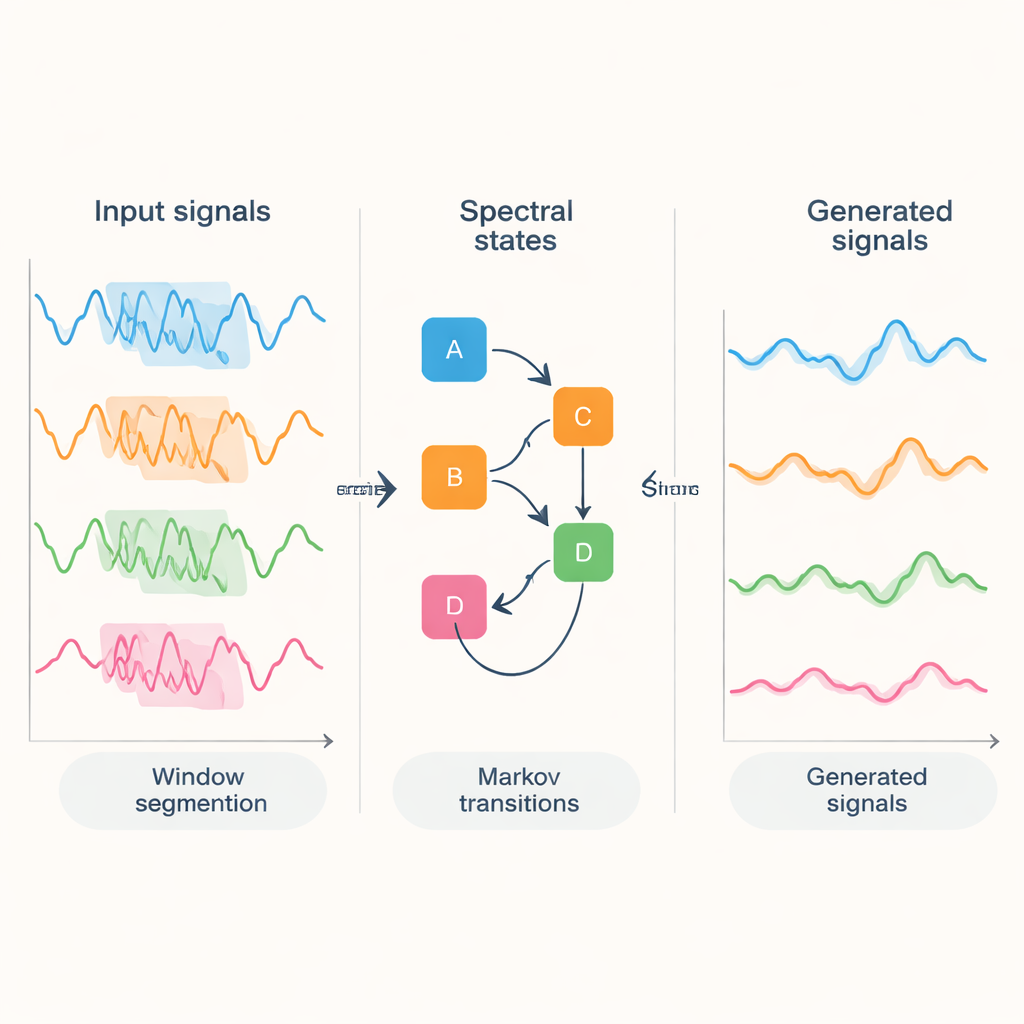
From raw waves to meaningful patterns
Time-series data—such as ECG traces, motion sensors, or chemical readings—contain two kinds of structure. First, there is rhythm in the frequency domain: repeating cycles, harmonics, and smooth trends. Second, there are “regimes” in time: stretches where behavior is relatively stable, punctuated by switches to different patterns. Most modern generative models treat a signal as a long vector of numbers, ignoring these two views. As a result, they can miss important structures that help distinguish one class from another, like the difference between a normal and abnormal heartbeat or between two types of machine operation.
A hybrid engine for realistic sequences
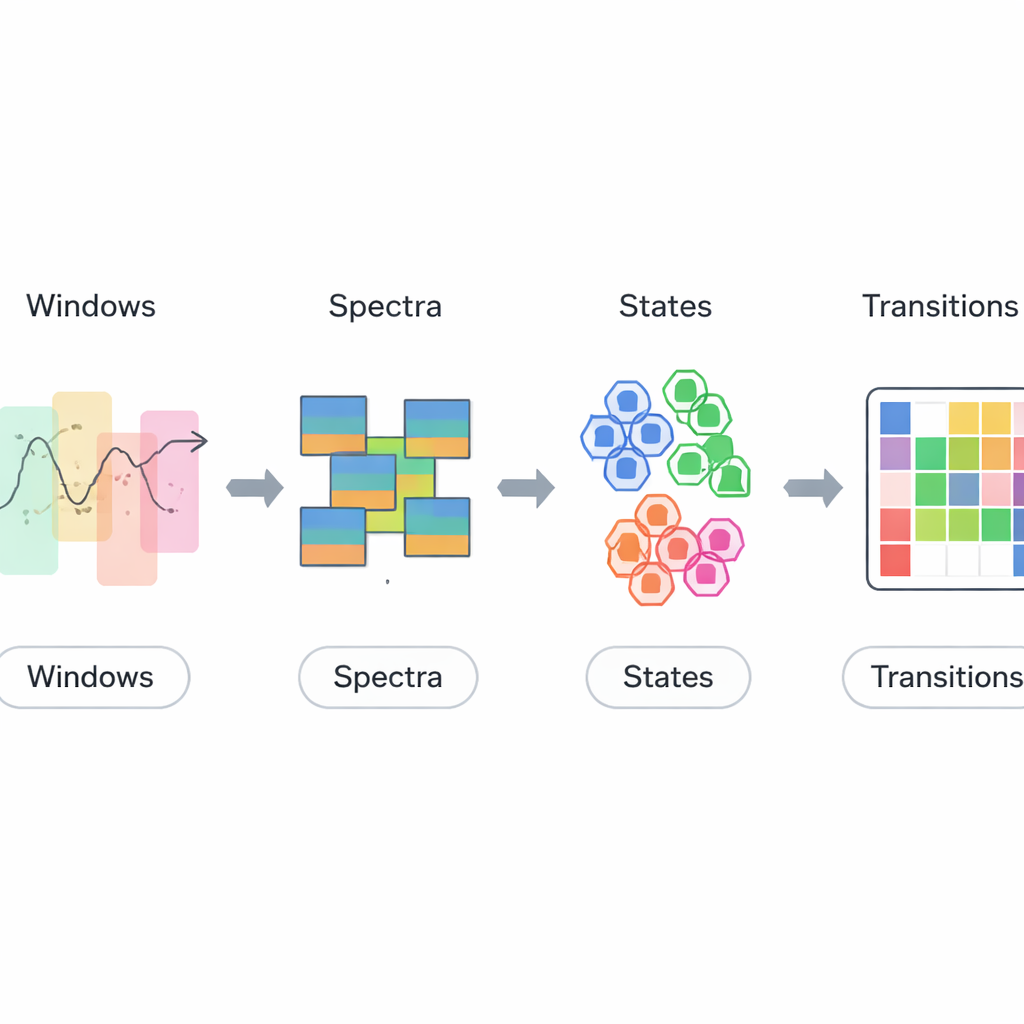
FMD-GAN combines three ideas to address this gap. It first chops each long signal into overlapping windows, then examines each window in the frequency domain using a short-time Fourier transform. Windows with similar spectral “fingerprints” are clustered together into latent states, which are gently aligned with known class labels. A simple Markov model then learns how these states tend to follow one another over time, capturing typical regime switches. At the same time, a diffusion process gradually corrupts and then denoises signals, but with a twist: the amount and shape of noise added at each frequency depends on the current latent state, so different regimes have different spectral noise patterns. This state-aware diffusion is wrapped inside a generative adversarial network, where a discriminator judges both the time-domain waveform and its overall frequency content.
How well does it work?
The authors test FMD-GAN on four standard benchmark datasets that cover heartbeats, human arm motion, car engine sensors, and chemical concentration signals. They compare their method to six strong baselines, including well-known GANs and diffusion models. Using a collection of metrics—how close the synthetic distribution is to real data, how well sequences can be aligned in time, how often a classifier assigns them the correct label, and how similar their frequency spectra are—FMD-GAN consistently matches or outperforms the alternatives. In some cases it cuts a key realism score by roughly half while also improving label consistency and spectral similarity. Additional visual analyses show that synthetic samples sit in the same clusters as real ones in a learned feature space and that their residual errors are small and structured rather than random.
Peeking inside the model’s decisions
Because FMD-GAN explicitly models latent states and their transitions, it is more interpretable than many black-box generators. The paper shows color-coded state sequences aligned with signals, revealing that certain states tend to coincide with peaks, plateaus, or other distinctive regions. When the authors systematically remove components—such as the spectral masks, the Markov transitions, the diffusion steps, or the adversarial discriminator—performance drops in predictable ways. Without spectral masks, the model loses frequency structure and class clarity; without Markov transitions, sequences become less smooth over time; without diffusion, global realism degrades sharply. This ablation study supports the claim that each ingredient plays a specific role rather than serving as arbitrary complexity.
Implications for sensors, health, and tiny devices
For non-specialists, the main message is that synthetic time-series data can now be generated in a way that better respects both the overall shape and the meaning of real signals. By tying together frequency analysis and simple probabilistic state modeling, FMD-GAN produces sequences that look realistic to both humans and downstream machine-learning systems. While the current experiments focus on moderate-length, single-channel benchmarks, the approach is designed to scale and could be adapted for multichannel medical monitors, industrial Internet-of-Things sensors, or small embedded “Tiny AI” devices where data is scarce but reliability matters. In short, this work suggests a step toward synthetic sensor streams that are not just pretty curves, but faithful stand-ins for the real-world phenomena they represent.
Citation: Ma, Y., Qu, D. & Wang, Y. Dynamic community detection using class preserving time series generation with Fourier Markov diffusion. Sci Rep 16, 6756 (2026). https://doi.org/10.1038/s41598-026-37699-1
Keywords: time series generation, synthetic data, diffusion models, sensor signals, Tiny AI