Clear Sky Science · en
Uncovering the hierarchical determinants of continuous usage in online health communities: integrating meta-analysis with FUZZY-DEMATEL-AISM
Why sticking with digital health communities matters
More and more people turn to online health communities to ask doctors questions, find reliable health information, and connect with others facing similar problems. Yet many users download an app, try it once or twice, and then never come back. This article asks a practical question that matters to patients, families, doctors, and policymakers alike: what really keeps people using these digital health platforms over the long term, and how do those reasons fit together?
The promise and problem of online health communities
Online health communities offer clear benefits compared with traditional clinic-only care. They can make expert advice easier to reach, help people manage chronic conditions from home, and reduce travel time and infection risk. During public health crises or for older adults and rural residents, these platforms can be a lifeline. At the same time, the reality is sobering: many health apps are abandoned within weeks, and some studies report dropout rates as high as 98% among people with chronic diseases. Without steady participation, the social value of these communities – shared experience, timely advice, and efficient use of limited medical resources – cannot be realized.
Sorting out dozens of conflicting findings
Researchers across information science, management, and psychology have already studied why people keep using or quit online health communities. They have tested many possible influences, such as trust, ease of use, privacy, service quality, and social pressure from friends or family. But results often conflict. For example, some studies say privacy worries matter a lot; others say they do not. Some find that technical support and resources make a difference; others see little effect. This tangle of mixed findings has made it hard for both scholars and app designers to know which levers truly matter most, and which are only minor details.
From scattered studies to a clear map of key factors
To bring order to this confusion, the authors first ran a large meta-analysis, pooling results from 51 empirical studies with more than 18,000 participants worldwide. They focused on 16 common factors and measured how strongly each was tied to continued use. Several stood out as strongly linked to people sticking with an online health community: a positive attitude toward the platform, feeling the app is useful and easy to use, sensing good value, feeling confident in one’s ability to use it, and trusting the platform. Service quality and system quality also helped, though somewhat less strongly, while technology anxiety – feeling nervous or stressed about using digital tools – pushed people away.
Revealing a hidden hierarchy of causes
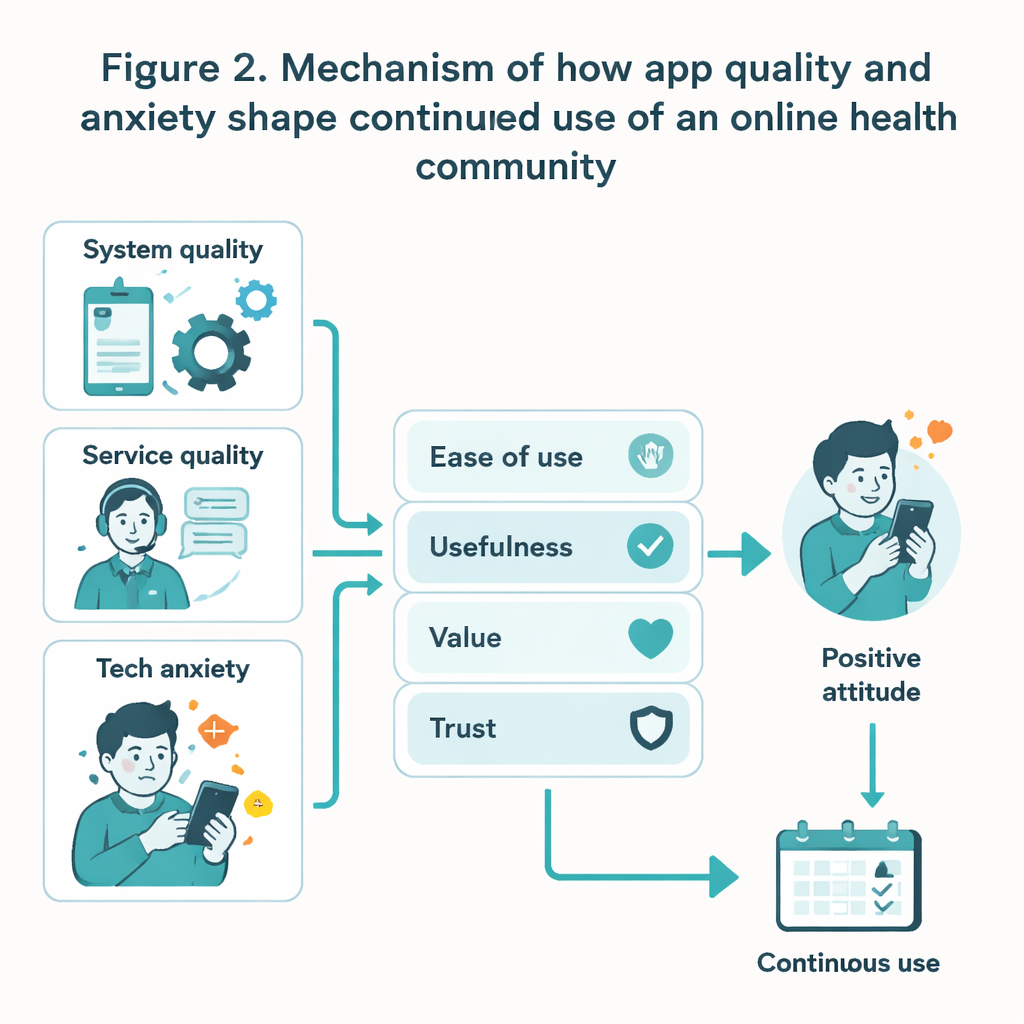
Counting strength alone is not enough; the key question is how these factors influence one another. To tackle this, the authors combined a cause-and-effect mapping method (FUZZY-DEMATEL) with a hierarchical modeling technique (AISM). Expert ratings and advanced math were used to trace who influences whom among the 16 factors. The resulting multi-layer structure looks like a pyramid. At the very top sits attitude: users’ overall positive or negative feeling about the community, which most directly drives their decision to continue. In the middle sit transitional factors such as trust, perceived value, perceived usefulness, perceived ease of use, and self-efficacy. At the base lie fundamental conditions: system quality, service quality, and technology anxiety. These bottom-layer elements do not act on behavior directly; instead, they shape how useful, simple, and trustworthy the platform feels, which in turn molds attitude and, finally, ongoing use.
Turning insights into better digital health design
This layered view has concrete implications. If platform designers improve system reliability, response speed, and clarity of information, and at the same time reduce users’ fear of making mistakes or losing privacy, they strengthen the base of the pyramid. That better technical and service foundation then boosts perceptions of ease, usefulness, value, and trust, gradually building a more positive attitude. The study also maps out specific chains, such as “system quality → ease of use → usefulness → attitude” and “service quality → self-efficacy → attitude.” These paths suggest that improving interfaces, personalizing content, offering clear guidance, and providing visible security protections can all have ripple effects that ultimately keep people engaged.
What this means for everyday users and health systems
For non-specialists, the main takeaway is simple: whether people stick with an online health community depends less on one flashy feature and more on a chain of experiences that starts deep in the design. When the app works smoothly, feels safe, answers questions clearly, and respects users’ time and abilities, people come to see it as helpful, easy, and worth their effort. That positive attitude then makes them far more likely to return, share data, and follow advice. For governments, hospitals, and companies investing in digital health, this study offers a roadmap: invest first in solid systems and high-quality service, manage technology-related worries, and deliberately nurture trust and perceived value. Do that well, and the chances rise that patients will not just try an online health community once, but weave it into their everyday care.
Citation: Cao, Z., Liu, R., Li, Y. et al. Uncovering the hierarchical determinants of continuous usage in online health communities: integrating meta-analysis with FUZZY-DEMATEL-AISM. Sci Rep 16, 7052 (2026). https://doi.org/10.1038/s41598-026-37694-6
Keywords: online health communities, digital health engagement, mHealth continuance, patient attitudes, health app design