Clear Sky Science · en
Caregiver acceptability, and uptake of voluntary medical circumcision among male children under 5 years in Gulu city, Northern Uganda
Why this matters for families
In many parts of Africa, circumcision for boys is promoted as one way to lower the risk of HIV later in life. But for very young children, the choice rests entirely with parents and caregivers, who must weigh health messages against their own beliefs, fears, and everyday realities. This study from Gulu City in northern Uganda looks closely at how caregivers feel about circumcising boys under five, how many are actually doing it, and what helps them move from uncertainty to action.
Health promise behind a small operation
Circumcision—the surgical removal of the foreskin—is one of the world’s oldest medical procedures. Modern research shows that, for heterosexual men, it can cut the risk of getting HIV by as much as 60 percent and also lower chances of urinary and some sexually transmitted infections. International agencies now see circumcising boys, especially in countries with high HIV rates, as an investment in their future sexual and reproductive health. Yet this promise only becomes real if parents are willing to allow the procedure for their sons, often long before the boys can decide for themselves.
A closer look at families in Gulu City
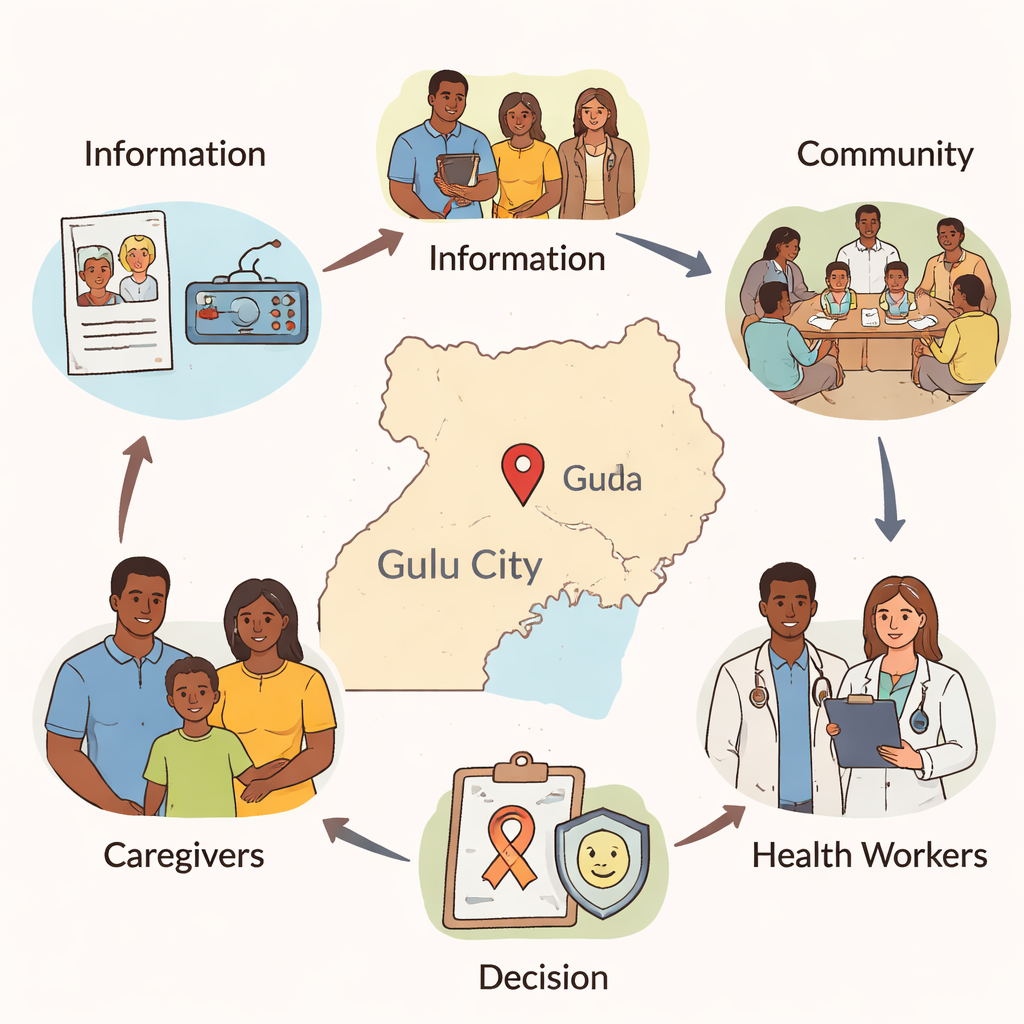
Gulu City is the largest urban center in northern Uganda and home to more than 45,000 boys under five. It sits in a region where circumcision has not traditionally been practiced, and adult circumcision rates remain very low. To understand parents’ views, researchers randomly selected 16 parishes across urban, semi-urban, and rural areas, then visited households to interview 427 caregivers of boys under five. Most respondents were mothers in their early thirties, and many had limited formal schooling. Trained interviewers used a structured questionnaire to ask about knowledge of circumcision, past decisions for their children, and how acceptable they found the idea overall.
What parents know and how they feel
Almost all caregivers had heard of childhood circumcision, mainly from health workers and radio or other media. Many recognized that the procedure could bring health benefits, but they were also keenly aware of risks such as pain, bleeding, or infection. Using a standard set of questions about emotions, effort, ethics, and understanding, the researchers judged that about 40 percent of caregivers found childhood circumcision acceptable. Most respondents said they felt positive about the idea in general and believed it was ethically appropriate, and over half thought it would be easy or very easy to take a child for the procedure. Still, understanding varied: only about a quarter felt they fully understood what the operation involved, and a majority felt that their communities lacked clear, detailed information.
From opinion to action: who actually circumcises?
When the team looked at what families had done in practice, they found that about 37 percent of caregivers had at least one boy under five who was already circumcised. Health benefits were by far the main reason for doing so, followed by advice from health workers and, to a lesser extent, cultural or family pressure. Among caregivers who had not circumcised any of their boys, the biggest obstacles were fear of complications, lack of information, cultural reservations, and difficulty reaching services. Notably, almost four in ten undecided caregivers were still unsure whether they might choose circumcision in the future, suggesting a large group that could be swayed by better support and clearer messages.
Key influences on decisions
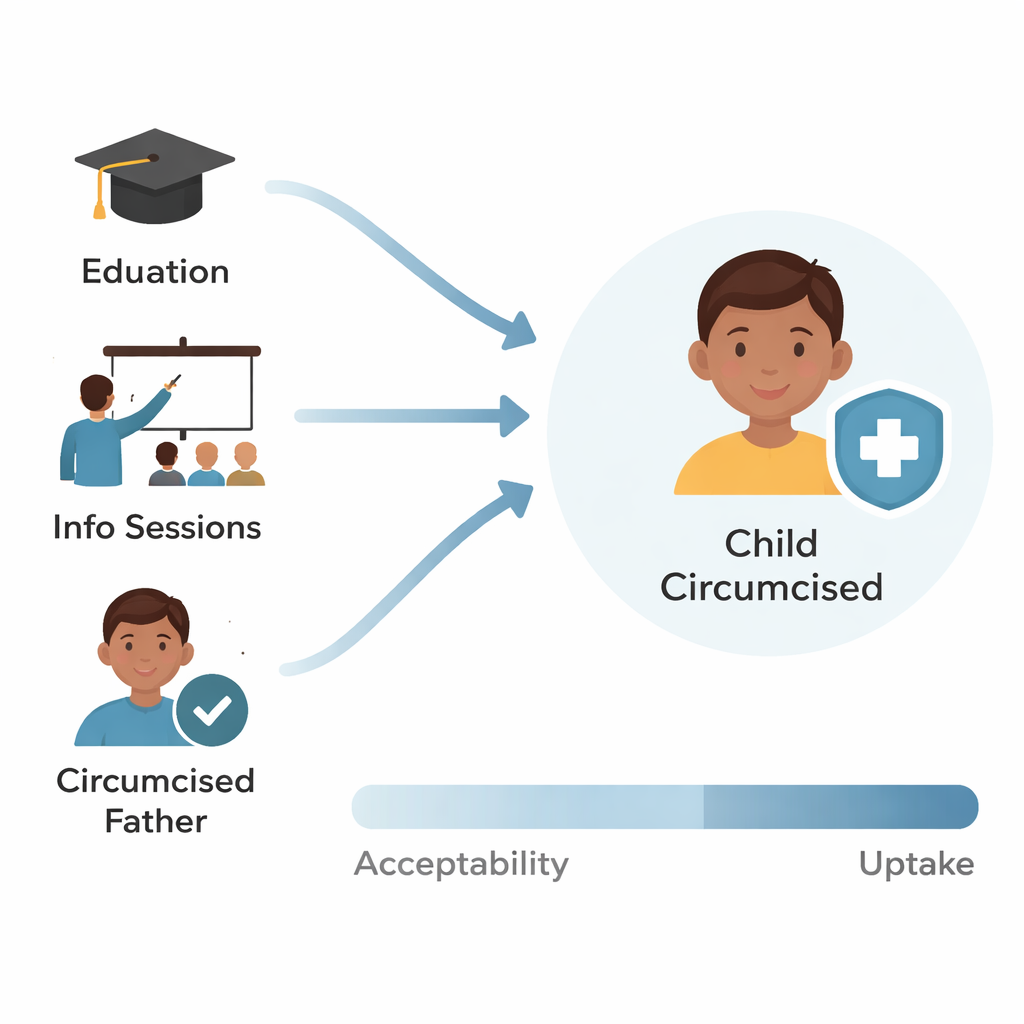
Certain patterns strongly shaped both how acceptable circumcision seemed and whether it was actually done. Caregivers with secondary or higher education were more likely to find circumcision acceptable than those with no schooling. Attending health talks or information sessions made a striking difference: parents who had ever attended such sessions were almost three times more likely to accept circumcision and more than three times more likely to have a circumcised son. The circumcision status of the father also mattered greatly. If the child’s father was circumcised, caregivers were roughly three times more likely both to accept the practice and to have had their boy circumcised. Simply put, informed families and those with firsthand experience of circumcision were much more open to choosing it for their children.
What this means for families and health programs
The study shows that while many parents in Gulu City see possible health benefits in circumcising their young sons, fewer than half are ready to embrace it, and just over a third have gone ahead so far. For families, the decision appears to hinge on clear, trustworthy information and the example set by fathers. For health planners, the message is that scaling up simple, well-designed education efforts—especially those that involve both parents and explain risks as well as benefits—could shift the balance toward higher acceptance. If done safely and respectfully, supporting caregivers to make informed choices about circumcision may become a practical part of long-term HIV prevention in communities like Gulu.
Citation: Otika, D., Okello, M.O., Opee, J. et al. Caregiver acceptability, and uptake of voluntary medical circumcision among male children under 5 years in Gulu city, Northern Uganda. Sci Rep 16, 6748 (2026). https://doi.org/10.1038/s41598-026-37693-7
Keywords: childhood circumcision, HIV prevention, caregiver attitudes, health education, Uganda