Clear Sky Science · en
Kaempferol inhibits osteoclast differentiation and bone resorption by targeting the TNF-α/NF-κB and SRC/PI3K/AKT signaling pathways
Plant power for fragile bones
As people age, their bones can become thin and brittle, turning a minor fall into a serious fracture. Many older adults and postmenopausal women face this silent condition, osteoporosis, and the medicines used to treat it can be costly or cause side effects. This study explores whether kaempferol—a natural compound found in everyday foods such as tea, broccoli, and berries, and in many traditional Chinese medicines—can help slow bone loss by calming the cells that chew away bone from the inside.
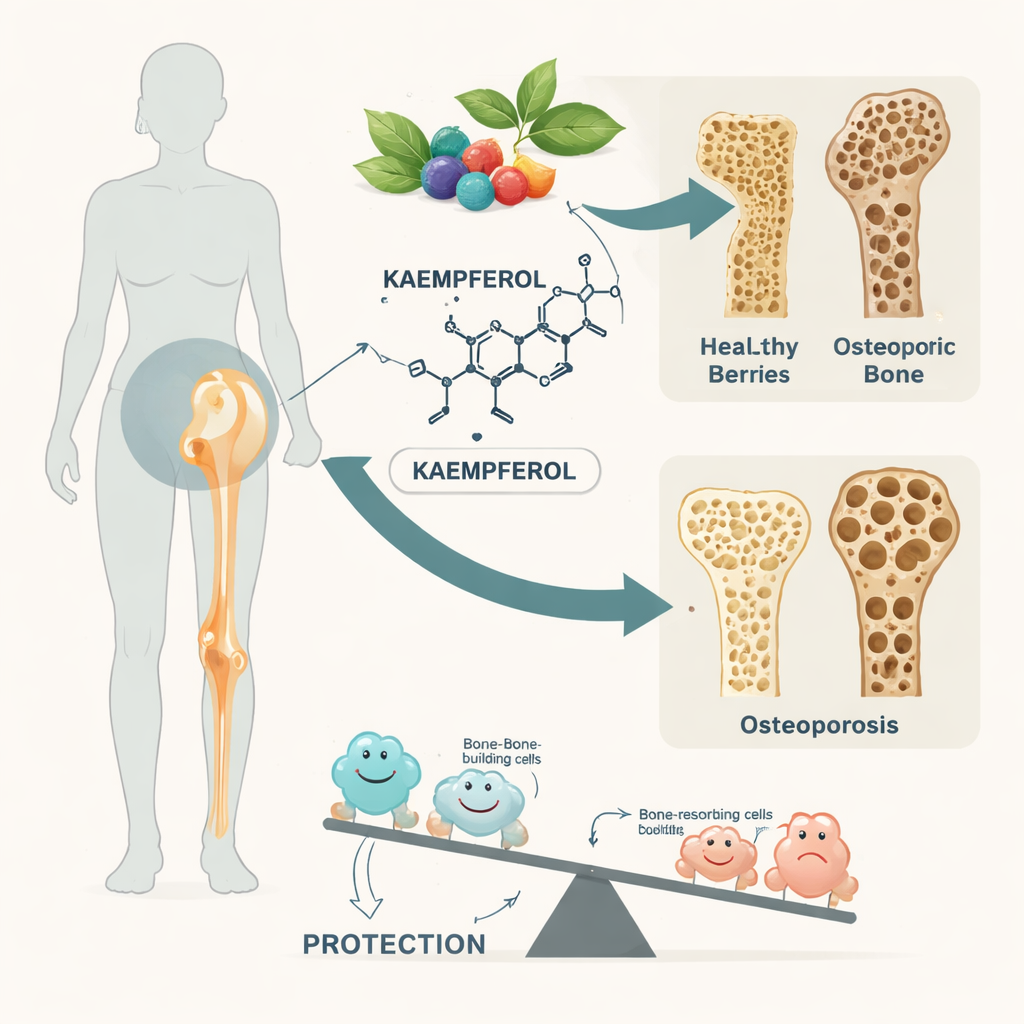
The seesaw of bone building and bone loss
Our skeleton is constantly being renewed by two opposing teams of cells. One team builds new bone, while the other, made up of cells called osteoclasts, breaks old bone down. In osteoporosis, the demolition team wins: bone becomes lighter, more porous, and easier to break. The researchers focused on whether kaempferol could rein in osteoclasts, tipping the balance back toward stronger bones. They also drew on traditional Chinese medicine, where herbs rich in kaempferol have long been used in formulas said to “strengthen the bones,” to see if modern tools could explain these age‑old observations.
Hunting for the compound’s hidden targets
To uncover how kaempferol might act in the body, the team first turned to large computer databases that list which human genes and proteins different molecules are likely to influence. They identified nearly 200 potential protein targets for kaempferol and close to 1,000 genes linked to osteoporosis, then looked for overlap. This cross‑matching yielded 56 shared targets and a smaller core group of key proteins that form a highly connected network inside cells. Several of these, including TNF, SRC, PI3K and AKT, are well‑known controllers of inflammation, cell survival, and bone remodeling. Computer docking simulations then suggested that kaempferol could bind tightly to these proteins, hinting that it might directly interfere with signals that spur bone breakdown.
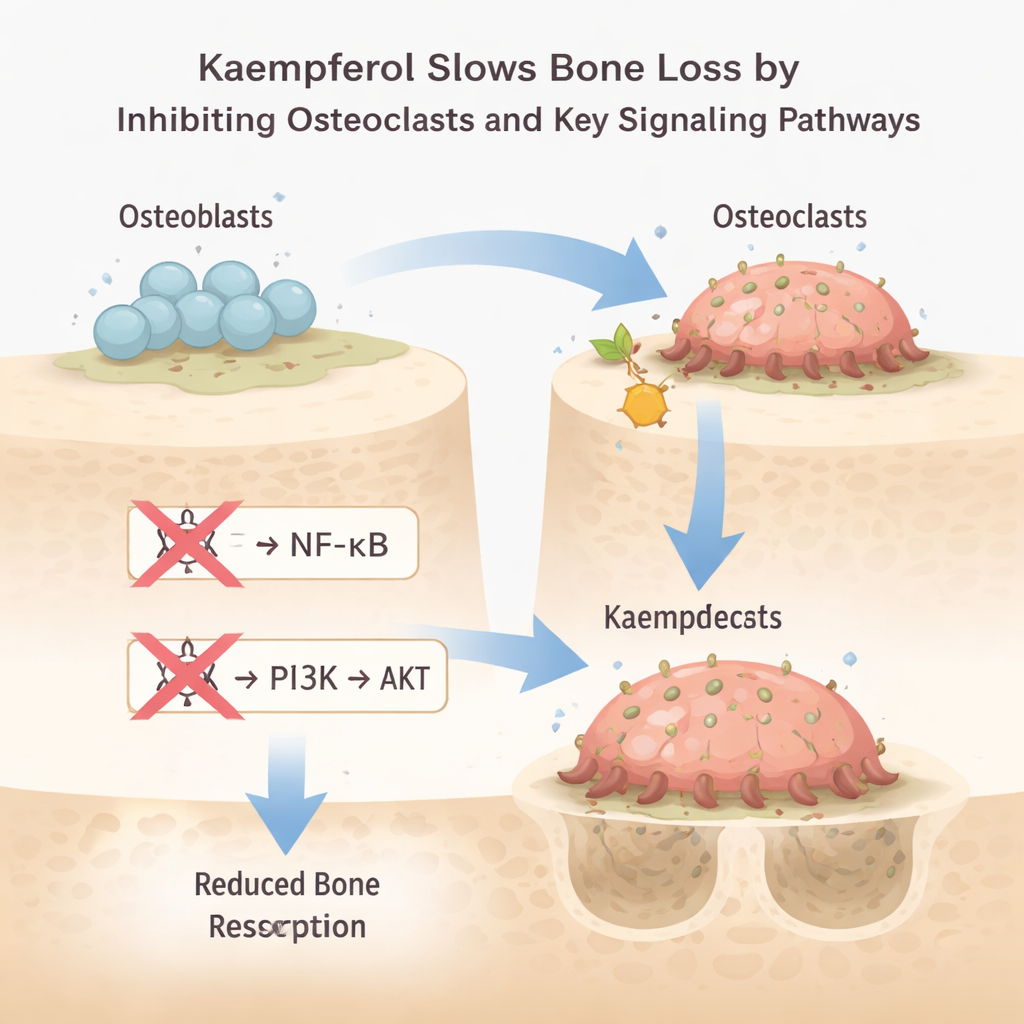
Putting kaempferol to the test in bone‑eating cells
Predictions from the computer were then checked in the lab using a mouse immune cell line that can be turned into bone‑eating osteoclasts by adding a signal called RANKL. When the researchers treated these cells with increasing doses of kaempferol, they saw fewer mature osteoclasts and fewer pits etched into tiny pieces of bone, showing that the compound directly reduced bone‑resorbing activity. Importantly, kaempferol did not harm cell survival; in fact, the highest dose modestly improved cell viability, suggesting that its anti‑resorptive effect was not simply due to toxicity.
Cooling oxidative stress and overactive signals
The study also examined how kaempferol affected “oxidative stress,” a form of internal wear‑and‑tear driven by reactive oxygen molecules that can damage cells and worsen bone loss. At medium and high doses, kaempferol lowered harmful markers of oxidation and boosted protective antioxidant activity. At the same time, it reduced the activity of several genes and proteins that drive osteoclast formation and function. Crucially, it dampened two major signaling routes inside these cells: one involving a potent inflammatory messenger (TNF) and a master switch called NF‑κB, and another involving SRC, PI3K and AKT, which together promote cell activation and survival. Kaempferol left the total amount of these proteins largely unchanged but blocked their switched‑on, phosphorylated forms.
What this could mean for future bone health
Taken together, the findings show that kaempferol can simultaneously slow the birth of new bone‑eating cells, reduce the damage they cause, and ease oxidative stress—all by dialing down key inflammatory and survival signals. While these results come from cell experiments and still need to be confirmed in animal models and human studies, they offer a modern biological explanation for the bone‑protective reputation of many kaempferol‑rich herbs and foods. In the long run, kaempferol or similar plant‑derived compounds could help inspire gentler treatments or nutritional strategies to keep bones stronger for longer.
Citation: Yu, Q., Jiang, T., Zhao, Y. et al. Kaempferol inhibits osteoclast differentiation and bone resorption by targeting the TNF-α/NF-κB and SRC/PI3K/AKT signaling pathways. Sci Rep 16, 6269 (2026). https://doi.org/10.1038/s41598-026-37688-4
Keywords: osteoporosis, kaempferol, bone resorption, osteoclasts, traditional Chinese medicine