Clear Sky Science · en
Optimizing gamma radiation shielding of low bismuth borate glass via antimony addition: optical and physical insights
Why safer see-through shields matter
From hospital X‑ray rooms to nuclear plants and airport scanners, invisible beams of high‑energy radiation help diagnose disease, generate electricity, and keep us secure. But the same rays that are useful can damage living tissue and raise cancer risk if people are not properly protected. Traditional shielding relies on thick concrete or toxic lead, which are heavy, opaque, and difficult to shape. This study explores a new family of golden, transparent glasses that could block harmful gamma rays almost as well as dense metals, but without the drawbacks—opening the door to windows, screens, and viewing panels that are both protective and see‑through.
Building a new kind of protective glass
The researchers started with a borate glass, a type of glass based on boron oxide that is already known for being easy to make, chemically stable, and highly transparent. They then mixed in small, carefully chosen amounts of several metal oxides: bismuth to boost density, sodium to help melt and shape the glass, zinc to strengthen the network, and antimony to fine‑tune both optical and shielding properties. Using a high‑temperature melt‑quenching process—heating the powders above 1100 °C and rapidly cooling the melt between steel plates—they produced a series of glasses that all looked similar: clear, mechanically robust plates with a slight yellowish‑gold tint.
How adding antimony reshapes the glass
To understand what antimony was doing inside the glass, the team measured its density, how tightly its atoms were packed, and how it interacted with light. As they increased the antimony content from 0 to 5 mol%, the glass became noticeably denser, while the empty space between atoms (the molar volume) shrank. Infrared and X‑ray tests confirmed that the material remained a true glass—amorphous and uniform—while its internal structure grew more compact and rigid. At the same time, the glass’s refractive index rose and its optical band gap, a measure of how easily electrons respond to light, decreased slightly. Together, these changes show that antimony helps build a heavier, more tightly knit network that still transmits visible light.
Seeing how well the glass stops radiation
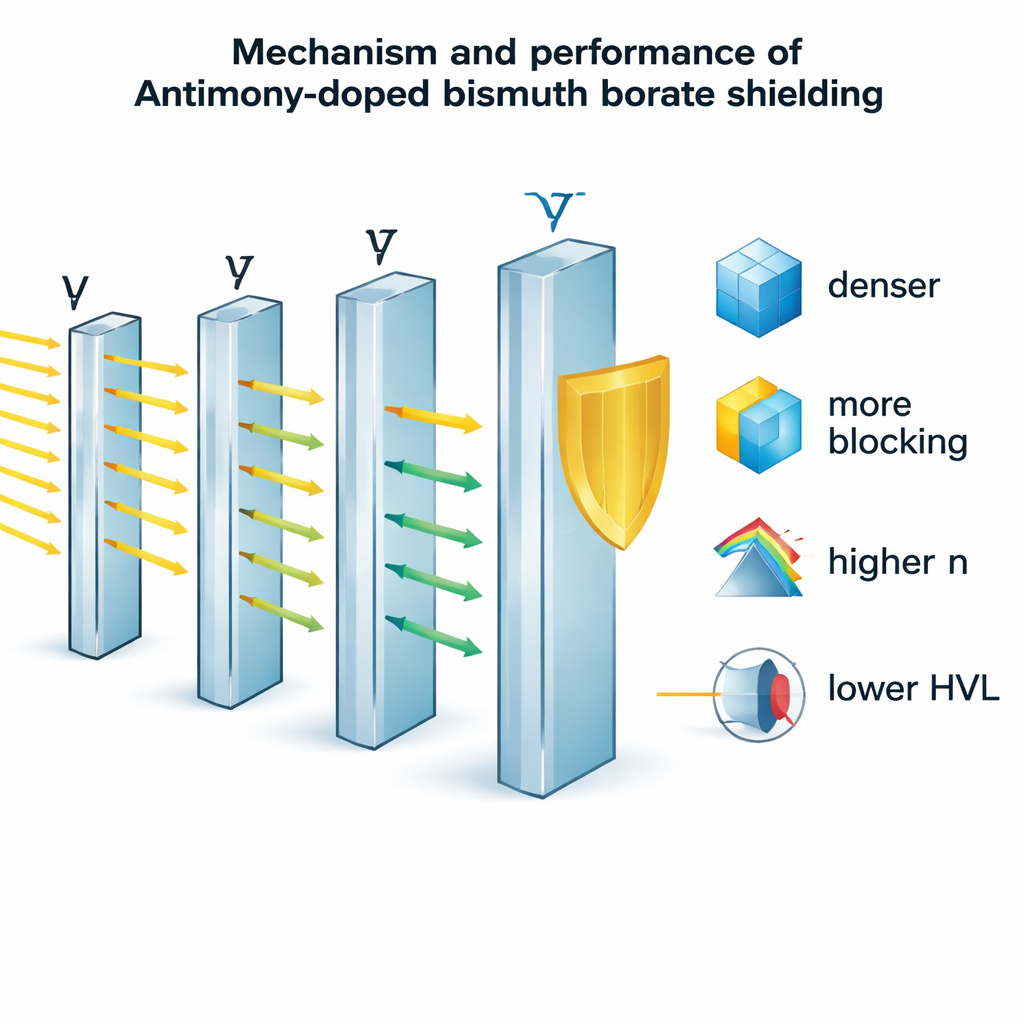
The central question was how effectively these glasses could stop gamma rays, the most penetrating form of common radiation. Using specialized software and the measured glass densities, the authors calculated key shielding quantities over a wide energy range: the mass attenuation coefficient (how strongly the material absorbs radiation), the effective atomic number (a measure of how “heavy” the atoms appear to radiation), and the half‑value layer (the thickness needed to cut the radiation intensity in half). For all energies tested, the antimony‑rich glasses outperformed standard Portland concrete, especially at the lower photon energies typical of many medical and industrial sources. As antimony content rose, the mass attenuation increased and the half‑value layer decreased, meaning thinner glass could provide the same protection.
Balancing clarity, strength, and shielding
What makes this glass system stand out is the way it balances several desirable traits at once. The added bismuth, zinc, and antimony make the glass dense and mechanically stable, which helps it stop gamma rays, while the borate‑based network and controlled metal content keep it optically clear rather than cloudy or crystalline. The sample containing 5 mol% antimony delivered the best overall performance: it had the highest density, the strongest interaction with radiation, the lowest required thickness for shielding, and improved nonlinear optical behavior that could be useful in photonic devices. Importantly, all of this is achieved without resorting to toxic lead.
What this means for everyday protection
For non‑experts, the takeaway is straightforward: by carefully tuning the recipe of common glass, it is possible to make transparent panels that block dangerous gamma rays far more effectively than ordinary window glass, and even better than some concretes, while avoiding heavy metals like lead. The study shows that a modest dose of antimony transforms a familiar material into a promising candidate for safe viewing windows in X‑ray suites, hot cells, and other radiation‑rich environments. In other words, the work points toward future walls and windows that let us see in, keep danger out, and do so with lighter, cleaner materials.
Citation: Hafez, S., Gomaa, W.M. & Salama, E. Optimizing gamma radiation shielding of low bismuth borate glass via antimony addition: optical and physical insights. Sci Rep 16, 7511 (2026). https://doi.org/10.1038/s41598-026-37686-6
Keywords: radiation shielding glass, gamma rays, borate glass, antimony doping, medical imaging safety