Clear Sky Science · en
Genetic predisposition to elevated total immunoglobulin E levels defines a distinct adult-onset-predominant asthma phenotype
Why some asthma starts in adulthood
Asthma is often thought of as a childhood disease brought on by allergies like dust mites or pollen. Yet many people first develop asthma well into adulthood, and not all of them test positive for common allergies. This study asks a simple but important question: could some kinds of adult-onset asthma be written into our genes through a natural tendency to make more of a certain antibody in the blood, even when obvious allergies are not present?
A closer look at an allergy-linked antibody
The antibody at the center of this work is immunoglobulin E, or IgE, best known for its role in classic allergic reactions. High IgE levels are common in asthma, but doctors have long noticed that they can also be elevated in people who do not seem allergic in the usual sense. The researchers proposed that there might be a subgroup of asthma patients whose airways are driven by an inborn tendency to produce extra IgE, rather than by specific allergy triggers alone. To test this idea, they focused on how many small genetic variations across the genome together nudge a person toward higher or lower IgE levels.
Building a genetic score for IgE
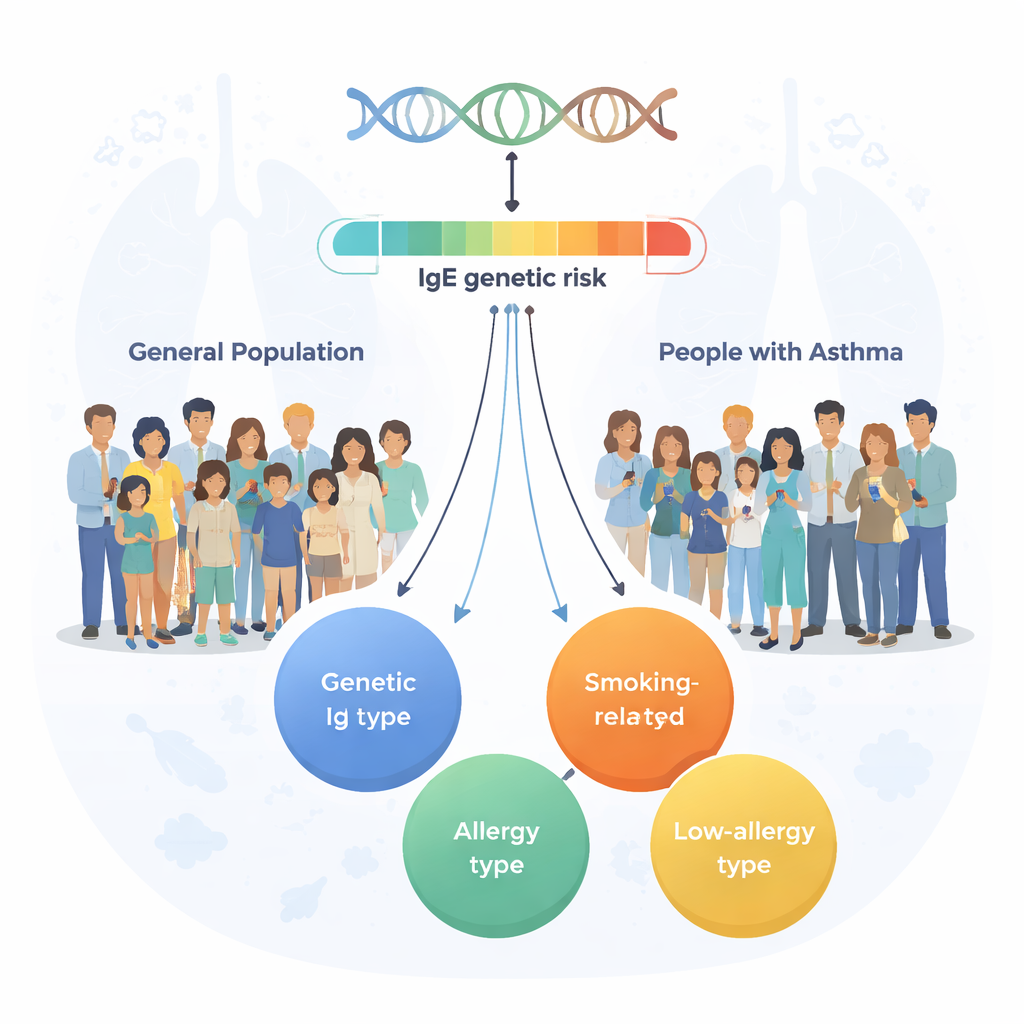
The team first studied 1,287 Japanese adults who did not have asthma. They scanned their DNA and measured total IgE in the blood, then created a “polygenic risk score” that sums the effects of many IgE-related gene variants into a single number for each person. This score captured a substantial portion of the natural spread in IgE levels: people with higher scores tended to have higher IgE, regardless of whether they smoked, their age, or whether they were allergic. Because the score was not tied to lifestyle or other clinical traits, it could be used as a clean measure of genetic predisposition to high IgE.
Four hidden types of adult asthma
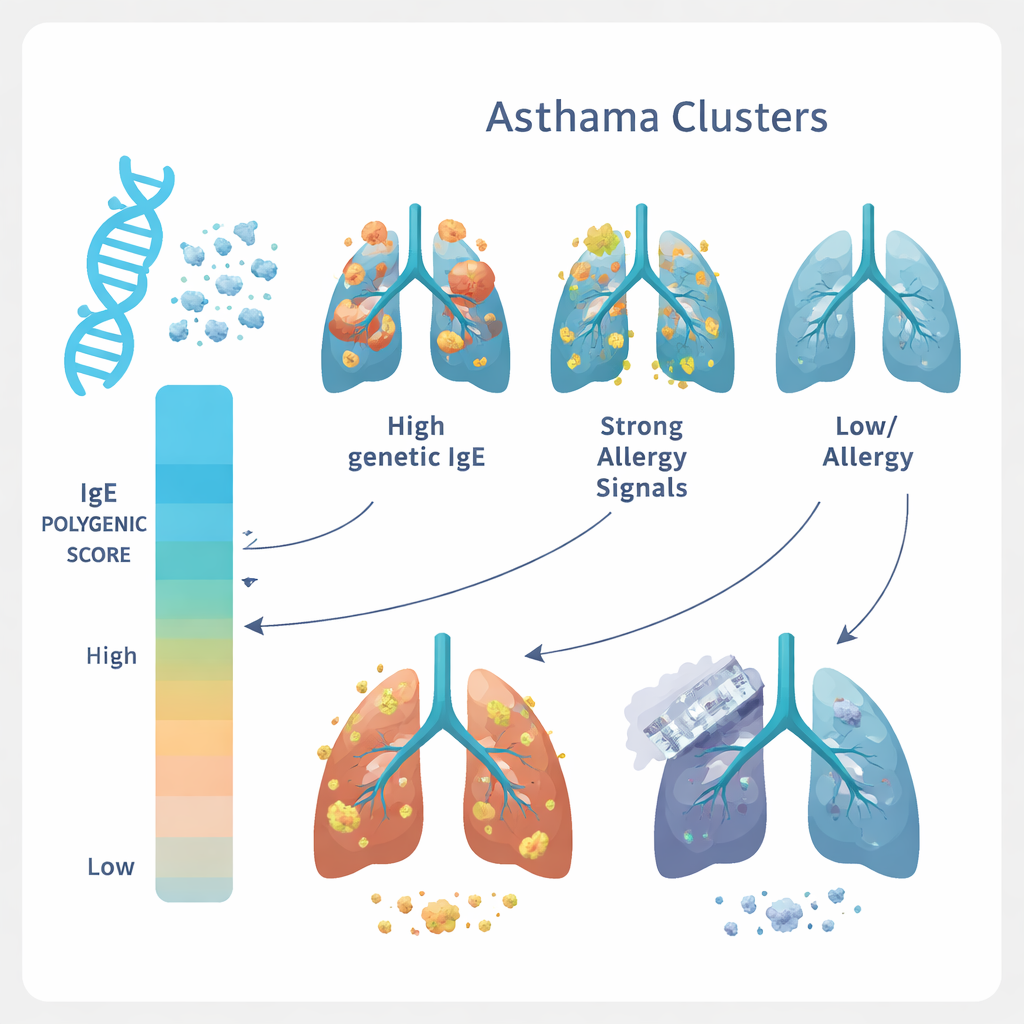
Next, the scientists applied this IgE genetic score to 745 adults with asthma. They combined four pieces of information for each patient—actual IgE level, IgE genetic score, age when asthma began, and a lung function measure—into a computer-guided cluster analysis that searched for natural groupings. Four distinct clusters emerged. One stood out: it had the highest IgE genetic scores, mostly adult-onset disease, moderately high IgE in the blood, and signs of type 2 inflammation, a pattern linked to certain immune pathways. A second cluster had the highest IgE levels and strong allergy features that began in childhood, but only average IgE genetic scores. A third cluster showed high IgE and many smokers with more severe airway narrowing, hinting at smoke-related inflammation. The fourth cluster had low IgE, few allergies, and relatively preserved lung function—a “low-allergy” form of asthma.
Genes behind the high-IgE adult type
To better understand the first cluster—the one with genetically high IgE—the investigators compared its DNA to that of non-asthmatic people and to the other asthma clusters. They found enrichment of variations in a region of the genome packed with immune-related genes known as the HLA region. Several of these genes are involved in controlling immune responses and the integrity of barrier tissues like skin and airway lining. This pattern supports the idea that, in this group, the body is primed, from birth, to favor IgE production and to maintain a subtly inflamed, reactive airway environment, even without classic allergies.
What this means for patients
When the researchers followed more than 1,500 initially healthy adults for 10 years, about one-third of those who went on to develop asthma fit into this genetically high-IgE cluster. In plain terms, a sizable share of adult-onset asthma appears to stem from a built-in tendency to make extra IgE, rather than from environmental factors alone. Recognizing this endotype could eventually help doctors move beyond one-size-fits-all treatment. In the future, simple genetic and blood tests might identify patients whose asthma is powered by IgE-related genes and who could benefit most from therapies that target IgE or its associated immune pathways, bringing medicine a step closer to truly personalized care.
Citation: Matsuda, T., Masuko, H., Ozawa, Y. et al. Genetic predisposition to elevated total immunoglobulin E levels defines a distinct adult-onset-predominant asthma phenotype. Sci Rep 16, 6597 (2026). https://doi.org/10.1038/s41598-026-37679-5
Keywords: asthma, immunoglobulin E, genetic risk, adult-onset asthma, polygenic score