Clear Sky Science · en
Higher-order aberrations and visual outcomes of a new refractive extended depth-of-focus intraocular lens with a target of slight myopia
Sharper Vision After Cataract Surgery
Cataract surgery is one of the most common operations in the world, and many people now hope to come out of it not just with clearer sight, but also with less need for glasses. This study explores a new type of artificial lens implanted during cataract surgery that aims to give patients good distance, computer, and reading vision all at once, without adding bothersome glare or halos around lights.
Why Distance-Only Lenses Aren’t Enough
Traditional monofocal lenses, which have been the workhorse of cataract surgery for decades, are designed mainly for crisp distance vision. They typically deliver sharp sight for driving or watching TV, but many patients still need glasses for reading or using a smartphone. More complex “multifocal” lenses can add near vision, yet they often split light into several focal points. That splitting can reduce contrast and increase unwanted light effects such as halos and starbursts, especially at night. This trade-off has created a strong interest in lenses that stretch the range of clear focus without greatly sacrificing comfort or image quality.
Stretching the Range of Clear Focus
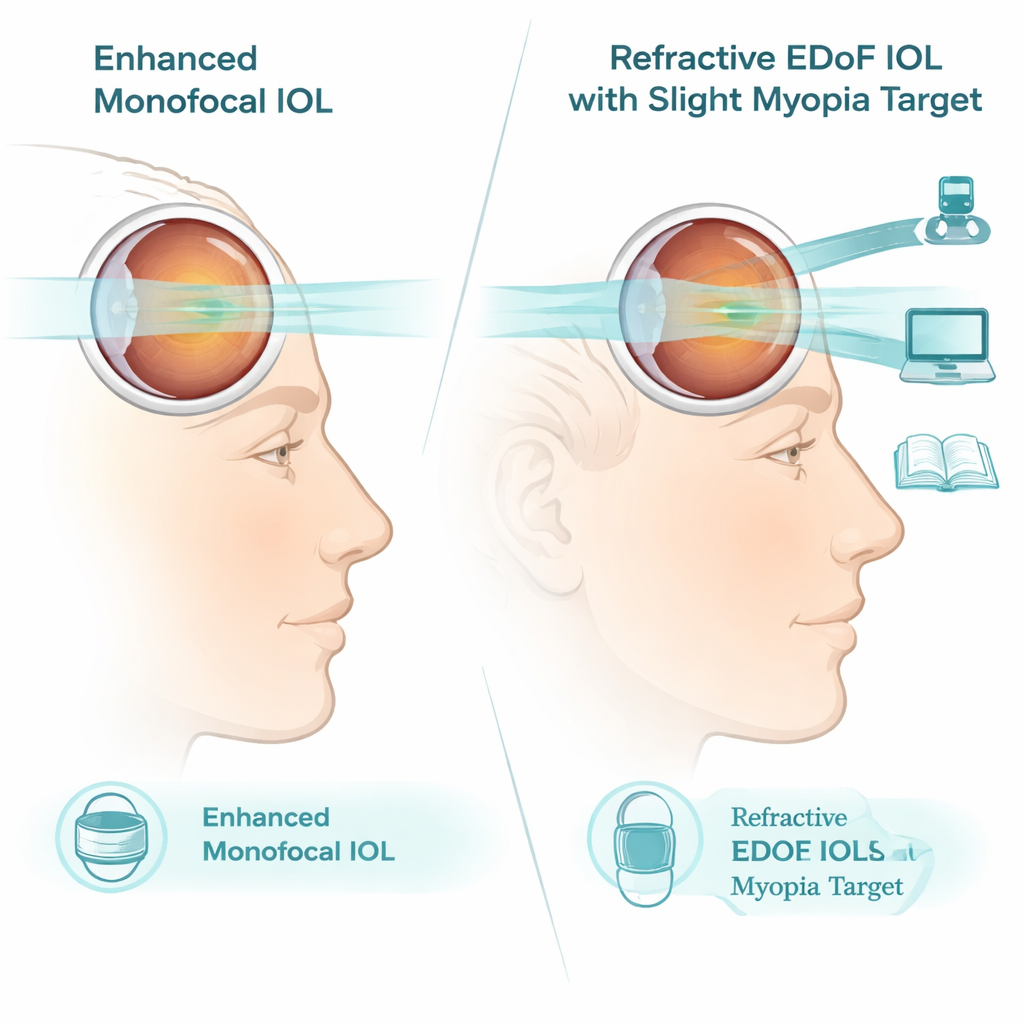
The lens tested here, called TECNIS PureSee, belongs to a class known as extended depth-of-focus (EDoF) lenses. Instead of creating separate distance and near focal points, it gently “elongates” the zone where objects appear clear. The researchers compared this new lens with an enhanced monofocal lens from the same company (TECNIS Eyhance). In a group of 88 eyes from 88 patients, they intentionally chose a slightly nearsighted target for the EDoF lens (about −0.5 to −1.0 diopters) and a nearly zero, but still mildly nearsighted, target for the enhanced monofocal. This small offset was meant to take advantage of the EDoF lens’s tolerance to blur and to see whether it could improve intermediate and near vision without sacrificing distance clarity.
What the Study Measured
Three months after surgery, the team checked standard eye-chart vision at distance, as well as more detailed “optical fingerprint” measurements that capture subtle distortions in how the eye bends light, called higher-order aberrations. In patients who had both eyes operated on, they also tested intermediate and reading vision, and recorded defocus curves—graphs that show how clearly people see as focus is shifted from far into near. Finally, they asked patients whether they noticed halos, glare, or starbursts; how often they needed glasses for daily tasks; and how satisfied they were overall.
Clear Distance, Better Near, and Few Trade‑Offs
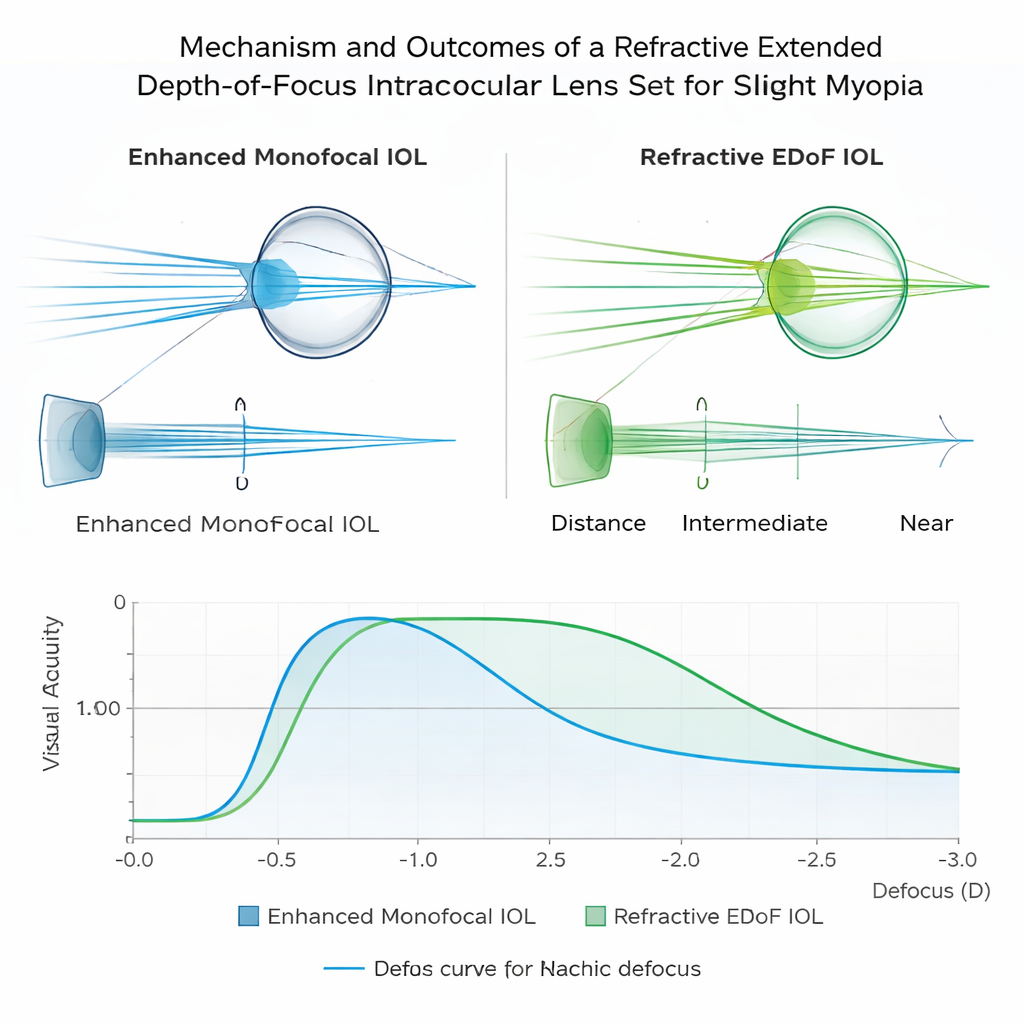
The slightly nearsighted EDoF group ended up more myopic on average than the enhanced monofocal group, just as planned. Even so, both groups achieved very similar distance vision, whether or not glasses were used for the test. In the subgroup with both eyes treated, intermediate vision at arm’s length was comparable between lenses, but near vision at typical reading distance was clearly better with the EDoF lens. Defocus curves showed that the EDoF lens maintained useful sharpness over a broader range of focus, especially toward near. Detailed optical measurements revealed that most subtle distortions were similar between lenses, with only one type (spherical aberration) being slightly higher for the EDoF design—a change expected from the way it stretches focus. Rates of halos, glare, and starbursts were low and not meaningfully different between groups, and satisfaction and willingness to recommend surgery were high for both.
What This Means for People Considering Surgery
For patients facing cataract surgery who hope to depend less on glasses, this study suggests that the new PureSee EDoF lens, when intentionally set to a slight amount of nearsightedness, can offer sharper reading and close-up vision while preserving distance clarity and overall visual quality comparable to an enhanced monofocal lens. In simple terms, it widens the “sweet spot” of clear focus without adding a noticeable burden of glare or halos for most people, making it a promising option for those who want more flexible vision throughout the day.
Citation: Lee, H., Kim, D.Y., Oh, J. et al. Higher-order aberrations and visual outcomes of a new refractive extended depth-of-focus intraocular lens with a target of slight myopia. Sci Rep 16, 7687 (2026). https://doi.org/10.1038/s41598-026-37674-w
Keywords: cataract surgery, intraocular lens, extended depth-of-focus, presbyopia, visual quality