Clear Sky Science · en
A lightweight neural network approach for predicting national Gross Domestic Product (LightNet-GDP) with regression benchmarks
Why predicting a nation’s income matters
Governments, investors, and ordinary citizens all care about how their country’s economy will perform in the coming years. A central yardstick of that performance is Gross Domestic Product, or GDP—the total value of all goods and services produced. Being able to estimate GDP accurately and cheaply can guide tax policy, social spending, business expansion, and even personal decisions like where to work or study. This article presents a new, streamlined artificial intelligence model that promises reliable GDP predictions without needing supercomputers or vast streams of data.
A simple model for a complex world
The authors introduce LightNet-GDP, a “lightweight” neural network designed specifically to predict national GDP. Unlike the massive and power-hungry AI systems often used in finance, this model is compact: it uses a modest number of layers and clever design choices to capture important patterns without overcomplicating things. The network ingests basic country information—such as population, literacy rates, the share of the economy in agriculture or industry, and migration flows—and outputs an estimate of income per person. The goal is to strike a balance between accuracy, speed, and ease of interpretation so that even data-poor governments or agencies can use it. 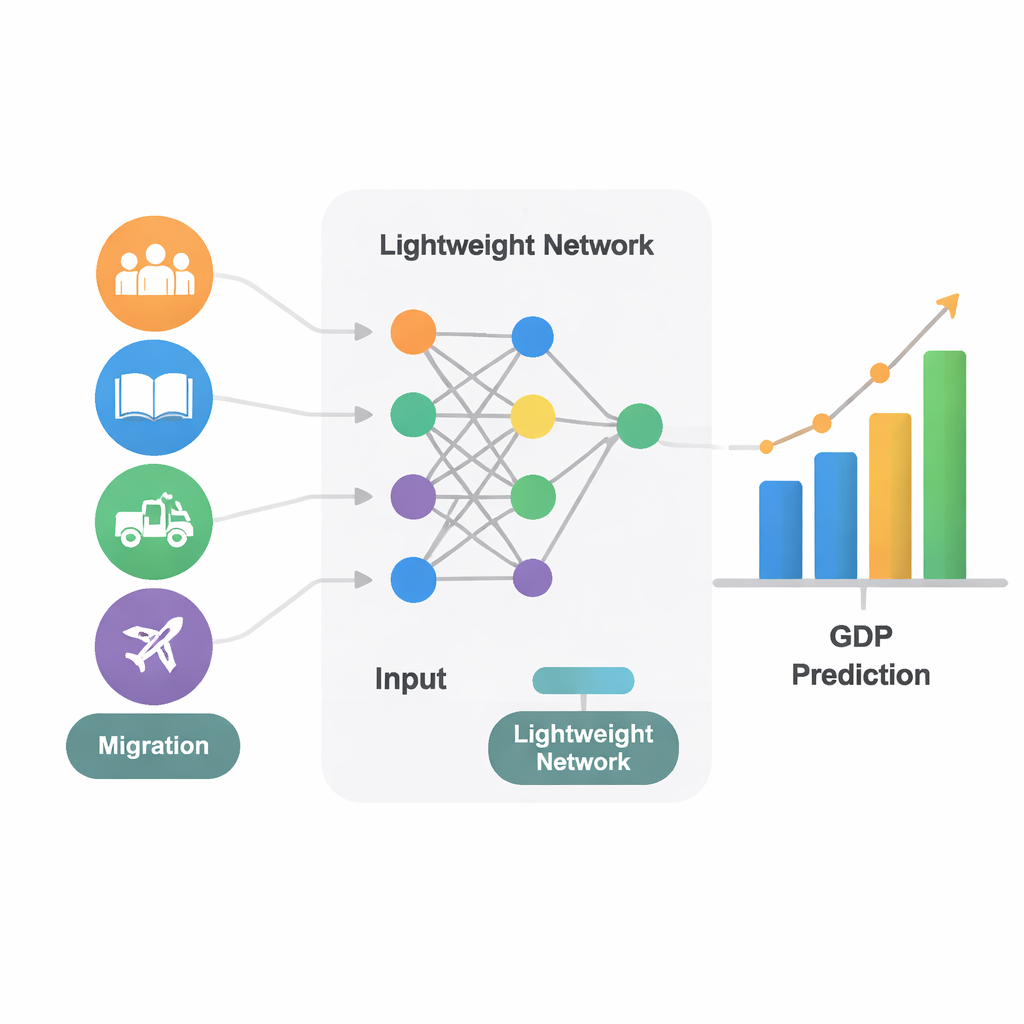
Cleaning and understanding the data
Before building any model, the researchers carefully prepared a dataset of 227 countries and territories, assembled from public sources. For each, they collected demographic, social, and economic indicators including population density, coastline length, infant mortality, phone access, and the mix of agriculture, industry, and services. Real-world data are messy, so the team filled in missing entries with reasonable estimates, standardized the scales of different variables, and examined how each feature related to GDP. Heatmaps and scatter plots revealed, for example, that higher literacy tends to go hand in hand with higher GDP, while high infant mortality is more common in poorer countries. They also reduced the list of inputs to those that were most informative but not redundant, helping the model stay small and robust.
Putting lightweight AI to the test
To judge whether LightNet-GDP was truly useful, the authors compared it to a suite of familiar prediction tools. These included straightforward methods like linear regression as well as more flexible techniques such as decision trees, random forests, and popular boosting algorithms. All models were trained and tested on the same cleaned dataset and evaluated with several yardsticks, including how far predictions strayed from actual GDP values and how much of the variation across countries they could explain. LightNet-GDP achieved lower average errors and a strong ability to explain differences in income, while remaining much smaller and less computationally demanding than many competing machine-learning approaches.
Stable predictions in a noisy economy
Economic data are notoriously unstable: sudden shocks, policy changes, or measurement errors can all disrupt neat patterns. To mimic this, the researchers deliberately “noised up” their data by slightly perturbing the input values and then checked how much the model’s predictions changed. LightNet-GDP’s error increased only slightly, indicating that its forecasts are resilient rather than brittle. The authors went further by using an explainable AI technique called SHAP to see which factors the model relied on most. They found that population density, migration, and industrial activity played especially strong roles in its GDP estimates, echoing well-known economic intuition about the importance of workers, movement of people, and productive sectors. 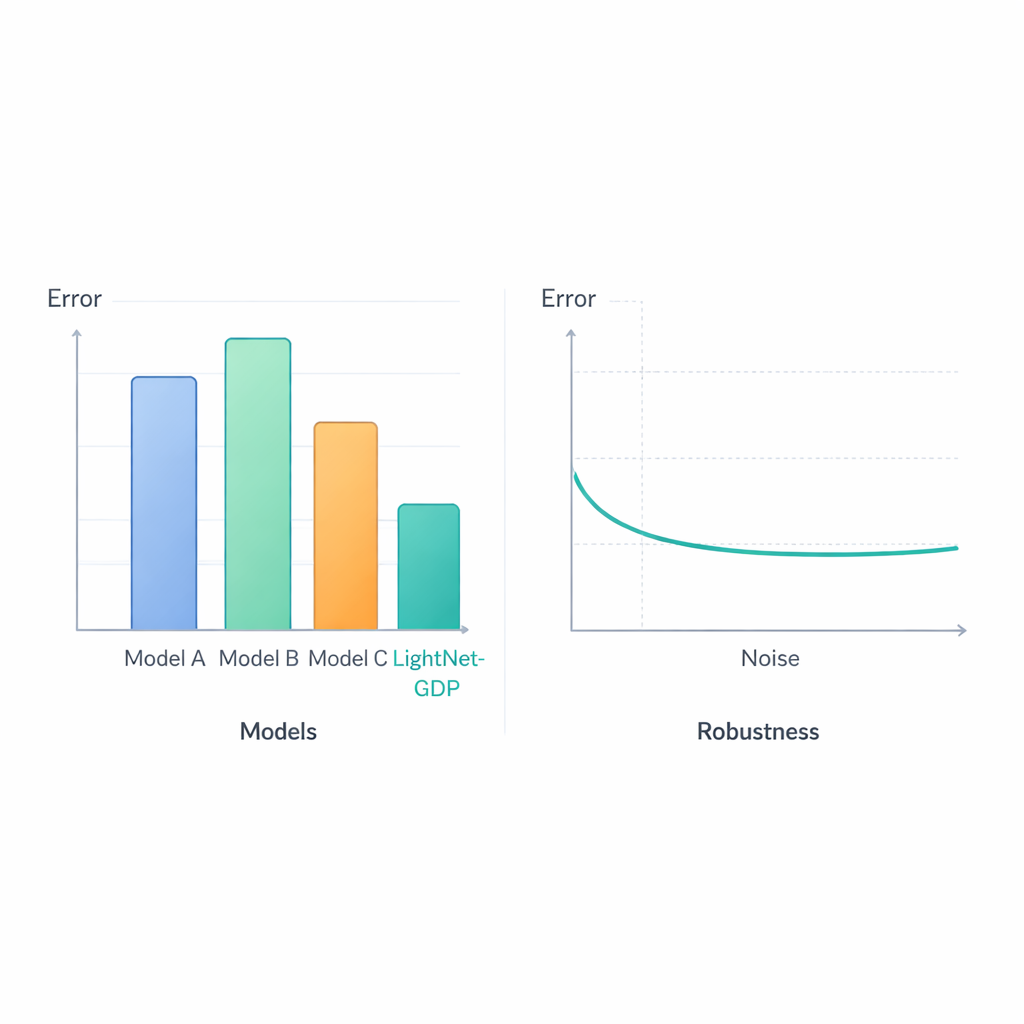
What this means for real-world decisions
In everyday terms, the study shows that a carefully designed, modest-sized AI model can predict countries’ economic output nearly as well as, or better than, heavier and harder-to-deploy methods. Because LightNet-GDP is relatively easy to run and interpret, it could be embedded in government dashboards, early-warning systems for downturns, or tools that help development agencies track progress. While it does not yet capture long-term trends over time, it demonstrates that smart use of basic national statistics can yield solid, understandable estimates of economic strength—offering a practical step toward more accessible, data-driven decision making around the world.
Citation: Raghavendran, C.V., Mouli, K.C., Latha, S.B. et al. A lightweight neural network approach for predicting national Gross Domestic Product (LightNet-GDP) with regression benchmarks. Sci Rep 16, 6634 (2026). https://doi.org/10.1038/s41598-026-37672-y
Keywords: GDP forecasting, neural networks, economic indicators, machine learning, economic planning