Clear Sky Science · en
Zn-based metal organic frameworks encapsuated cauliflower leaves-derived biochar composite for photocatalytic removal of victoria blue and crystal violet
Turning Vegetable Waste into Clean Water Helpers
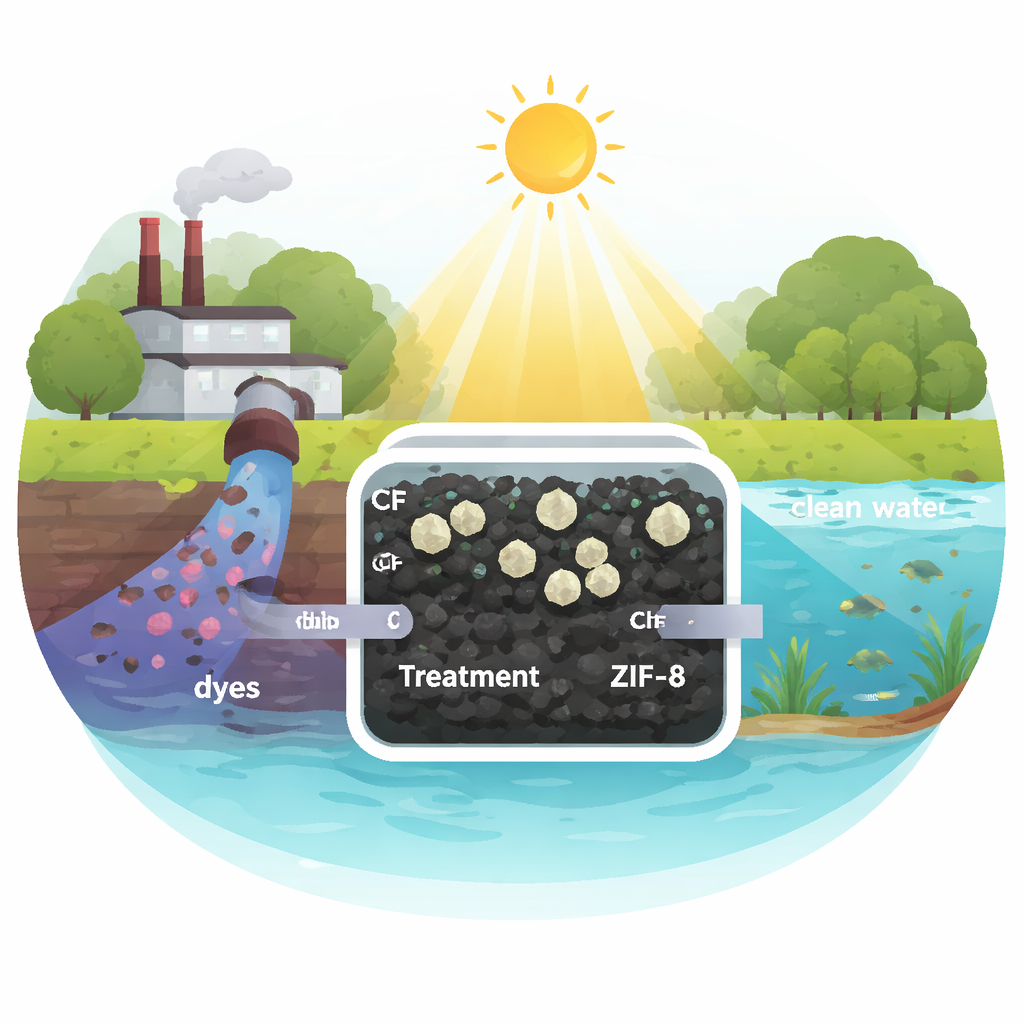
Colorful dyes make our clothes and products attractive, but when they wash out of factories into rivers, they can harm fish, plants, and even human health. This study explores an unusually simple idea: turning discarded cauliflower leaves into a special charcoal and combining it with a modern porous material to build a sunlight-driven "self-cleaning" powder that strips two stubborn purple dyes, crystal violet and victoria blue, out of water. It is a story of waste turned into a tool for tackling pollution.
Why Colored Water Is a Hidden Threat
Across the world, textile, leather, paper, and cosmetic industries release large amounts of dye into wastewater. These bright molecules block sunlight in rivers and lakes, choking off photosynthesis in aquatic plants. Many dyes can also trigger allergies, damage organs such as the kidneys, and increase the risk of cancer. Traditional cleanup methods like filtration, sludge treatment, and adsorption often just move the pollution from water to another waste stream, or they require constant supplies of chemicals and energy. Scientists therefore look for approaches that can actually break these molecules apart rather than simply trapping them.
Building a New Cleaner from Cauliflower Leaves
The researchers focused on two ingredients that sound very different: biochar and a metal–organic framework called ZIF-8. Biochar is a carbon-rich solid made by heating plant waste in low oxygen; it has a highly porous structure and many chemical groups on its surface that help it attract pollutants. ZIF-8, on the other hand, is a crystalline network built from zinc ions and organic linkers, riddled with tiny pores and able to absorb light. On its own, ZIF-8 tends to clump in water and mainly responds to ultraviolet light, while plain biochar does not drive strong chemical reactions. By attaching ZIF-8 particles onto the surface of cauliflower-leaf biochar, the team created a composite material called CF–ZIF-8 that fuses the strengths of both components and reduces their weaknesses.
How Sunlight Powers the Cleanup
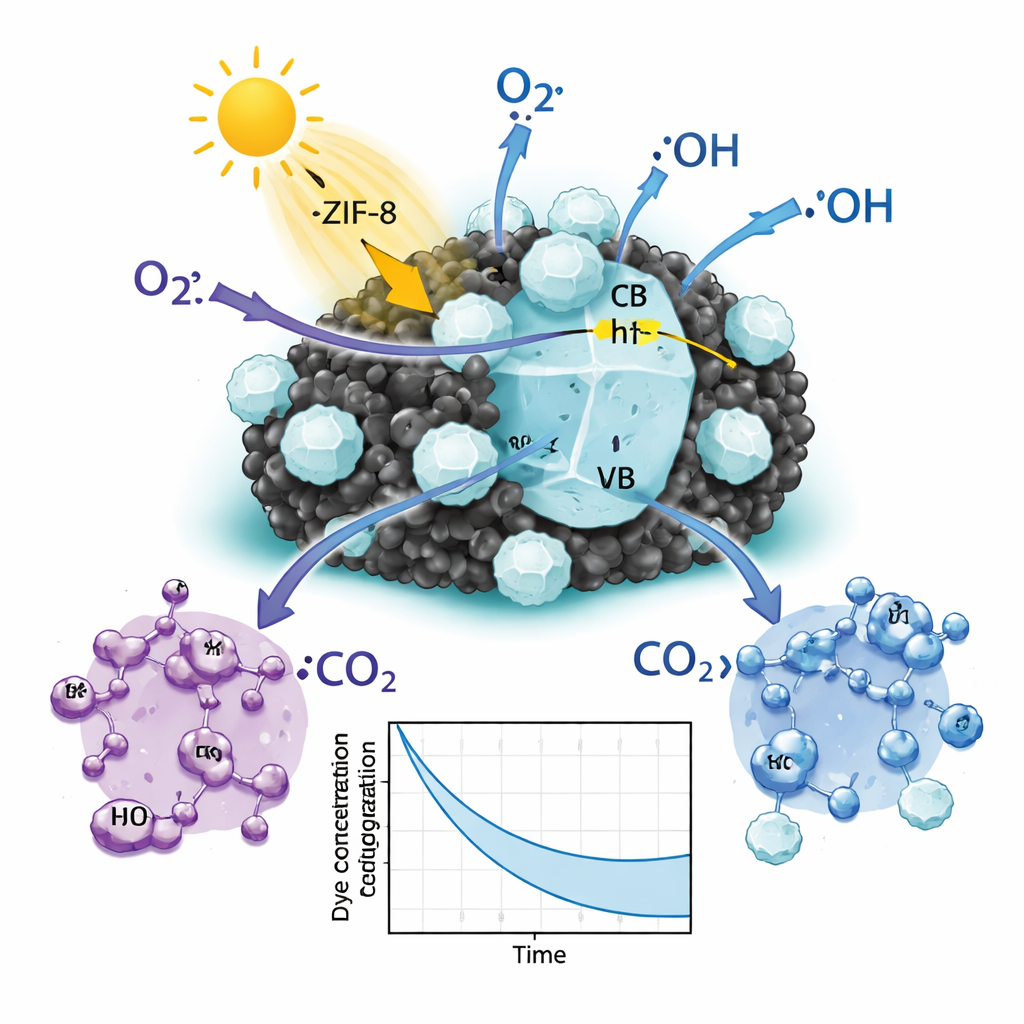
To test this new material, the team stirred small amounts of the CF–ZIF-8 powder into water containing either crystal violet or victoria blue and exposed the mixture to natural sunlight. First, they allowed the system to sit in the dark so they could separate simple dye sticking to the surface from true breakdown. Only minor adsorption occurred. Under sunlight, however, the composite quickly bleached the solutions: with an optimized dose of 18 milligrams of catalyst in 35 milliliters of dye solution at alkaline pH, about 92% of victoria blue and 89% of crystal violet disappeared within 50 minutes. The reaction followed first‑order kinetics, meaning the dyes vanished faster when their concentration was higher, and the process produced no detectable buildup of new harmful colored by-products.
What Happens to the Dye Molecules
Microscopy and spectroscopy confirmed that ZIF-8 crystals coat the cauliflower-derived carbon, while optical studies showed that this combination absorbs both ultraviolet and visible light better than ZIF-8 alone and more effectively separates the tiny positive and negative charges that light creates. Scavenger tests and fluorescence probing revealed that two highly reactive species, hydroxyl radicals and superoxide radicals, are mainly responsible for attacking the dye molecules. These radicals break chemical bonds, strip away side groups, open aromatic rings, and ultimately convert the dyes into small, colorless molecules such as carbon dioxide and water. Additional experiments showed that common ions and real water samples (from tap, lake, and bottled sources) only modestly slowed the process, suggesting that the catalyst can function under realistic conditions.
Durability and Future Promise
The CF–ZIF-8 powder remained effective over several cleanup cycles; after four rounds of use, its ability to remove the dyes dropped by only about five to six percentage points, and its crystal structure stayed intact. Because the key ingredient is agricultural waste, this strategy offers a low-cost and more sustainable route to water treatment, especially in sunny regions. While the current work focuses on only one biochar recipe and two dyes, it opens the door to tailoring similar sunlight-driven materials using other plant residues to tackle a broader array of pollutants in wastewater.
What This Means for Everyday Life
In simple terms, the study shows that something as humble as discarded cauliflower leaves can be converted into the backbone of an advanced water-cleaning material. When coated with a porous zinc-based framework, this biochar acts like a tiny solar-powered scrubber that not only captures bright dye molecules but also tears them apart into harmless pieces. If scaled up and adapted to other contaminants, such materials could help communities and industries clean wastewater more cheaply and with less chemical waste, easing the pressure on already stressed freshwater supplies.
Citation: Darabdhara, J., Hazarika, B. & Ahmaruzzaman, M. Zn-based metal organic frameworks encapsuated cauliflower leaves-derived biochar composite for photocatalytic removal of victoria blue and crystal violet. Sci Rep 16, 7232 (2026). https://doi.org/10.1038/s41598-026-37671-z
Keywords: wastewater treatment, photocatalysis, biochar, textile dyes, metal organic frameworks