Clear Sky Science · en
Panoramic image restoration and visual quality enhancement methods for digital art creation
Why fixing panoramic pictures matters
Panoramic images — the wraparound views you see in virtual museum tours, 360-degree videos, and immersive games — are quickly becoming raw material for digital art. Yet these wide, information‑rich pictures are surprisingly fragile. When they are captured or stitched together, they can turn blurry, break at the seams, or lose key details in dark or crowded areas. This study introduces a new way to clean up and repair such images so that artists and designers get crisp, coherent panoramas that still feel true to the original scene and style.
The challenge of wide, immersive views
A panoramic image tries to show almost everything around you at once, which makes it harder to handle than a normal photo. Traditional tools can correct exposure or sharpen textures, but they often treat each patch in isolation. As a result, a restored sky may not line up with distant buildings, or repaired areas may clash with the overall artistic style. Earlier deep‑learning systems improved resolution and removed noise, yet they tended to struggle in tricky situations such as low light, motion blur, water, or glass reflections. They also demanded heavy computation, which is a problem for real‑time creative work like interactive installations or live VR experiences.
A three‑step upgrade for clarity and detail
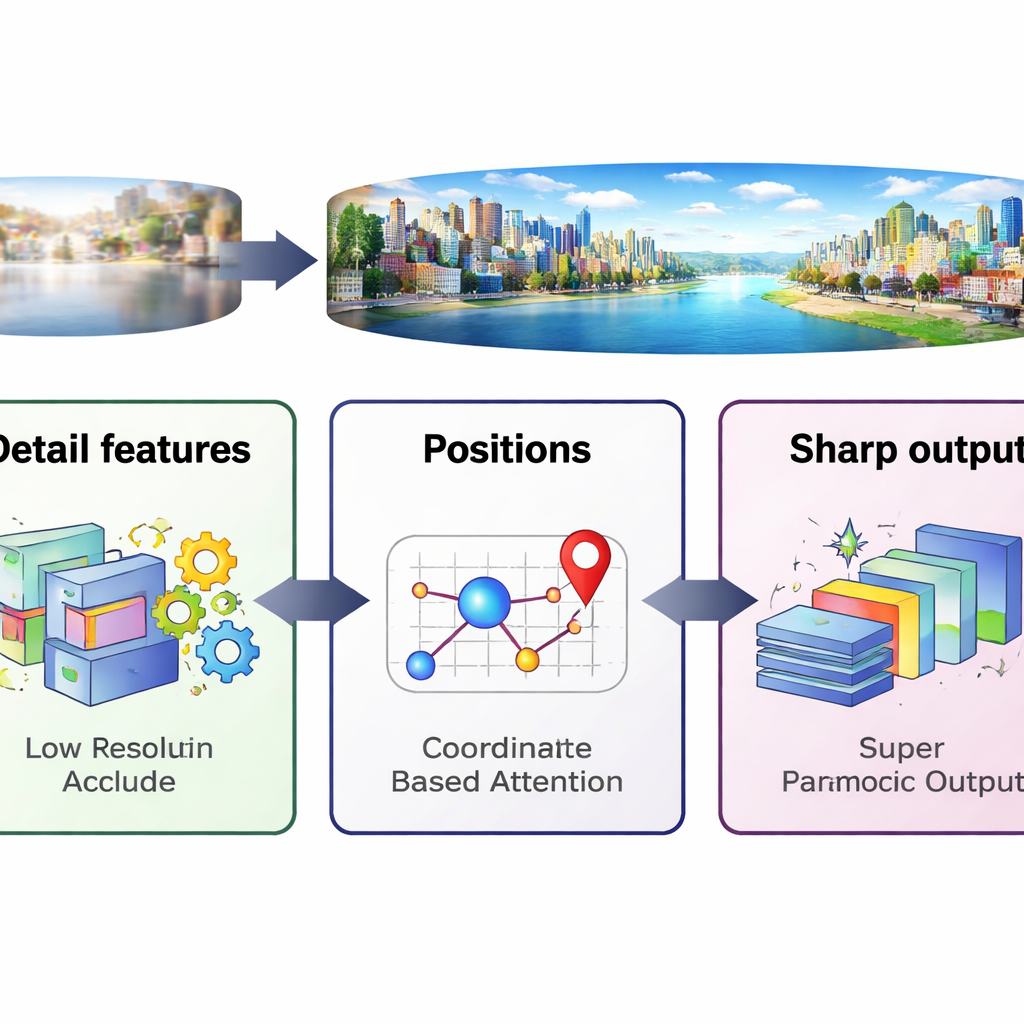
The authors first design an enhancement method called SMC that focuses on making a low‑quality panorama sharper and more detailed. It works in three coordinated steps. A multi‑scale residual network learns to read both fine textures (like brushstrokes or bricks) and large structures (like walls or horizons) at the same time. A coordinate‑based attention module then tells the system where each pixel sits in the overall view, so important edges and textures are not lost as information flows through the network. Finally, a super‑resolution step uses this enriched information to boost image resolution, adding crisp high‑frequency details while keeping the big picture consistent. Tests on large public datasets show that this combination produces clearer edges, richer textures, and more reliable global structure than several popular enhancement methods.
Teaching the system to fill in the gaps
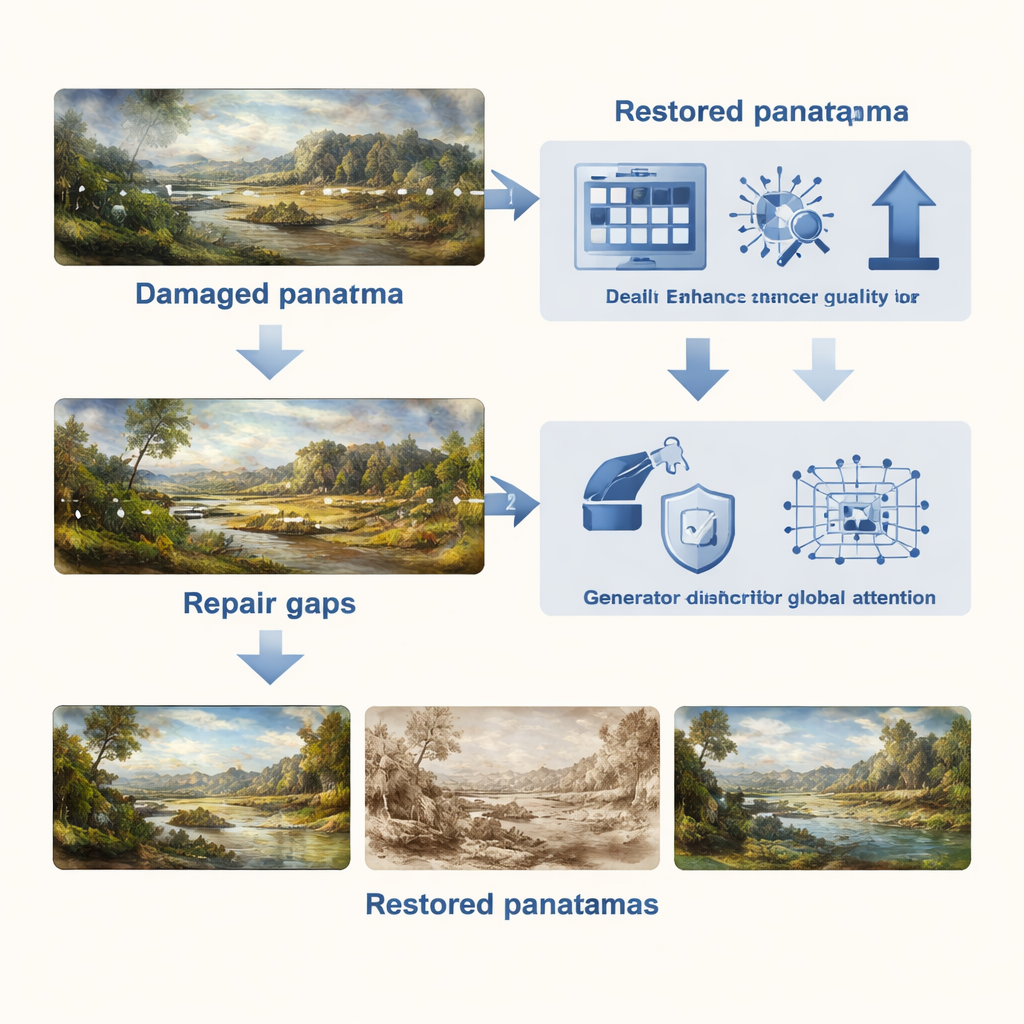
Real‑world panoramas are not just blurry; they are often damaged or blocked by objects such as camera tripods, visitors, or display cases. To handle this, the researchers combine their enhancement pipeline with a powerful repair module, forming a full model they call SMC‑VGV. Here, a generative adversarial network learns to invent plausible content for missing regions, while a variational autoencoder keeps this process stable and grounded in the statistics of real images. A vision transformer, which excels at spotting long‑distance relationships in a picture, helps the model ensure that any repaired area makes sense in the overall scene: lines continue properly, lighting is coherent, and objects do not contradict one another. A carefully designed loss function forces the system to respect three things at once: structure (are shapes and edges right?), style (does it look like the same artwork?), and semantics (does the content make sense?).
Performance in realistic and extreme scenes
To see how well this approach works in practice, the team tested it on challenging panoramic collections from street‑view imagery and full‑surround scenes. Compared with several advanced competitors, the new model produced the sharpest, most faithful reconstructions, reaching very high scores on measures of similarity and signal quality. It also did so efficiently: memory use and running time stayed low enough for large‑scale or near real‑time use. Importantly for digital artists, the model preserved the look and feel of different styles — from oil painting to sketch and 3D rendering — better than alternatives, even when parts of the image were missing, very dark, or had extreme contrast.
What this means for digital art and VR
In everyday terms, this work shows how panoramic images can be both cleaned up and intelligently repaired so that they look natural, consistent, and artistically coherent. Instead of faded, broken 360‑degree scenes, creators can start from panoramas that are sharp, complete, and faithful to their chosen style. That opens the door to richer virtual exhibitions, smoother immersive storytelling, and more reliable reuse of archival material. While the authors note that extremely complex scenes still pose challenges, their model marks a significant step toward making panoramic imagery a robust, dependable building block for future digital art and virtual reality experiences.
Citation: Yu, Z., Wang, T., Tian, P. et al. Panoramic image restoration and visual quality enhancement methods for digital art creation. Sci Rep 16, 7140 (2026). https://doi.org/10.1038/s41598-026-37659-9
Keywords: panoramic images, digital art, image restoration, super resolution, generative models