Clear Sky Science · en
Experimental investigation of energy and exergy characteristics of a novel solar collector with swirling reversed circular flow jet impingement
Why keeping solar panels cool matters
Solar panels are becoming a cornerstone of clean energy, but they have an Achilles’ heel: they hate heat. As a panel bakes in the sun, its surface temperature rises and its ability to turn sunlight into electricity steadily drops. This study explores a new way to keep panels cooler using cleverly shaped air channels beneath them, boosting both their power output and the amount of usable energy we can harvest from the sun.
A fresh spin on panel cooling
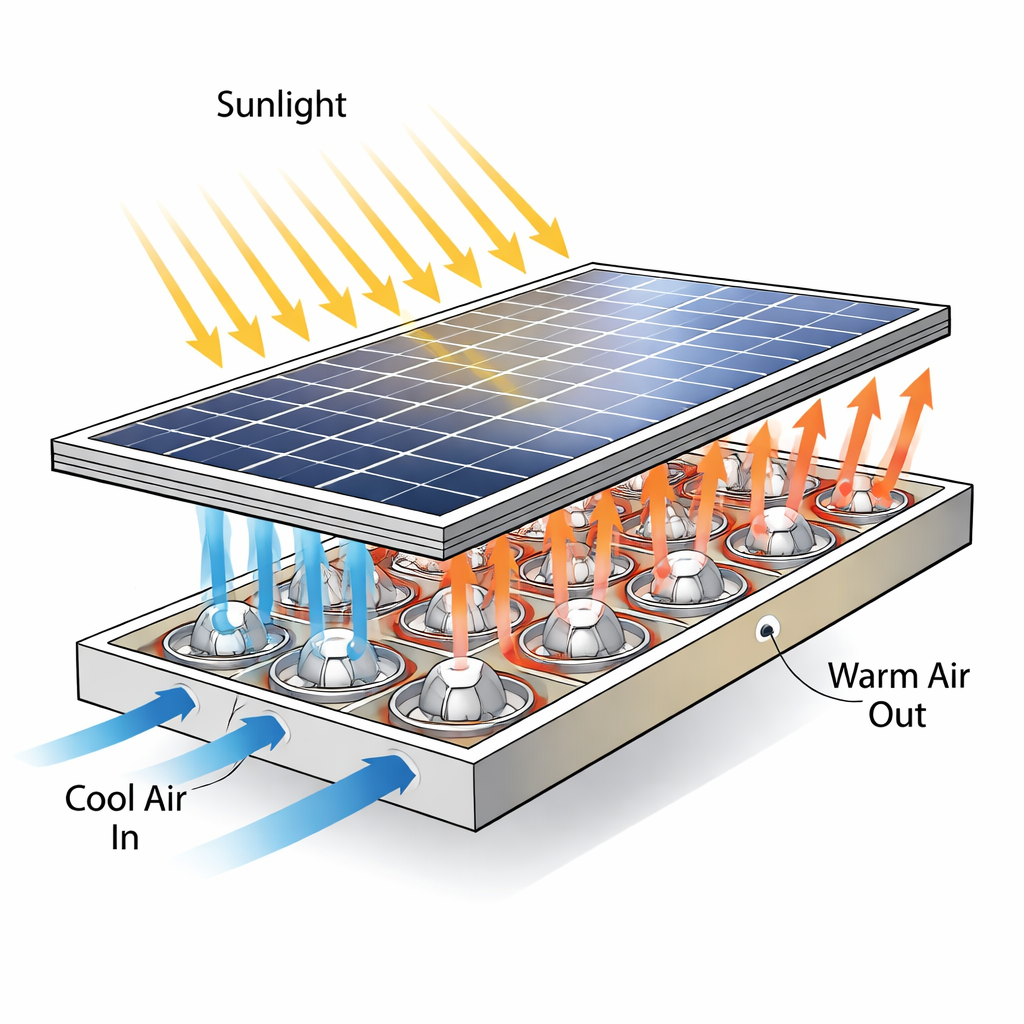
Most rooftop systems simply let the back of a solar panel sit in the breeze. Engineers know they can do better by pushing air or water behind the panel to carry heat away. The team behind this work focused on air, which is free, clean, and easy to handle. Building on earlier “jet impingement” designs—where jets of air strike the back of the panel—they created a new collector that adds a swirling motion to the airflow. Small cup-shaped pieces, 3D-printed from plastic, sit in a shallow box under the panel. Air enters each cup from the side, spins around inside, and then jets upward toward the back of the solar cells before leaving the collector.
How the new system was tested
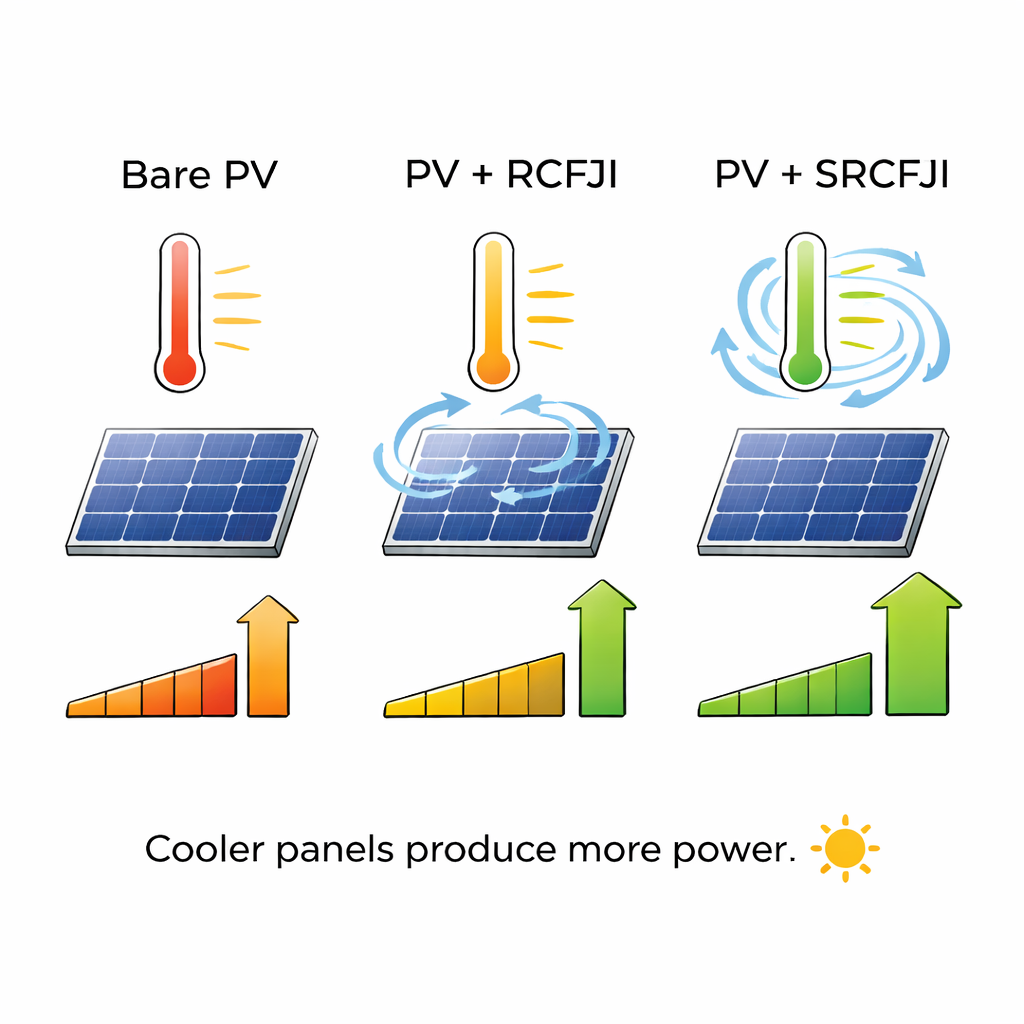
The researchers built three versions of a small solar setup: a bare panel with no special cooling, a panel with a standard reversed circular flow jet impingement (RCFJI) collector, and a panel with the new swirling design, called SRCFJI. All three were tested indoors under artificial sunlight that could be dialed between moderate and strong brightness levels (500 to 900 watts per square meter). They also varied how much air was pushed through the collector, from a gentle breeze to a much stronger flow. During each test they carefully measured panel temperatures, electrical output, the heat removed by the air, and how much of the incoming solar energy could, in principle, be turned into useful work.
Cooler panels, better performance
The results showed a clear pattern: more airflow meant cooler panels and better performance; stronger sunlight, while increasing raw power, also drove up temperatures and ultimately hurt efficiency. Compared with the bare panel, both jet designs cut surface temperatures significantly, but the swirling version did best. At the harshest test condition—high sunlight and strong airflow—the bare panel’s surface reached nearly 80 degrees Celsius. The standard jet design lowered that by about 21.6%, and the swirling design pushed the reduction to roughly 25.3%, keeping the panel several degrees cooler still. This extra cooling translated directly into higher electrical efficiency and more watts produced.
Looking beyond simple efficiency: useful energy
To judge the system more deeply, the team also used “exergy” analysis, which estimates how much of the captured energy can be turned into practical work, after accounting for all the unavoidable losses. Here again, the swirling design came out ahead. Compared with a bare panel, the SRCFJI collector raised electrical energy efficiency by about 12% and thermal energy efficiency by more than 4%. In exergy terms, electrical performance improved by roughly 11%, and the portion of heat that could be considered truly useful rose by nearly 5%. Overall power output from the upgraded setup increased by about 22% compared with the standard panel alone.
What this means for future solar systems
For non-specialists, the message is straightforward: by reshaping the air channels under a solar panel so that air swirls and strikes the back surface more effectively, we can keep the panel cooler and draw more usable energy from the same sunlight. The new swirling jet collector delivers more electricity and more useful heat without adding moving parts at the panel face or relying on scarce materials. While this prototype was tested under controlled indoor conditions and at small scale, it points toward practical upgrades for real-world solar installations, especially in hot climates where overheating is a constant problem.
Citation: Alzoubi, M.A., Ibrahim, A., Alkhedher, M. et al. Experimental investigation of energy and exergy characteristics of a novel solar collector with swirling reversed circular flow jet impingement. Sci Rep 16, 6812 (2026). https://doi.org/10.1038/s41598-026-37654-0
Keywords: solar panel cooling, photovoltaic thermal, jet impingement, swirling air flow, energy efficiency