Clear Sky Science · en
Synergistic effects of ground granulated blast furnace slag and nano-silica on the consolidation, compressibility and microstructural behavior of high plasticity clay
Why Taming Problem Soils Matters
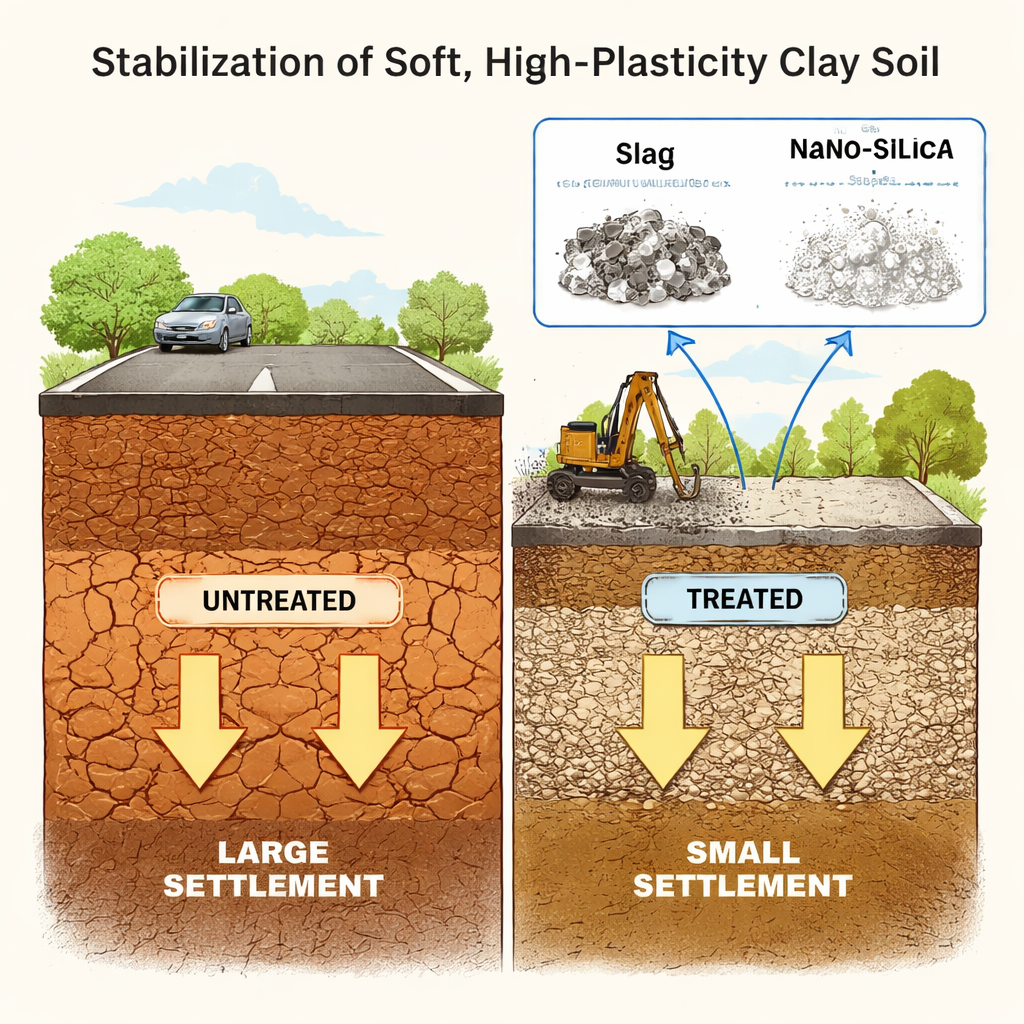
Many roads, buildings, and pipelines are built on clay soils that swell when wet and shrink when dry. These movements can crack pavements, tilt foundations, and drive up maintenance costs. This study explores a cleaner way to calm such “nervous” clays by blending them with an industrial by‑product from steelmaking and ultra‑fine particles of silica. The goal is to make troublesome clays settle less, swell less, and support structures more reliably, while reusing waste materials instead of relying on traditional high‑carbon cements.
Turning Steel Waste and Nanopowder into Soil Helpers
The researchers focused on a highly plastic clay specially mixed in the lab to behave like very expansive natural clays. They combined two additives: ground granulated blast furnace slag, a glassy powder left over from iron and steel production, and nano‑silica, a fumed silica powder with particles tens of nanometers across. The slag brings calcium and aluminum that can react with water to form cement‑like gels, while nano‑silica, with its huge surface area, can pack into tiny voids and speed up those reactions. By adjusting how much of each material they added, the team tested whether the two together could outperform slag alone.
How the New Soil Mixes Were Put to the Test
Clay–slag–nano‑silica mixtures were prepared with slag contents from 10% to 40% of the dry soil and nano‑silica at 0%, 1%, or 1.5%. The team first measured basic traits like how much water the soil can hold before it turns runny or crumbly, and how densely the soil can be compacted—key information for construction practice. Next, they used standard consolidation equipment to squeeze samples under different loads, tracking how quickly water drained out, how much the soil layer thinned, and how well it bounced back when the load was partially removed. Separate tests measured how much the samples swelled when soaked under light pressure. Finally, high‑magnification imaging and X‑ray methods were used to see how the soil’s internal structure changed and what new reaction products formed.
Making Clay Settle Less and Stiffen Up
The untreated clay behaved like a classic problem soil: very soft, easily compressed, and prone to large long‑term settlements. Adding slag alone steadily reduced how much the clay layer shrank under load and how much it expanded again when unloaded, while also speeding up the rate at which excess water escaped. When nano‑silica was added on top of slag, the improvements became stronger: the most effective blend—about 40% slag with 1% nano‑silica—cut the main compressibility measure to roughly one‑third of its original value and significantly increased stiffness. The soil consolidated faster and showed less time‑dependent “creep” after the initial settlement. Pushing nano‑silica to 1.5% did not help further and sometimes slightly worsened behavior, suggesting that too many ultra‑fine particles can clump, demand more water, and interfere with efficient packing.
Holding Back Harmful Swelling
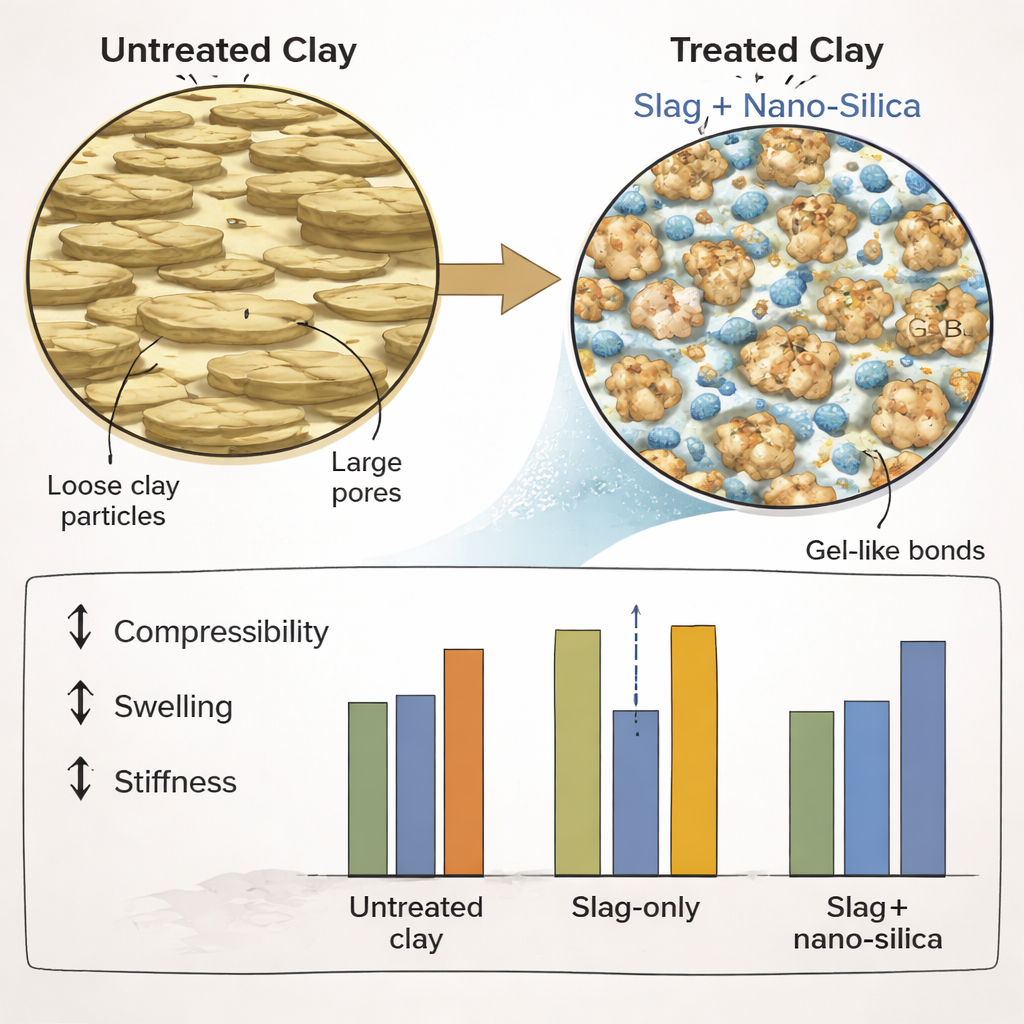
For structures on expansive clays, swelling is often as dangerous as settling. In this study, the untreated clay had a very high expansion index, indicating strong heave potential when wetted. Slag addition alone cut this index substantially, and combining slag with nano‑silica reduced it even more—by about two‑thirds compared with slag‑only mixes in the best cases. The authors link this improvement to chemical changes on clay particle surfaces and to the growth of gel‑like products that pull particles together and fill the voids between them. As the soil fabric becomes denser and better bonded, there is less room for water to wedge plates apart and cause upward movement.
What Happens Inside the Soil
Microscope images of the original clay showed a loose, porous arrangement of plate‑shaped particles. After treatment with slag, and especially with slag plus nano‑silica, those open spaces became filled with a more continuous, glue‑like matrix rich in calcium, silicon, and aluminum. X‑ray patterns confirmed a shift toward more amorphous, poorly crystalline material—hallmarks of cement‑like gels rather than distinct mineral grains. These internal changes match the test results: a denser, more interconnected skeleton resists volume change, carries load more effectively, and allows excess water to drain in a more controlled way.
A Practical Takeaway for the Field
For non‑specialists, the key message is that a smart blend of steelmaking slag and nano‑silica can transform a highly unstable clay into a much more reliable ground material. The treated soil settles less, swells less when soaked, and stiffens up under everyday loads, all while making use of industrial by‑products. Although the exact “sweet spot” for nano‑silica will vary from site to site, this study shows that modest doses—around 1% by soil weight—can unlock a useful synergy with slag. In the long run, such dual‑binder systems could help engineers build safer roads and foundations on difficult clays without leaning as heavily on conventional, carbon‑intensive cement.
Citation: Uysal, F., Yılmaz, V. Synergistic effects of ground granulated blast furnace slag and nano-silica on the consolidation, compressibility and microstructural behavior of high plasticity clay. Sci Rep 16, 6548 (2026). https://doi.org/10.1038/s41598-026-37652-2
Keywords: soil stabilization, expansive clay, blast furnace slag, nano-silica, ground improvement