Clear Sky Science · en
The impact of AI anxiety on career decisions of college students
Why this matters for students and parents
As artificial intelligence rapidly enters classrooms, offices, and everyday tools, many college students quietly wonder: will there still be a place for me in tomorrow’s job market? This study looks closely at that worry—called AI anxiety—and asks how it shapes young people’s confidence, planning, and choices about their careers. By examining Chinese college students navigating an AI-heavy future, the research offers lessons that resonate with students, families, and educators around the world.

New technology, new kinds of worry
The authors start from the simple observation that AI is changing what work looks like, from customer service to data analysis and even creative fields. For college students, this can spark fears of being replaced, of choosing the “wrong” major, or of studying skills that may soon be outdated. The researchers define AI anxiety as persistent unease and fear tied specifically to these technological changes. Rather than treating careers as fixed tracks, they draw on a perspective called Career Construction Theory, which views each person as actively building their own working life in response to shifting social and technological conditions. Within this view, anxiety about AI does not just feel bad; it can directly interfere with how clearly and confidently students shape their career paths.
The study: listening to students in an AI hotspot
To explore these questions, the team surveyed 315 students from three different types of universities in Baise City, China: a comprehensive university, a medical university, and a vocational college. Most participants had taken at least one AI-related course and many used AI tools, giving them firsthand exposure to the technology. Students answered detailed questions about how anxious AI made them feel, how well they believed they could handle career challenges and changes, how confident they were in finding and choosing suitable jobs, and how sure they felt about their future work goals. The researchers then used statistical modeling to see how these pieces fit together, searching for hidden patterns in the relationships among anxiety, flexibility, self-belief, and career decision making.
How anxiety drains flexibility and blurs choices
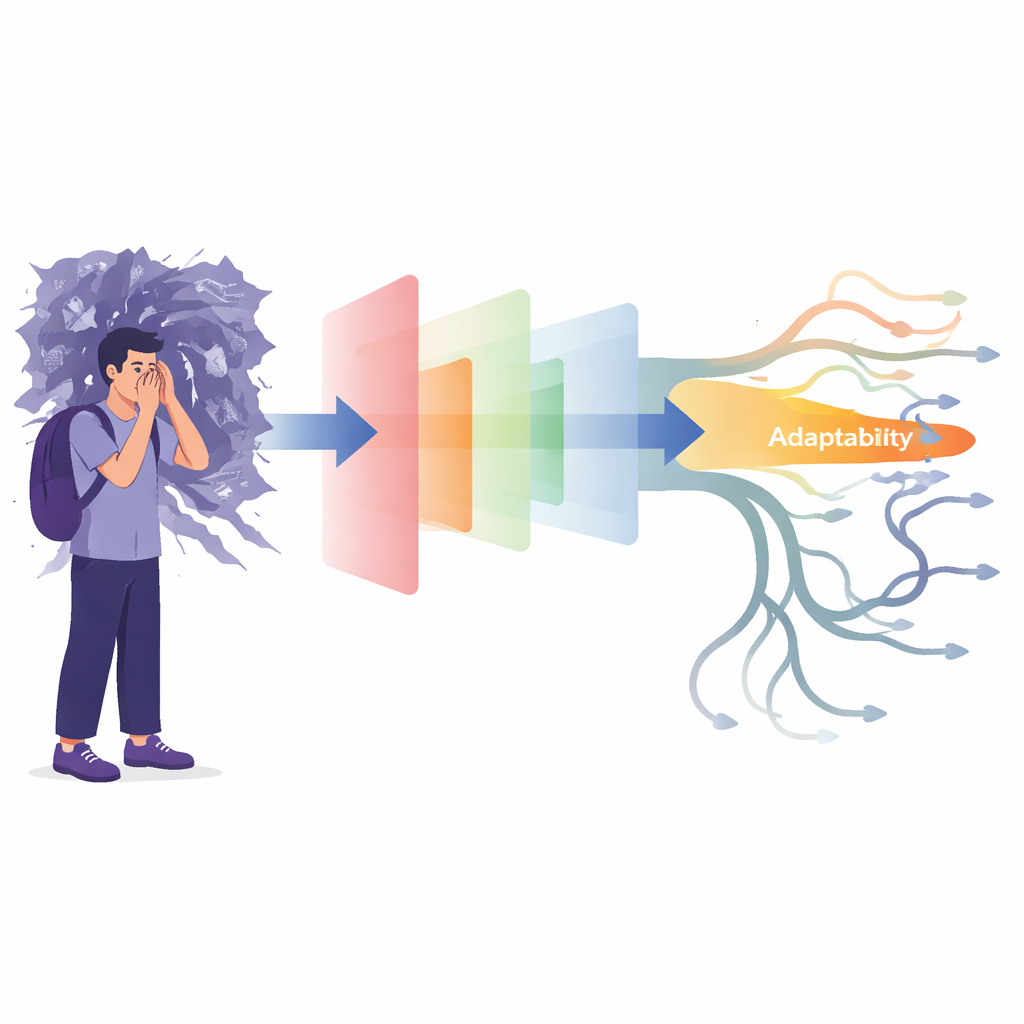
The results paint a clear picture. Students who felt more anxious about AI tended to report poorer career decisions: less confidence, weaker clarity about goals, and feeling less prepared for job hunting. A crucial part of the story is a trait called career adaptability—the ability to think ahead, take charge of choices, stay curious about options, and trust one’s ability to cope with challenges. The study found that AI anxiety strongly undermined this adaptability, and that adaptability in turn strongly supported better career decisions. When the authors added everything up, nearly two-thirds of the total impact of AI anxiety on career decisions flowed through this loss of adaptability. In other words, it is not just that students feel scared; the fear eats into the very flexibility and resourcefulness they need to respond constructively to change.
When confidence is not enough
The researchers also looked at self-efficacy—students’ belief that they can successfully search for information, weigh options, and choose a career path. In theory, such confidence might act like a psychological shield, softening the blow of AI-related worry. But in this sample, self-efficacy did not significantly weaken the link between AI anxiety and shaky career decisions. One possible explanation is that feeling capable of choosing a career in general is different from feeling capable of dealing specifically with complex, fast-moving AI tools. Another is that when students see AI as a large, impersonal force reshaping entire job markets, individual confidence alone may not be strong enough to counter these concerns.
What this means for campuses and careers
Taken together, the findings suggest that AI anxiety is not just background noise in students’ minds; it actively shapes how they plan for their futures. Yet the study also offers a hopeful message: by building career adaptability—through future-oriented planning, real-world practice, and honest discussions about how to work with AI rather than fear it—schools can help students turn anxiety into preparation. The authors argue that universities should weave AI literacy and career planning into regular coursework, expand internships and industry partnerships, and create support systems that help students update their skills over time. For students and parents, the core takeaway is that in an AI-driven world, the most valuable asset may not be a single “safe” major, but the ability to keep learning, adjusting, and choosing with confidence as technology continues to evolve.
Citation: Duan, N., Li, L., Lin, G. et al. The impact of AI anxiety on career decisions of college students. Sci Rep 16, 8409 (2026). https://doi.org/10.1038/s41598-026-37648-y
Keywords: AI anxiety, career decisions, college students, career adaptability, future of work