Clear Sky Science · en
Magnetotelluric forward modeling on fine grid via deep learning with physical information constraints
Listening to Earth’s Hidden Signals
Geophysicists have a clever way to “see” deep underground without drilling: they listen to faint natural electric and magnetic signals that ripple through the Earth. By modeling how these signals travel, they can map buried faults, ore deposits, and geothermal resources. But doing this accurately has long required heavy, time‑consuming calculations. This paper shows how a new deep‑learning approach, guided by the laws of physics, can dramatically speed up these calculations while keeping or even improving their accuracy.

Why Fine Details Matter Underground
The magnetotelluric (MT) method works a bit like medical imaging for the planet. Sensors at the surface record naturally occurring electromagnetic waves. From these data, scientists infer how well different rocks conduct electricity, which reveals structures such as mineral bodies, faults, or magma. To compute what signals should look like for a given underground structure, researchers divide the subsurface into a grid of small cells and calculate the response—this is called forward modeling. Using a very fine grid captures subtle features, like narrow ore zones or sharp boundaries between rock types, but it explodes the size of the equations that must be solved. Traditional numerical methods, such as finite‑element or finite‑difference schemes, can then take hundreds of seconds for a single fine‑grid model on an ordinary computer, slowing down exploration and interpretation.
Teaching a Neural Network the Rules of the Earth
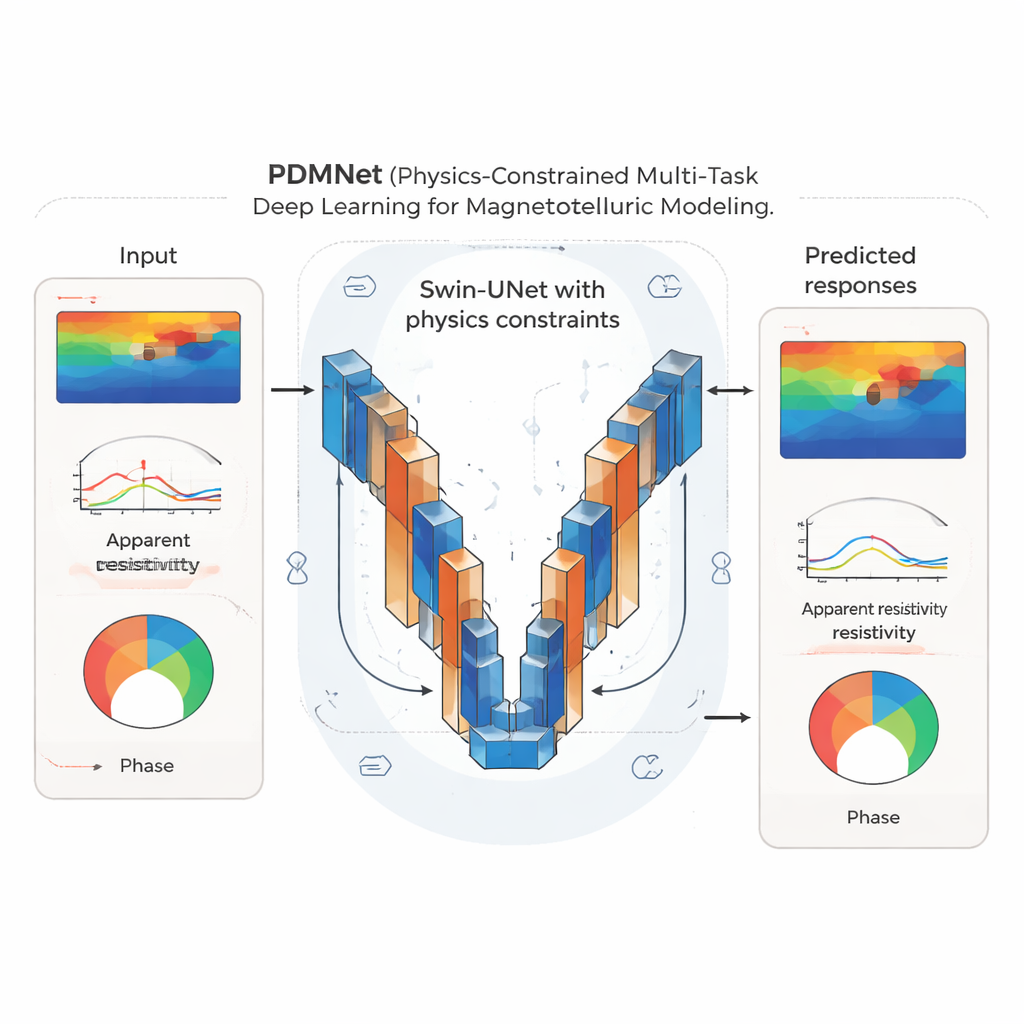
Many teams have turned to deep learning to bypass these slow calculations by training neural networks to imitate the forward modeling step. However, purely data‑driven networks often drift away from physical reality: they may fit their training examples but fail to honor how electromagnetic fields truly behave, especially when noise or unfamiliar geology is involved. The authors tackle this by designing PDMNet, a physics‑constrained multi‑task neural network built on a U‑shaped architecture called Swin‑UNet. This network takes a 2D resistivity model as input and predicts two key MT outputs—apparent resistivity and phase—at once. Crucially, it is trained not only to match example data, but also to satisfy physical rules extracted from magnetotelluric theory.
Building Realistic Training Worlds
To prepare PDMNet for real‑world work, the researchers created a large library of 34,733 synthetic underground models. Instead of simple, blocky structures, they used cubic spline interpolation to generate smoothly varying resistivity patterns that better mimic natural geology and include volume effects of larger bodies. For each model, a conventional finite‑element solver produced precise MT responses on a fine grid, which served as teaching examples. They also added a small amount of random noise, up to 5%, to simulate disturbances that field data inevitably contain. Before feeding the data to the network, they carefully normalized the ranges of resistivity and phase values so that training remained stable and the model generalized better.
Letting Physics Steer the Learning
During training, PDMNet is pulled in two directions that work together. One part of its loss function measures how closely its predicted apparent resistivity and phase match the fine‑grid results from the finite‑element method. Another part compares the original resistivity model with a resistivity profile reconstructed from the network’s own predictions using a quick magnetotelluric imaging formula known as Bostick inversion. This second term acts like a physical watchdog: if predictions would imply an impossible underground structure, the network is nudged back toward physically consistent behavior. A residual term related to Maxwell’s equations and boundary conditions is also woven into the learning process. Over time, the weight of the Bostick‑based constraint is gradually reduced, so early training is strongly guided by physics, while later stages let the network fine‑tune its fit to the data.
Faster Results Without Sacrificing Accuracy
Tests on unseen synthetic models and on a real geological setting—the Jinchuan nickel‑copper sulfide deposit in China—show that PDMNet closely reproduces the detailed patterns and structures obtained from the gold‑standard finite‑element solver. Measures of numerical error and structural similarity both favor PDMNet over a purely data‑driven Swin‑UNet, especially in capturing subtle local features and in handling noisy inputs. Most strikingly, once trained, PDMNet can produce fine‑grid forward responses in about one second, compared with roughly 210 seconds for the traditional solver under the same grid resolution. In plain terms, it delivers high‑resolution views of the subsurface hundreds of times faster while still respecting the underlying physics.
A New Tool for Exploring Beneath Our Feet
For non‑specialists, the main message is that this work turns a slow, computation‑heavy step in subsurface imaging into a fast, AI‑accelerated operation without giving up scientific rigor. By blending deep learning with carefully designed physical constraints, the authors show that machines can learn not just patterns in data, but also the rules that govern Earth’s electromagnetic behavior. This makes it easier and quicker to test many possible underground scenarios, supporting better decisions in resource exploration, geothermal development, and studies of Earth’s deep structure. The same strategy could eventually extend to full 3D models, promising even richer pictures of what lies below our feet.
Citation: Wang, K., Yuan, C., Zhu, H. et al. Magnetotelluric forward modeling on fine grid via deep learning with physical information constraints. Sci Rep 16, 6412 (2026). https://doi.org/10.1038/s41598-026-37645-1
Keywords: magnetotellurics, geophysical imaging, deep learning, physics-informed AI, subsurface exploration