Clear Sky Science · en
Exploring the mechanism of Platycladi Cacumen in intervening androgenetic alopecia based on network pharmacology, molecular docking, and molecular dynamics simulation
Why a traditional tree might matter to thinning hair
For millions of people, hereditary hair thinning is more than a cosmetic worry; it can affect confidence, mood, and quality of life. Modern drugs can slow hair loss, but they often bring side effects and do not work for everyone. This study asks a simple but intriguing question: can a traditional herbal remedy from the leaves of the Platycladus orientalis tree, long used in East Asia to encourage hair growth, have a real scientific basis for helping with androgenetic alopecia, the most common form of hair loss?
Looking at hair loss as a network, not a single switch
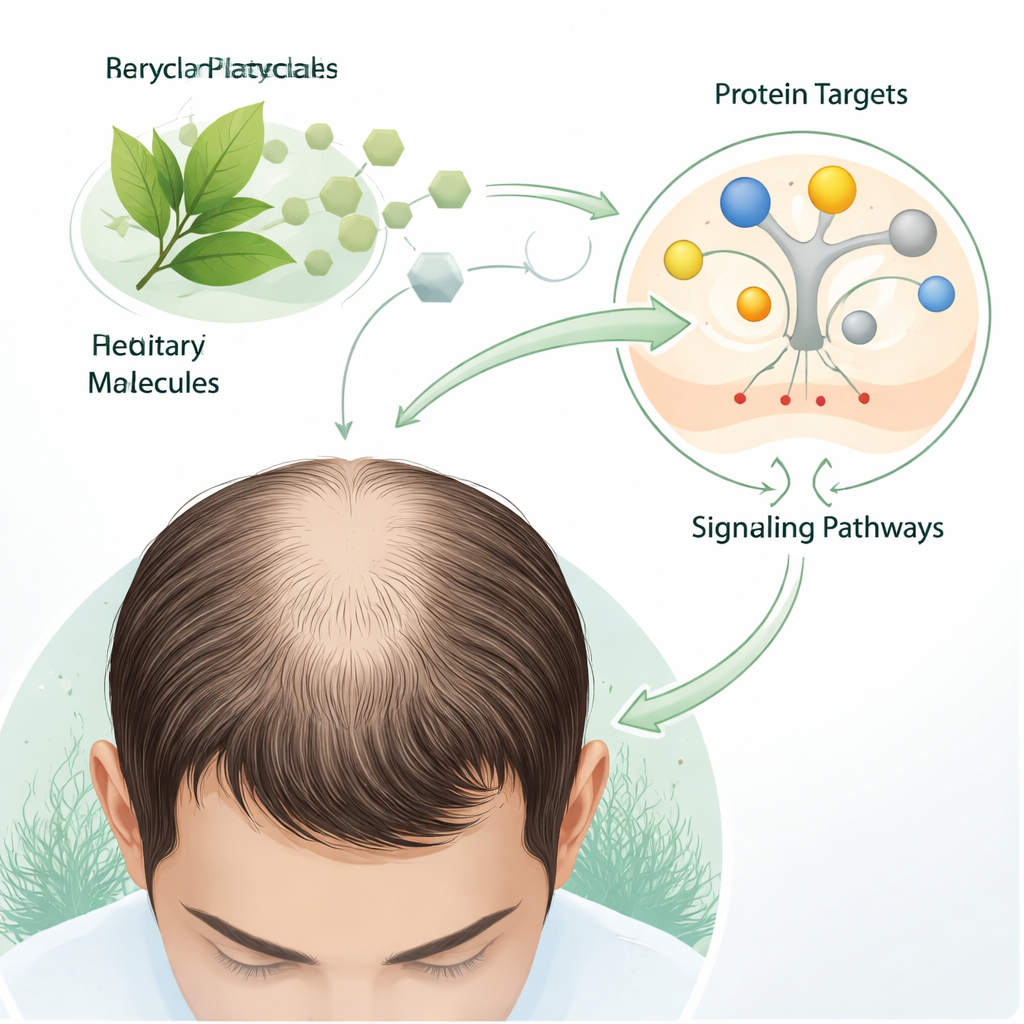
Hereditary hair loss is driven by many intertwined processes. Male hormones are converted into a stronger form that acts on hair roots, gradually shrinking them. At the same time, stress signals, inflammation, changes in cell survival, and shifts in oxygen and nutrient handling all push follicles toward producing shorter, finer hairs. Because so many pathways are involved, a single "on-off" drug may never be enough. The researchers instead treated the problem as a network. Using large online databases, they listed the chemical components found in Platycladi Cacumen leaves and predicted which proteins in the human body each component might influence. They did the same for known proteins linked to androgenetic alopecia, then looked for overlaps.
Key plant ingredients and their most important targets
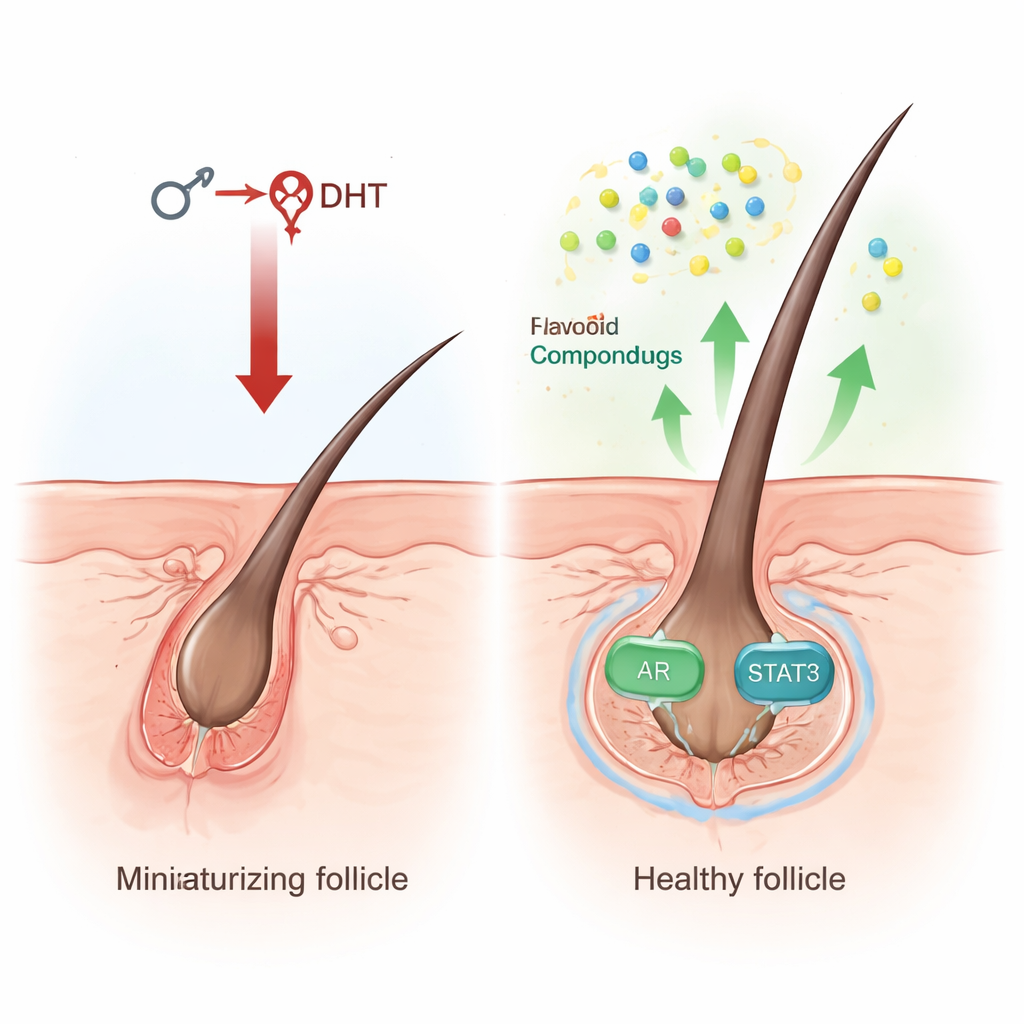
This network approach revealed 32 promising plant compounds that collectively touched hundreds of human proteins. Among them, four stood out as hubs: quercetin, apigenin, myricetin, and hinokinin. These molecules connected to many of the proteins suspected to shape hair follicle health. On the disease side, the team identified hundreds of proteins linked to hereditary hair loss, then narrowed these down to 14 core "choke points" where many signals converge. Two of these were especially important. One is the androgen receptor, the docking site for male hormones that drives follicle shrinkage. The other is STAT3, a protein that helps cells respond to inflammation and stress and has been tied to hair cycle control. Computer analyses of biological functions suggested that the herb’s targets cluster in hormone control, cell growth and death, and the local environment around the follicle.
Testing virtual fit between plant molecules and hair-loss proteins
To see whether the plant compounds might realistically latch onto these core proteins, the researchers used molecular docking—essentially a 3D puzzle solver that predicts how well two molecules can fit together. They focused on the four key plant compounds and eight key proteins, including the androgen receptor and STAT3. All combinations showed reasonably strong binding in silico, and several plant compounds were predicted to grip their targets as well as, or even better than, minoxidil, a front-line hair-loss drug used as a comparison. The team then ran molecular dynamics simulations, which follow the movement of atoms over time in a virtual watery environment, to see whether these bound pairs remained stable. Measures of motion, compactness, and exposure to solvent all indicated that complexes such as quercetin–STAT3 and apigenin–androgen receptor held together steadily over a 100-nanosecond window.
Connecting signals back to the hair follicle
When the authors linked these structural findings back to cell signaling maps, a picture emerged. By attaching to the androgen receptor, some Platycladi Cacumen compounds might subtly tune the powerful hormone signals that shrink follicles, possibly dampening their harmful impact without turning them off completely. By binding to STAT3 and related proteins, other compounds could influence how follicle cells respond to stress, oxygen levels, and inflammation. Many of the affected pathways—such as MAPK and HIF-1—are already known to shape whether a hair follicle enters a growth phase, rests, or regresses. In this view, the herb does not act as a magic bullet but as a gentle multi-pronged nudge, adjusting several control knobs at once in favor of healthier, more resilient hair roots.
What this means for people worried about hair loss
For non-specialists, the takeaway is that there is now a mechanistic, computer-based framework showing how a traditional hair-growth herb could, in principle, influence the same biological levers that modern drugs target in androgenetic alopecia. The study does not prove that Platycladi Cacumen will regrow hair in real people; it offers carefully argued predictions about which plant molecules matter most and how they might work together on key hormone and stress sensors in the follicle. The next steps—lab experiments on hair cells, tests in animals, and eventually human trials—will be needed to see whether these virtual results translate into meaningful protection against hair thinning. Still, this work lays scientific groundwork for developing gentler, plant-based treatments that act on multiple aspects of hair-follicle health rather than relying on a single, hard-edged drug target.
Citation: Liu, J., Mei, H., Ren, C. et al. Exploring the mechanism of Platycladi Cacumen in intervening androgenetic alopecia based on network pharmacology, molecular docking, and molecular dynamics simulation. Sci Rep 16, 6895 (2026). https://doi.org/10.1038/s41598-026-37638-0
Keywords: hereditary hair loss, androgenetic alopecia, traditional herbal medicine, hair follicle biology, network pharmacology