Clear Sky Science · en
Enhanced active learning Gaussian process metamodel for estimating the one-sided tail probability of nonlinear structural response
Why rare failures in big structures matter
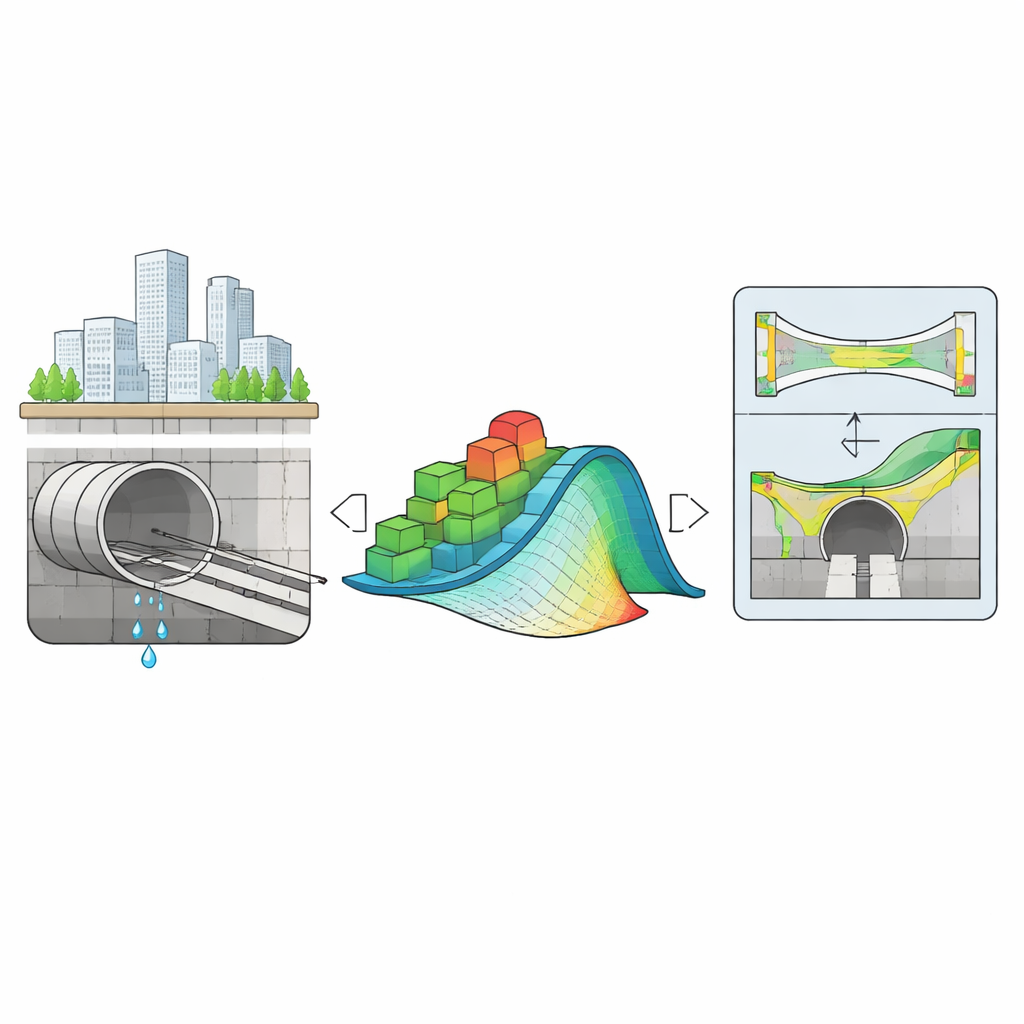
Modern cities depend on huge engineering works—subway tunnels, long-span bridges, offshore platforms—that are built to last for decades. These structures almost always perform safely, but on very rare occasions something goes wrong: a tunnel joint leaks, concrete cracks grow, or bolts slip just enough to let water in. Because such failures are both rare and costly, engineers struggle to estimate how likely they are. This paper presents a new way to calculate the chances of these extreme events more accurately and with far less computer time, using a smart learning algorithm called Tail-Sensitive Global Learning (TS-GL).
Seeing danger in the far edges
When engineers talk about risk, they are often interested in the “tails” of a probability curve—the thin ends that represent very unlikely but very serious outcomes. Standard statistical tools and computer simulations work well for the middle of the curve, where events are common, but they become inefficient and unreliable in the far tails. To get enough rare failures to study directly, a brute-force simulation might need millions of runs of an expensive structural model, which can take days or weeks. Worse, if engineers guess the wrong shape for the tail of the curve, they may underestimate how often extreme events actually occur, giving a false sense of safety.
Teaching a smart surrogate to focus on extremes
To overcome these limits, the authors build a “metamodel,” a fast stand-in for a heavy numerical simulation, using a technique called a Gaussian process. This surrogate does two things at once: it predicts how a structure will respond to different inputs, and it estimates how uncertain each prediction is. An active learning strategy then decides where to sample next, adding new simulation runs only where they will most improve the model. The key advance in TS-GL is that this search is deliberately biased toward one side of the probability curve—the side linked to dangerous outcomes—rather than wasting effort on both tails or on safe regions that are already well understood.
A sharper eye on the risky side
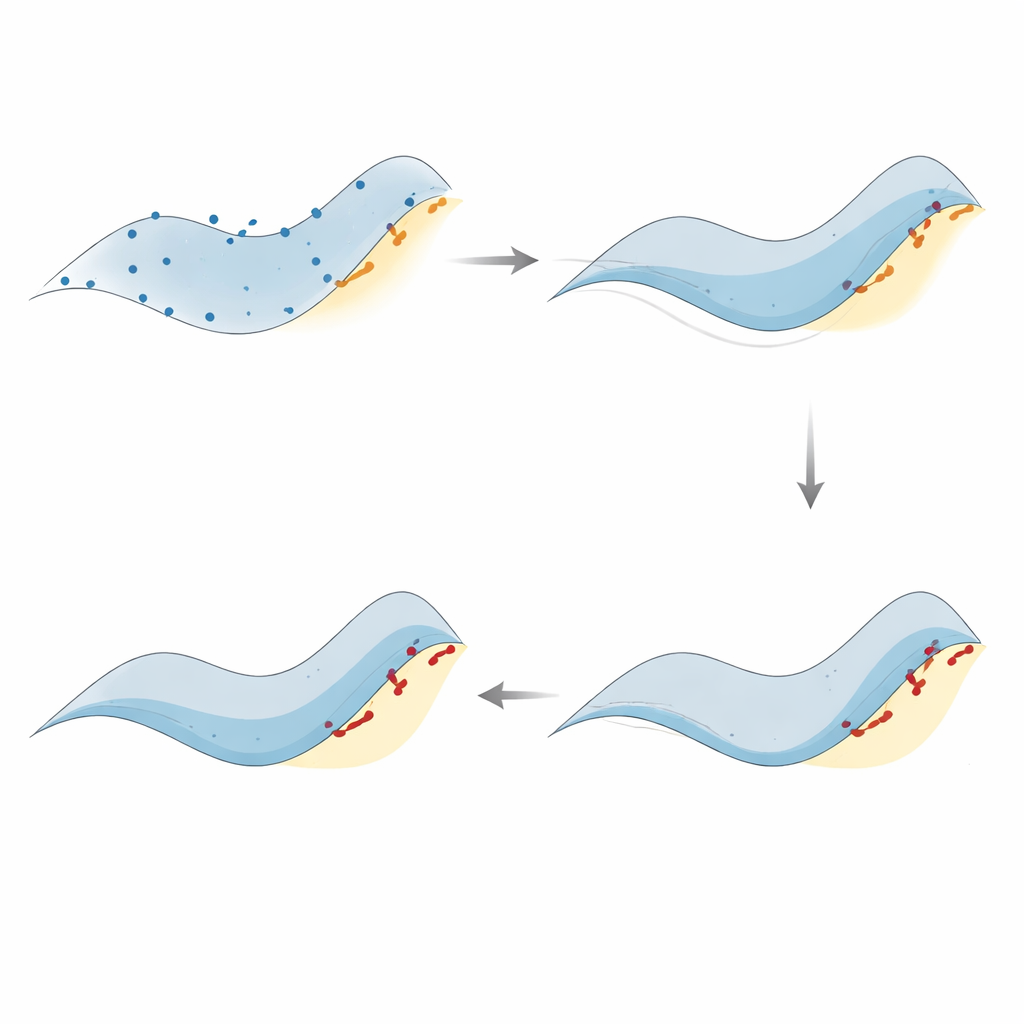
TS-GL introduces a new “tail-sensitive” weighting scheme and a search function that constantly asks: at which response level is the current model most likely to be wrong in the risky tail? It then places new samples near that level, where extra information matters most. By repeatedly updating the surrogate and concentrating points in the hazardous region, TS-GL refines estimates of the one-sided tail probability—the chance that a critical response exceeds a safety threshold. The authors test several mathematical activation functions inside this weighting scheme and find that, while their detailed shapes differ, the overall gains mainly come from the focused search rather than from the specific function chosen.
Putting the method to work on subway tunnels
To show that TS-GL is more than a theoretical idea, the researchers apply it to a real engineering problem: the bond-slip behavior between steel bolts and concrete in subway tunnel joints. If the anchorage length is too short or the connection deteriorates, bolts can slip and allow tunnel segments to separate slightly, opening paths for water leakage and deformation. The team compares TS-GL with earlier active-learning Gaussian process methods and with conventional Monte Carlo simulation. For the same accuracy in predicting the tail of the slip distribution, TS-GL needs only about a quarter as many expensive model evaluations as a two-sided learning method and roughly three orders of magnitude less total computation time than brute-force simulation.
What this means for real-world safety
In plain terms, TS-GL gives engineers a faster, sharper lens for spotting rare but dangerous behavior in complex structures. Instead of spending most of the computer effort on ordinary, well-behaved cases, the method automatically concentrates attention on the small slice of possibilities where failures lurk. It delivers credible estimates of how likely extreme slips, stresses, or deformations are, while keeping computing costs manageable for large, nonlinear models. As monitoring data from tunnels, bridges, or wind turbines accumulate, TS-GL could be used to update risk estimates in near real time, helping operators move from reacting to failures after they occur toward anticipating and preventing them before they happen.
Citation: Wang, Y., Huang, Y., Huang, Y. et al. Enhanced active learning Gaussian process metamodel for estimating the one-sided tail probability of nonlinear structural response. Sci Rep 16, 8832 (2026). https://doi.org/10.1038/s41598-026-37630-8
Keywords: structural reliability, extreme events, Gaussian process, subway tunnels, tail probability