Clear Sky Science · en
Predominantly positive XCO2 anomalies in the Caatinga biome highlight carbon vulnerability
Why this dry forest matters for the climate
The Caatinga in northeastern Brazil is the world’s largest tropical dry forest and the country’s only exclusively Brazilian biome. It covers an area nearly the size of France, yet most climate discussions focus on the Amazon. This study shows that the Caatinga quietly plays a major role in absorbing and releasing carbon dioxide (CO2), and that parts of it may be shifting from a protective carbon sponge toward a source of greenhouse gases. Understanding this hidden climate player helps explain how changes in land use and rainfall in semi‑arid regions can either slow or speed up global warming.
A unique landscape under pressure
The Caatinga is a patchwork of thorny shrubs, seasonal forests, and pockets of greener woodland spread across nine Brazilian states. Rainfall is scarce and erratic, with long dry seasons and short, intense wet periods. Soils are often shallow and rocky, making life hard for plants and people alike. At the same time, the region faces strong human pressures: farming, ranching, wood extraction, and fire. These conditions create a natural laboratory for asking how a dry forest responds when both climate and land use are changing.
Watching carbon from space
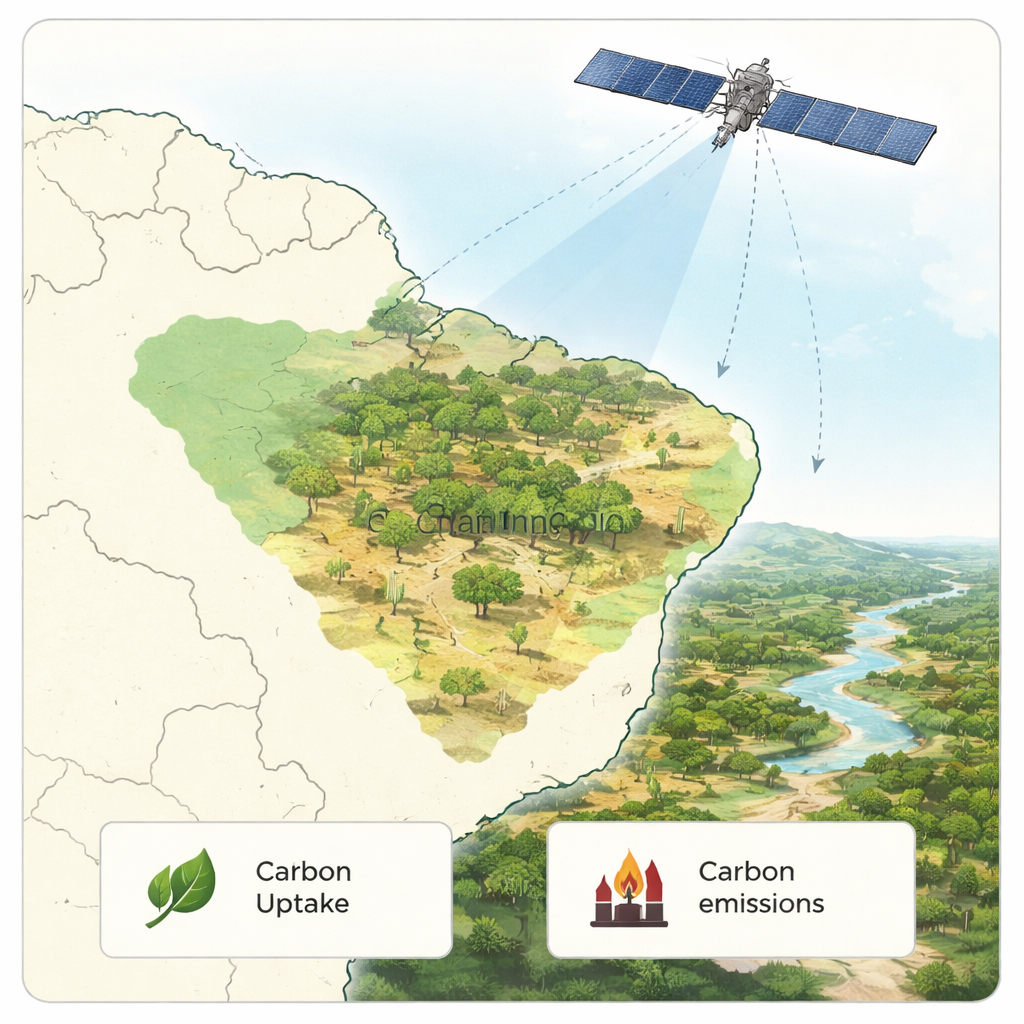
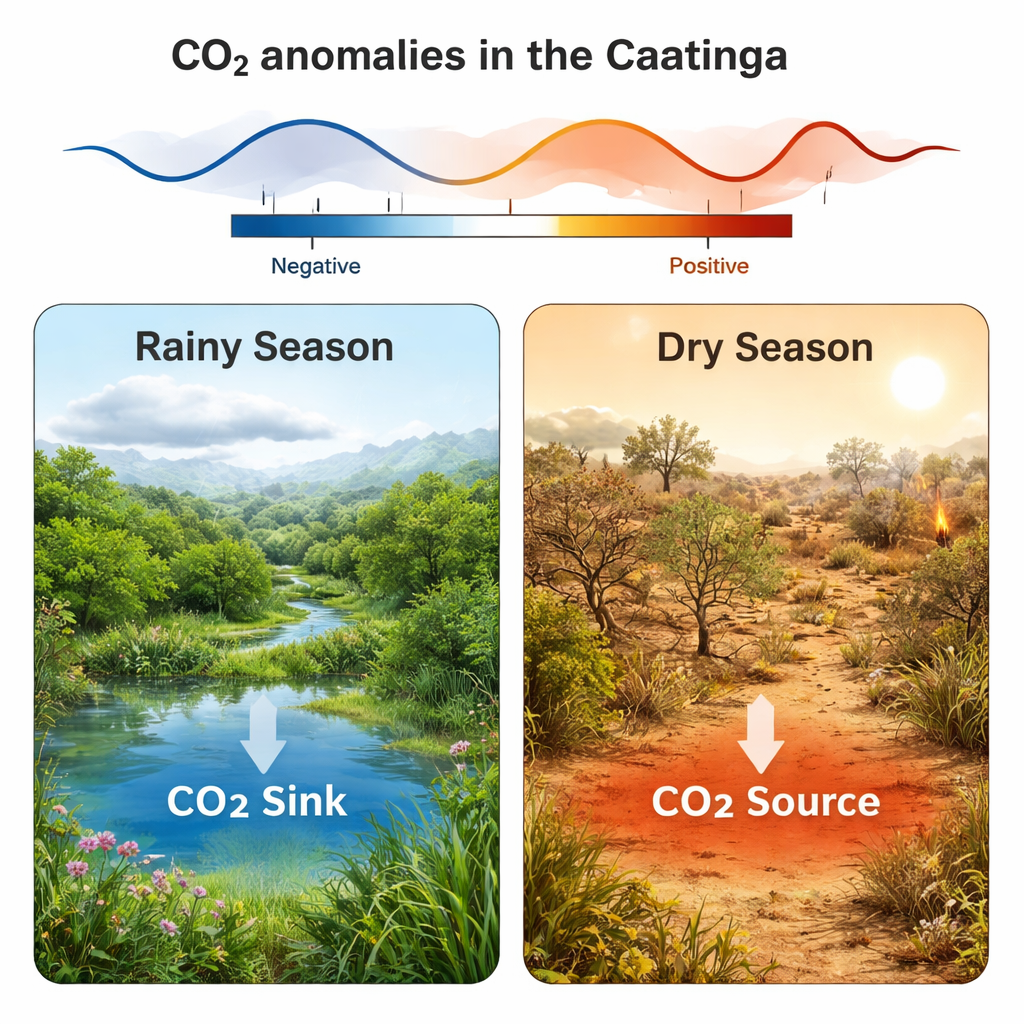
To track how the Caatinga breathes in and out CO2, the researchers used data from NASA’s Orbiting Carbon Observatory‑2 (OCO‑2) satellite collected between 2015 and 2023. Rather than just looking at raw CO2 levels, they measured “anomalies” – how much higher or lower the CO2 above the Caatinga was compared with the global average on the same day. Negative anomalies signal that the land below is acting as a carbon sink, pulling CO2 out of the air. Positive anomalies point to emission hotspots, where vegetation loss, fires, heat, or human activities are pushing extra CO2 into the atmosphere. The team overlaid these satellite readings with maps of different vegetation zones, as well as rainfall, temperature, and greenness indicators derived from other satellites.
Seasonal rhythms and shifting trends
The Caatinga’s carbon behavior follows a strong yearly rhythm. At the end of the long dry season and just as the rains begin, plants are still leafless or recovering, so CO2 uptake is low and positive anomalies often appear. As the wet season unfolds, vegetation greens up, photosynthesis ramps back up, and anomalies drop toward zero or become negative, revealing months when the biome acts as a net carbon sink. Across most years and areas, negative or neutral anomalies dominate, confirming the Caatinga’s capacity to absorb carbon. However, the amplitude and timing of this cycle vary from year to year, reflecting differences in when and how much it rains, as well as local land use. Some vegetation types, especially denser forests known as ombrophilous formations, show worrying long‑term increases in anomalies, hinting that their ability to lock away carbon may be weakening.
Patchy hotspots in a drying world
The study reveals that the Caatinga is far from uniform. Savanna‑like and steppe‑savanna areas, along with pioneer formations that occupy disturbed or recently colonized lands, show the strongest clusters of positive anomalies. These hotspots often appear in the north and northeast, where land‑use pressure, higher temperatures, and water stress are common. By contrast, zones with denser, greener vegetation tend to show more frequent negative anomalies and cooler, wetter conditions, underscoring how intact plant cover helps regulate both local climate and carbon. Statistical analyses indicate that vegetation activity, closely tied to rainfall, is the main independent driver of CO2 patterns, while temperature and precipitation matter most through their effects on plant growth and stress.
What this means for people and policy
Overall, the Caatinga still behaves largely as a carbon sink, but with growing pockets of vulnerability where CO2 emissions are rising and sink strength appears unstable. Because this biome already operates near the edge of water scarcity, future droughts, warming, and continued deforestation could tip more areas from sink to source. For a layperson, the key message is simple: keeping the Caatinga’s vegetation healthy—through conservation, sustainable land use, and restoration—helps hold carbon in the ground instead of letting it accumulate in the air. Protecting this overlooked dry forest is therefore not only about saving a unique ecosystem; it is also a concrete way to support Brazil’s and the world’s climate goals.
Citation: Silva, L.J., da Costa, L.M., de Oliveira Bordonal, R. et al. Predominantly positive XCO2 anomalies in the Caatinga biome highlight carbon vulnerability. Sci Rep 16, 7783 (2026). https://doi.org/10.1038/s41598-026-37629-1
Keywords: Caatinga, carbon sink, satellite CO2, dry forests, climate vulnerability