Clear Sky Science · en
Response to multigenerational graphene oxide exposure in acheta domesticus strains selected for longevity
Why tiny crickets matter for big new materials
Graphene oxide is a rising star in industry and medicine, used in everything from advanced electronics to drug delivery. But as these ultra-thin carbon sheets move from lab to everyday life, they are likely to end up in soil, water, and food chains. This study uses an unexpected hero—the common house cricket—to ask a simple but important question: what happens when living creatures, and their descendants, live for many generations with low levels of graphene oxide in their diet?
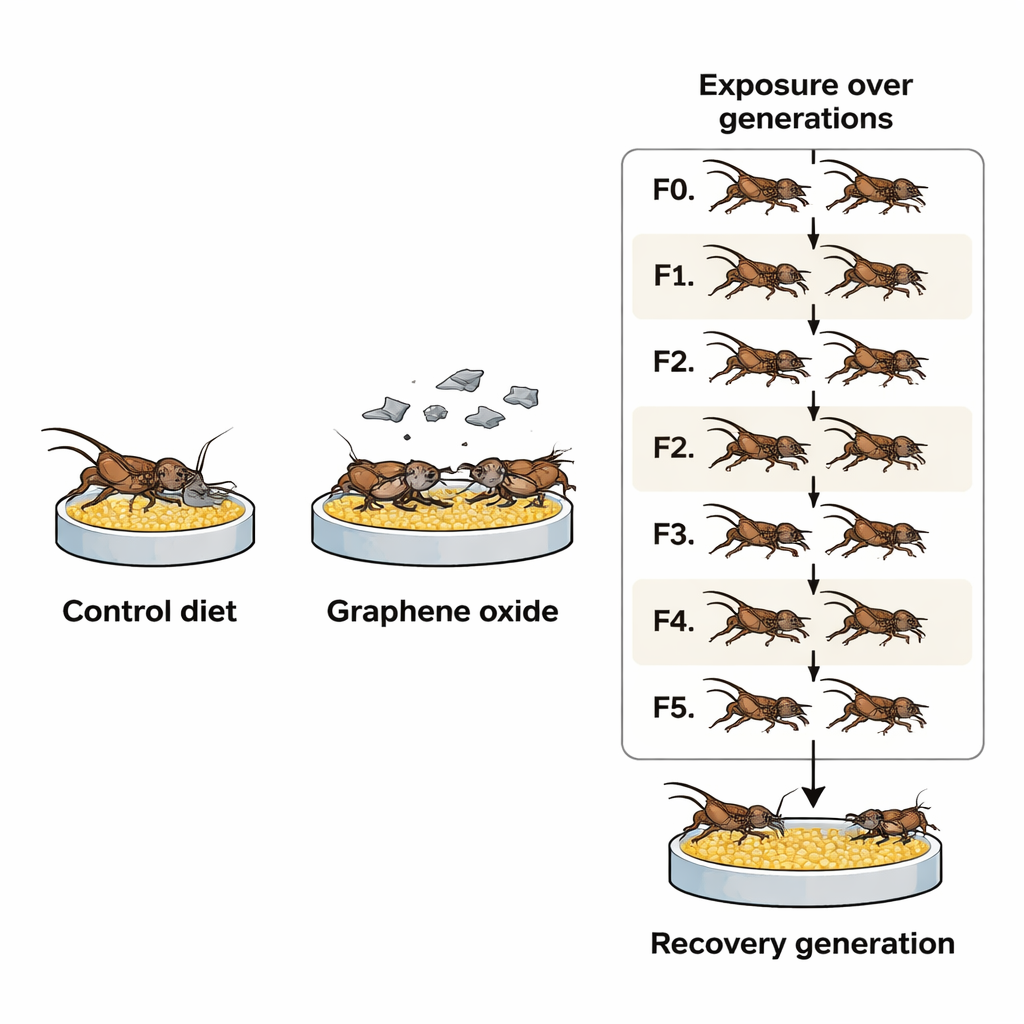
Following families across six generations
The researchers raised two strains of house crickets for six generations: a standard "wild-type" strain and a specially bred, long-lived strain. Young crickets in each generation were fed either normal food or food laced with very low doses of graphene oxide, at levels far below those usually used in lab toxicity tests. The first five generations (F0–F4) ate the graphene-spiked diet, while a sixth "recovery" generation (F5) received clean food again. By comparing the groups over time, the team could watch how the animals’ cells coped with ongoing exposure, and whether that experience seemed to be "remembered" by later generations.
What was happening inside the gut
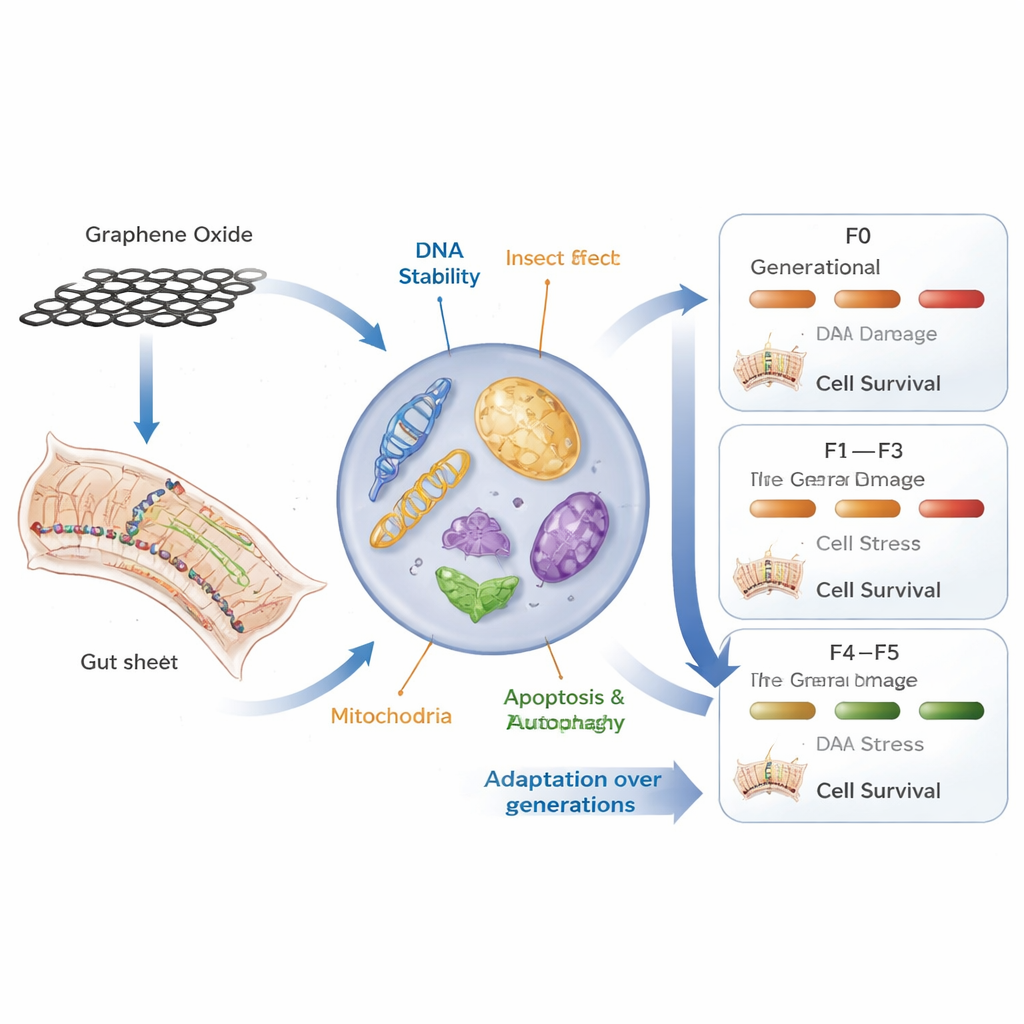
Because ingested graphene oxide first meets the digestive system, the scientists focused on gut cells. Using flow cytometry—a technique that quickly measures properties of thousands of cells—they tracked several hallmarks of cell health. These included damage to DNA, the stability of mitochondria (the cell’s power plants), the share of cells on the path to programmed death (apoptosis), and signs of cellular recycling and clean-up (autophagy). Together, these measures provide a multi-layered snapshot of how stressed the cells are and how effectively they are responding.
Three distinct phases of cellular response
The crickets’ cells did not react in a simple, one-directional way. Instead, the authors identified three broad phases. In the first exposed generation (F0), gut cells showed clear DNA damage and disturbed mitochondrial activity, but surprisingly little increase in cell death—suggesting that the animals were trying to repair rather than sacrifice damaged cells. In the next phase (F1–F3), this balance shifted: DNA damage remained elevated, mitochondrial problems persisted, and the proportion of dying cells rose, while overall cell viability dropped. Intriguingly, the lower graphene oxide dose often had stronger negative effects than the higher one, possibly because mild stress was not strong enough to fully trigger protective repair systems.
Adapting to a new normal—and then losing it
By the fourth generation (F4), the picture changed again. Many of the measured cell-health indicators in exposed crickets moved back toward control-like levels or even improved, hinting that the animals had reached a new internal balance despite the ongoing presence of graphene oxide. Statistical analyses that considered all cellular markers together supported this idea of partial stabilization. However, when graphene oxide was removed from the diet in the fifth generation (F5), the system was disturbed once more. Instead of simply "recovering" to the original state, the recovery generation often showed new shifts in DNA damage and cell stress, as if the sudden loss of a long-standing stressor itself acted like a shock.
Different lifespans, different coping strategies
The long-lived cricket strain did not behave exactly like the wild type. Across many measures, the long-lived animals appeared somewhat better at normalizing DNA damage and maintaining a more stable overall cellular profile under prolonged exposure. This is consistent with the idea that organisms selected for greater lifespan often invest more in DNA repair and other protective mechanisms. Yet even this strain showed that cellular responses depended strongly on generation and dose, underscoring that low-level, long-term exposure to graphene oxide is far from harmless.
What this means for people and the environment
To a non-specialist, the takeaway is that graphene oxide—even at very low levels—can subtly reshape how cells work, not just in directly exposed individuals but across multiple generations. The study suggests these lasting changes may be carried by epigenetic mechanisms: chemical switches on DNA and its associated proteins that tune gene activity without altering the genetic code itself. While crickets are not humans, they are valuable stand-ins for many short-lived animals in real ecosystems. The findings argue that safety assessments of nanomaterials should look beyond short-term toxicity and consider how long, low-dose exposure might ripple through generations, potentially rewriting the biological "memory" of exposure in ways we are only beginning to understand.
Citation: Flasz, B., Babczyńska, A., Tarnawska, M. et al. Response to multigenerational graphene oxide exposure in acheta domesticus strains selected for longevity. Sci Rep 16, 6687 (2026). https://doi.org/10.1038/s41598-026-37623-7
Keywords: graphene oxide, multigenerational effects, epigenetic inheritance, nanotoxicology, insect model