Clear Sky Science · en
Group-specific effect of interannual water level fluctuation on consumers trophic niche area
Why shrinking shorelines matter to underwater life
As climate change and dam operations make lake and reservoir levels more erratic, it is not only shorelines that shift. The entire underwater community must adapt to new food and shelter conditions. This study looks inside a Czech drinking-water reservoir to see how a sudden, human-made drop in water level changed what different animals eat, and how flexibly they could respond, over three consecutive years.
Reading diets from invisible chemical fingerprints
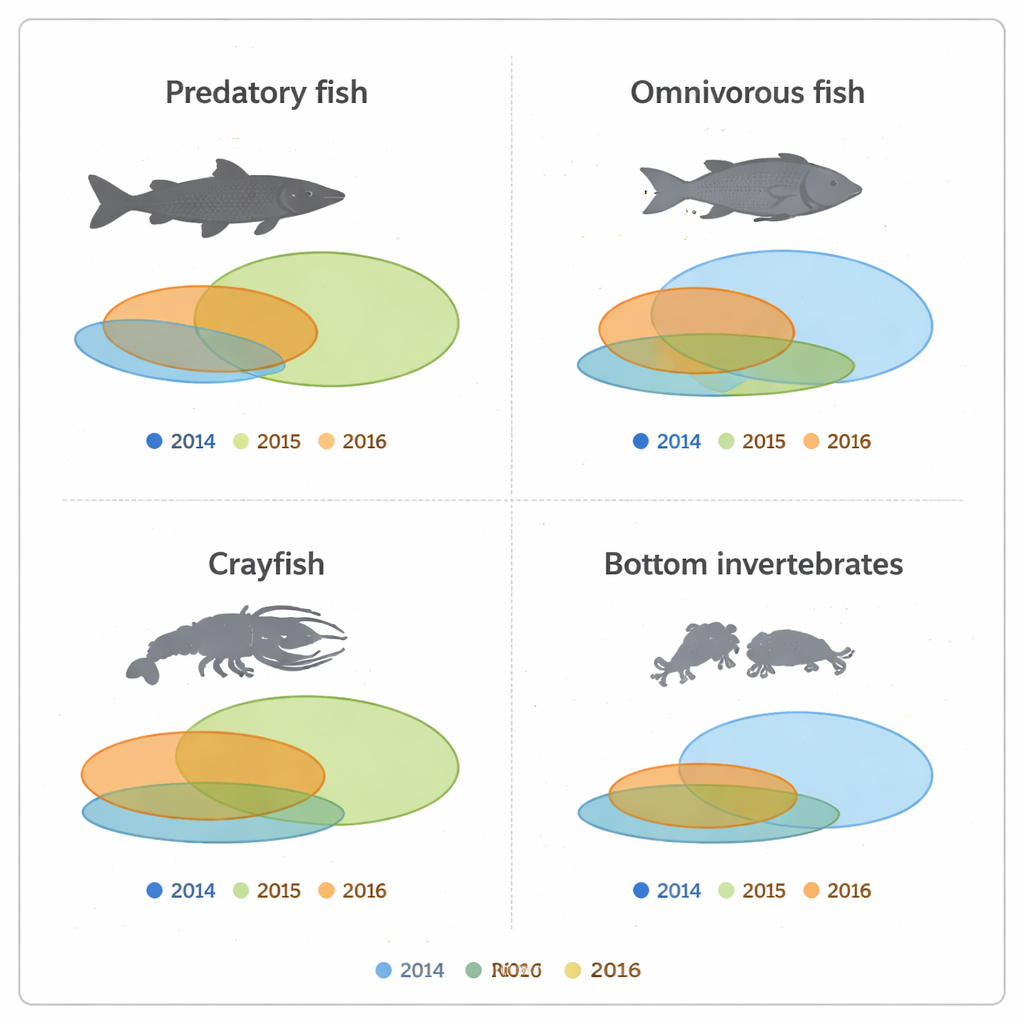
Instead of watching animals feed, the researchers used a powerful forensic tool: stable isotopes of carbon and nitrogen in body tissues. These chemical signatures act like long-term diet records, revealing both the types of food an animal uses and its position in the food chain. By plotting these signatures for many individuals of a species, scientists can draw a “diet space” showing how wide or narrow the range of food sources is. A large area means a flexible, varied diet; a small area means a more limited, specialized menu.
A reservoir experiment written by engineers
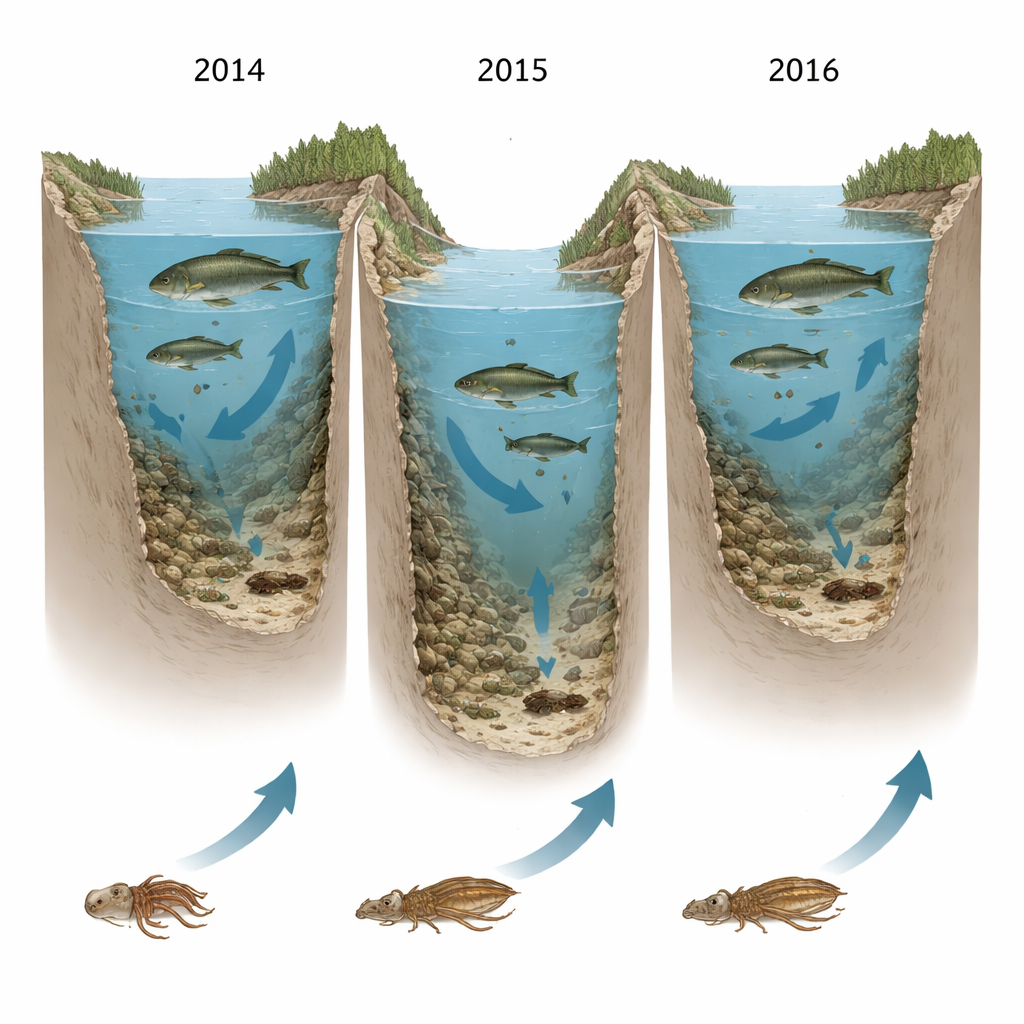
The Nýrsko reservoir in West Bohemia usually has only minor, predictable water level changes. But in 2015, engineers lowered the water by about a meter and a half for dam repairs, and it stayed low for the whole growing season before recovering in 2016. This created a rare real-world experiment. The team sampled two common fish (predatory perch and omnivorous roach), the native noble crayfish, and two groups of bottom-dwelling invertebrates (predators and detritus-feeders) in each of the three summers. They then compared how the size of each group’s diet space changed from a normal-water year (2014), through the low-water year (2015), and into the recovery year (2016).
Winners and losers when water retreats
The effects of the water level drop were strikingly different among groups. Perch, the top predators, showed the narrowest diet space before the drop and a much broader one afterward, suggesting they began to exploit a wider mix of prey, possibly including young fish and animals forced into tighter quarters. Crayfish also expanded their diet dramatically in the low-water year, taking advantage of their ability to move across depths and sample many kinds of food. In contrast, the roach, which normally eat a bit of everything, saw their diet space shrink sharply in the low-water year and remain small even after water levels returned to normal, hinting at lasting limits on their food options.
Life on the bottom feels the squeeze
For small invertebrates living in or on the sediment, losing the shallow fringe of the reservoir was particularly harsh. Both predatory and detritus-feeding bottom animals showed a drastic contraction of their diet space in the low-water year, with only a slight or no rebound the following year. Chemical evidence from algae and detritus suggests that these invertebrates were pushed toward relying on fewer, more similar food sources, such as algal films, rather than the richer mix of plant debris and microscopic life they could tap when shorelines were fully flooded.
What this means for future lakes and reservoirs
The study shows that a single, planned water-level drop can reshuffle who eats what in a reservoir, and that not all groups bounce back quickly. Mobile, generalist feeders like crayfish and predatory fish can broaden their diets and cope, while shoreline-dependent species and bottom dwellers may be squeezed into narrow, fragile niches. Because extreme low-water events are expected to become more common with climate change and continued dam operation, understanding these group-specific responses helps scientists and water managers anticipate which parts of aquatic food webs are most at risk when the water line moves.
Citation: Veselý, L., Ruokonen, T.J., Ercoli, F. et al. Group-specific effect of interannual water level fluctuation on consumers trophic niche area. Sci Rep 16, 7519 (2026). https://doi.org/10.1038/s41598-026-37620-w
Keywords: water level fluctuation, food webs, stable isotopes, reservoir ecology, aquatic animals