Clear Sky Science · en
Seismic response analysis of coal mine shaft tower structure considering PSSI effect under different sites
Why underground towers and earthquakes matter
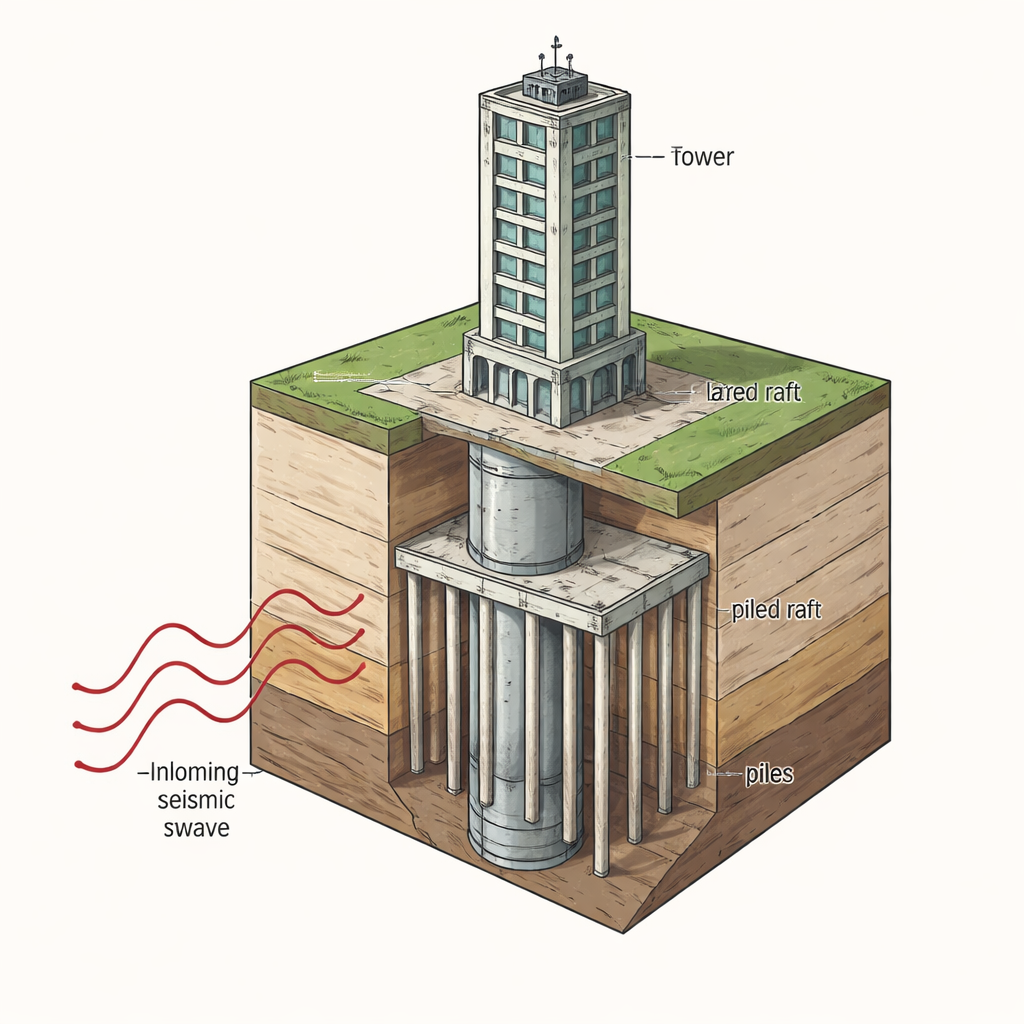
Deep coal mines rely on tall concrete shaft towers at the surface to lift people and coal from great depths. These towers sit on foundations that extend into layered soil and rock. When an earthquake hits, the shaking does not just move the tower; it also moves the piles and the surrounding ground, and all three influence each other. This study asks a practical question with big safety and cost implications: how much does this hidden interaction between soil, piles, and tower change the way a shaft tower responds to earthquakes, and does it make today’s design rules too risky in some places and too conservative in others?
How the tower, piles, and soil move together
The authors focus on a modern, large coal mine shaft tower about 90 meters tall, supported by a piled raft foundation rigidly connected to a vertical concrete wellbore. Instead of assuming the base is perfectly fixed, they treat the tower, the piles, the raft, the wellbore, and the layered soil as one coupled system. Using well-established physical models, they simplify this complex assembly into a set of springs, masses, and dampers that can mimic how each part bends, rocks, and slides when shaken. They then derive equations of motion that link the motion at the tower’s floors with the motion of the buried foundation and the surrounding soil, and solve these equations numerically with custom MATLAB code.
Testing realistic earthquakes and ground types
To see how this coupled behavior plays out in practice, the team uses a real mine in Anhui, China, as a case study. They select 21 earthquake records—both strong natural quakes and carefully simulated ones—and apply them horizontally at the base. They examine three typical ground conditions used in Chinese seismic codes: a relatively stiff “Type II” site, an intermediate “Type III” site, and a softer “Type IV” site, each represented by multiple soil layers with differing stiffness and density. For comparison, they run every ground motion twice: once with the full soil–pile–tower interaction and once using the common shortcut that treats the foundation as perfectly rigid.
What happens to story-by-story sway
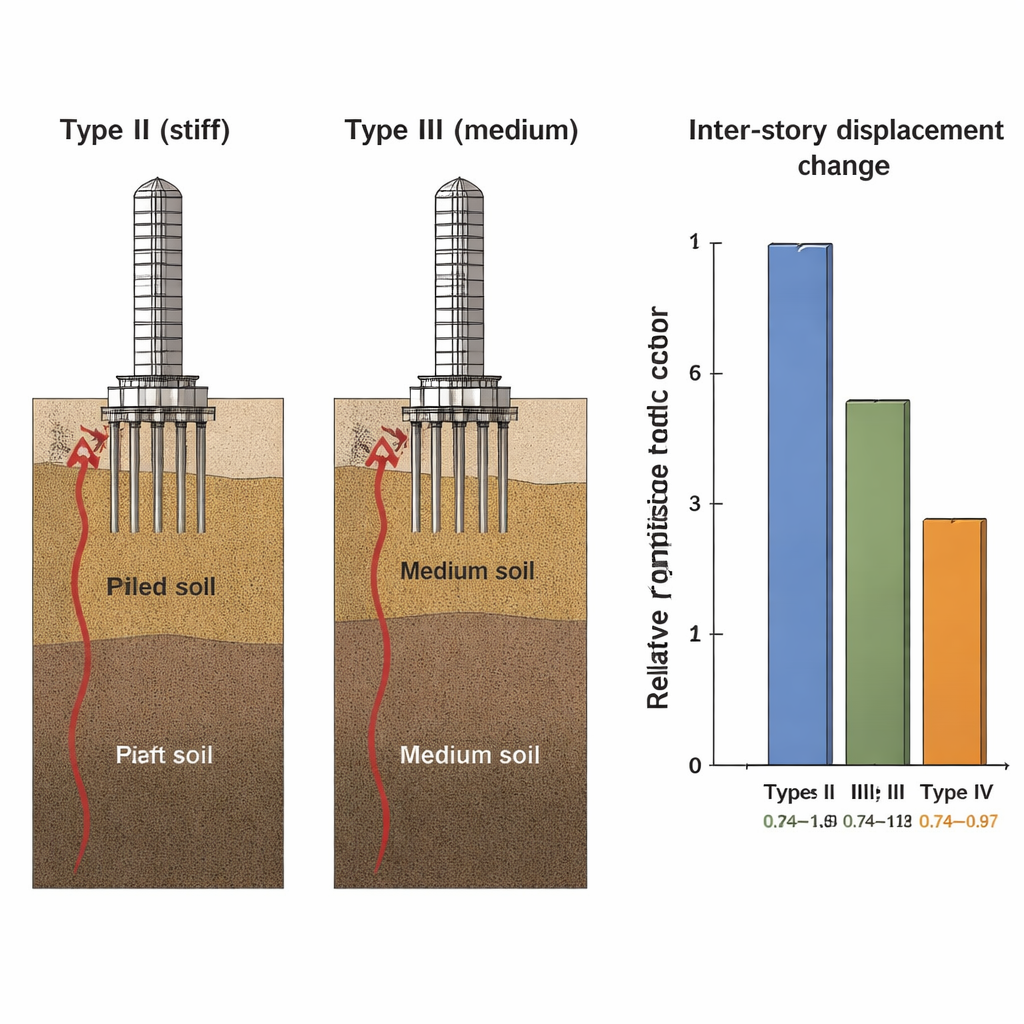
The key quantity they track is inter-story displacement—the relative sideways movement between adjacent floors—which is closely linked to bending forces in walls, beams, and columns. The authors define an “enhancement coefficient” as the ratio of this inter-story drift in the realistic interacting system to that in the rigid-foundation idealization. Values above one mean the interaction increases forces; values below one mean it actually relieves them. Across all three site types, the largest enhancement consistently appears at the very top of the tower, where a whip-like effect concentrates motion, while middle floors move less dramatically.
Different soils, different safety margins
The results show that ignoring soil–pile–structure interaction can be dangerous in some settings and wasteful in others. On stiff Type II ground, the average enhancement coefficients for inter-story displacement fall between about 1.31 and 1.61, meaning that the real tower can experience 30–60 percent larger drifts, and therefore higher internal forces, than predicted by a rigid-base design. For Type III ground, the averages are closer to unity, roughly 0.89 to 1.25, with amplification mainly at the upper stories. On the soft Type IV ground, the averages drop to about 0.74 to 0.97, so the interaction usually reduces drifts compared with the rigid-base assumption. Physically, the coupled soil–pile–tower system has a longer vibration period than the rigid tower alone, which can shift it away from the most damaging frequency band of the ground motion and cut the seismic demand.
What this means for mine safety and design
For practicing engineers, the message is twofold. In stiff-soil regions and strong seismic zones, designing a shaft tower as if it sat on an unyielding base can underestimate the real earthquake forces, especially near the top stories, leaving existing structures with hidden safety risks. In softer soils, the same simplification can overestimate forces and drive unnecessarily heavy and costly designs. The study provides a practical framework for including soil–pile–structure interaction in shaft tower analysis and highlights which combinations of soil type, tower height, and vibration period most strongly affect seismic response. While the exact numbers will differ from tower to tower, the general pattern—that the top stories are most vulnerable and that softer sites can sometimes help rather than hurt—offers a clearer, more nuanced basis for designing and retrofitting coal mine shaft towers in earthquake-prone regions.
Citation: Han, L., Zhao, S., Zhang, Y. et al. Seismic response analysis of coal mine shaft tower structure considering PSSI effect under different sites. Sci Rep 16, 6656 (2026). https://doi.org/10.1038/s41598-026-37617-5
Keywords: coal mine shaft tower, soil–structure interaction, piled raft foundation, earthquake engineering, inter-story displacement