Clear Sky Science · en
Modeling metacognition and executive functions in the metacognitive wisconsin card sorting test using the neuropsychological digital-twin method
Why Thinking About Our Thinking Matters
Why do some people adapt quickly when rules change, while others get stuck or overconfident in a wrong strategy? This study looks at the mental skills that let us notice our own mistakes, change course, and learn from experience. By combining psychology, brain science, and computer models, the authors show how “thinking about our thinking” – metacognition – works together with executive functions, the mental tools we use to plan, focus, and switch tasks. Their work helps explain not only everyday flexibility, but also the hidden mental difficulties seen in conditions like anorexia nervosa and schizophrenia.
Three Building Blocks of Flexible Thought
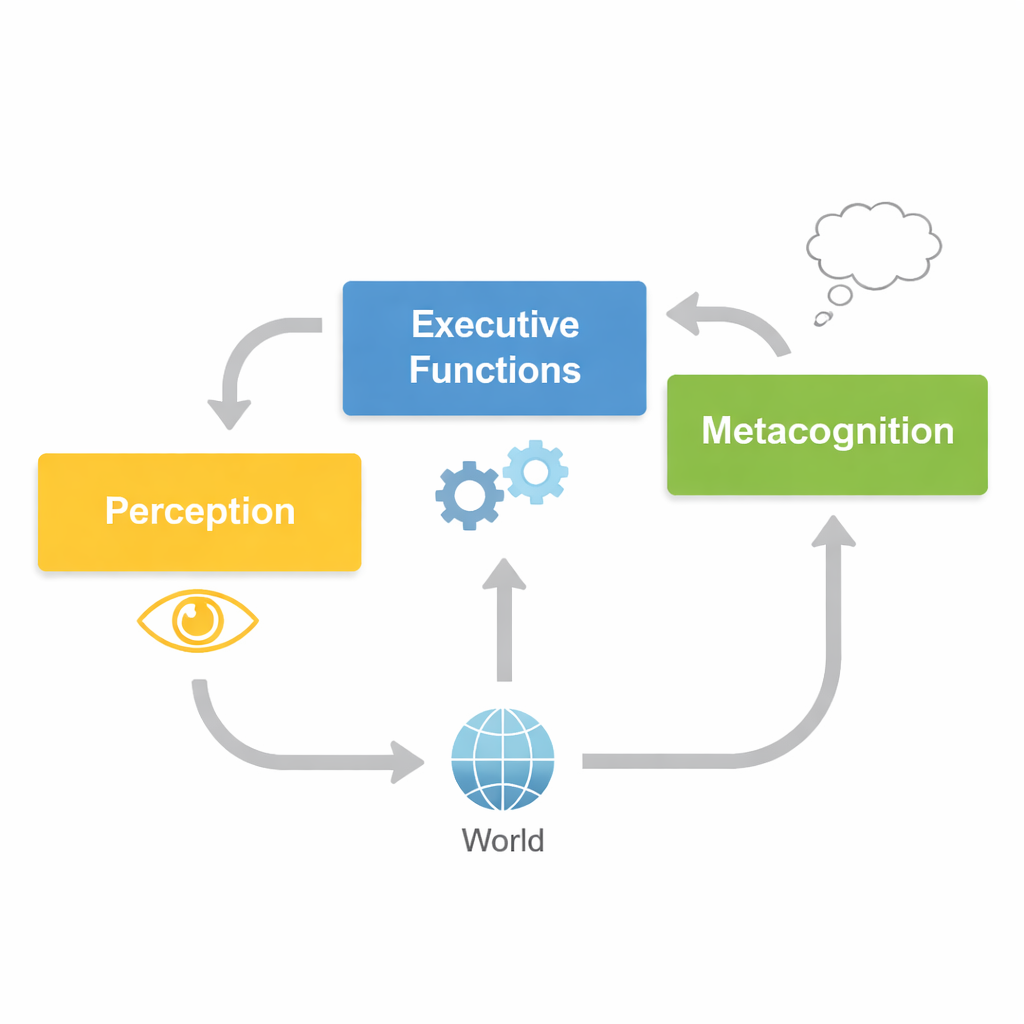
The authors start from a simple but powerful idea: flexible behavior grows out of three interacting systems. First is perception, which turns sights and sounds into internal representations. Second are executive functions, which hold goals in mind, select rules, and guide actions. Third is metacognition, which monitors how well those goals and rules are working and decides when to adjust them. Rather than treating the brain as just a reward-seeking machine, the theory emphasizes how these systems constantly reshape internal representations – what we focus on, what we treat as important, and which options we consider. Metacognition sits at the top of this hierarchy, evaluating how clear and reliable our current mental state is and nudging executive functions to sharpen goals or pay closer attention when things feel uncertain.
A Card Game That Reveals How We Self-Monitor
To probe these processes, the researchers turn to a classic psychology task, the Wisconsin Card Sorting Test, where people must discover and then adapt to changing sorting rules (such as by color or shape) using only yes/no feedback. A newer version, the Metacognitive Wisconsin Card Sorting Test, adds an extra twist: before seeing whether they were right, participants rate their confidence and choose whether the trial should count toward their score. This small change opens a window onto metacognition. It separates simple performance (getting the rule right) from how accurately people judge their own performance and how wisely they act on those judgments, for example by discarding guesses they feel unsure about.
Building a “Digital Twin” of Human Problem Solving
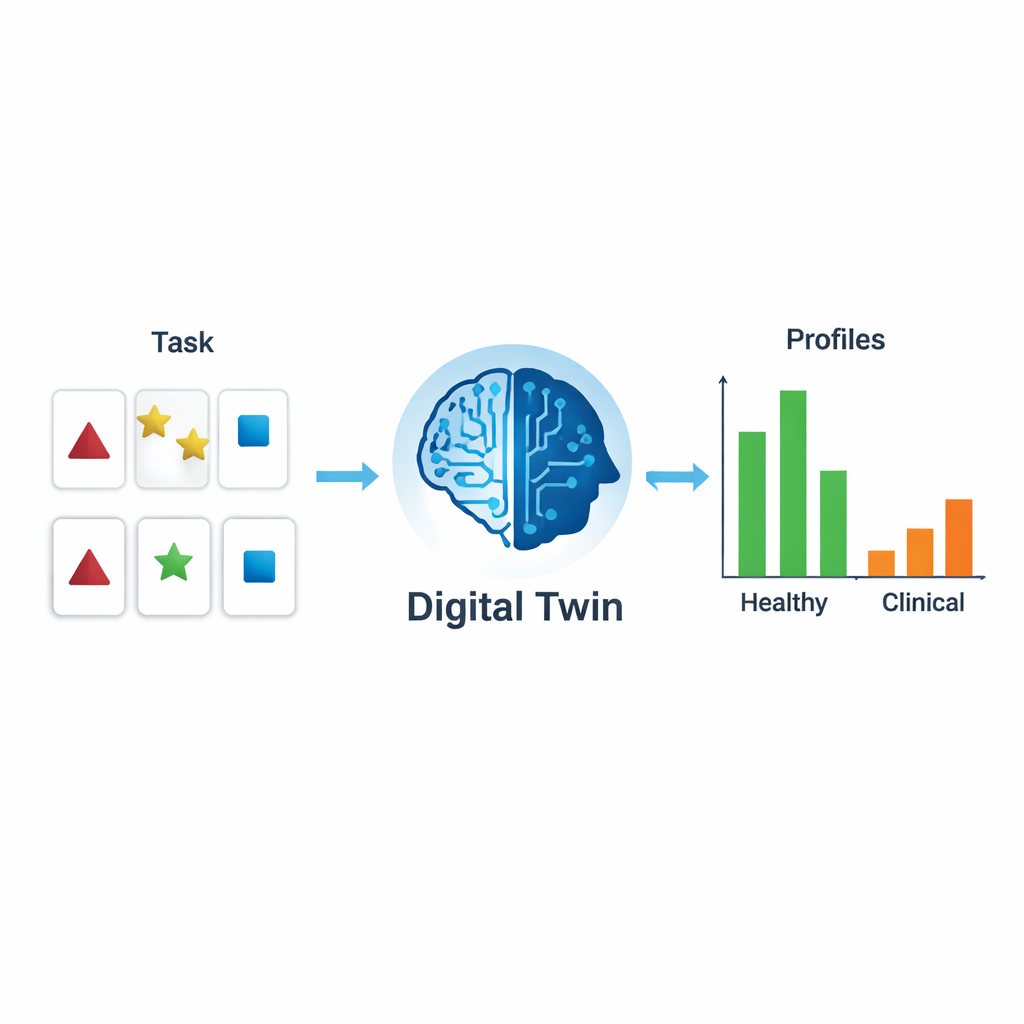
The core contribution of the paper is a neuro-inspired computer model – a kind of digital twin of human cognition – that can perform the metacognitive card-sorting task. The model includes modules for perception, working memory, motivation, and a metacognitive layer. It tracks recent rewards and punishments, estimates how clearly one rule stands out from alternatives, and then combines this information into a confidence signal. That signal drives two kinds of metacognitive control: a simple decision about whether to “count” a response, and a slower self-improvement process that adjusts how strongly the model reacts to feedback or how distractible it is. By tuning a small set of parameters, the authors fit the model to real data from healthy adults and from people with anorexia nervosa or schizophrenia, matching not only overall accuracy but also rich patterns of errors and confidence.
Hidden Similarities and Crucial Differences in Mental Disorders
Once fitted, each version of the model acts as a digital twin of a group: one for healthy controls, one for anorexia, and one for schizophrenia. This lets the researchers “lesion” specific parameters or simulate therapy-like changes and watch what happens. The simulations suggest that both clinical groups share two subtle problems: weakened motivation and a tendency toward overconfidence, which may help explain rigid beliefs and delusion-like thinking. Yet their profiles diverge in important ways. The anorexia-like twin shows strong perseverance and poor self-improvement – it clings to a rule even when it stops working. The schizophrenia-like twin drifts toward distraction and poor self-evaluation – it switches rules too often and keeps feeling confident even as performance falls. When the authors emulate metacognitive psychotherapy in the model, they find that anorexia may benefit most from boosting self-improvement, while schizophrenia may require strengthening both self-evaluation and self-improvement.
What This Means for Everyday Life and Future Technologies
For lay readers, the takeaway is that flexible behavior is not just about raw intelligence or willpower. It depends on a layered system that perceives the world, holds goals, and constantly evaluates its own reliability. When this system works well, we notice when a strategy is failing, adjust how we pay attention, and slowly refine our habits. When it falters, we may become rigid, scattered, or unjustifiably sure of ourselves. By capturing these interactions in a concrete computer model, this work offers a roadmap for more personalized mental health treatments, for educational tools that train self-monitoring, and even for future robots that can reflect on their own performance rather than blindly following rules.
Citation: Granato, G., Mattera, A., Cartoni, E. et al. Modeling metacognition and executive functions in the metacognitive wisconsin card sorting test using the neuropsychological digital-twin method. Sci Rep 16, 7145 (2026). https://doi.org/10.1038/s41598-026-37612-w
Keywords: metacognition, executive functions, digital twin, Wisconsin Card Sorting Test, cognitive flexibility