Clear Sky Science · en
Brief mindfulness meditation increases risk-taking behavior
A Calm Practice With a Hidden Twist
Mindfulness meditation is often promoted as a safe, soothing way to handle stress, sharpen focus, and improve well‑being. But what if a few minutes of quietly following your breath could also nudge you toward taking bigger chances with money and other rewards? This study asks a surprisingly down‑to‑earth question: after a single short meditation session, do people become more willing to gamble on uncertain outcomes, and if so, what exactly changes in their decision-making process?
Putting Mindfulness to the Test
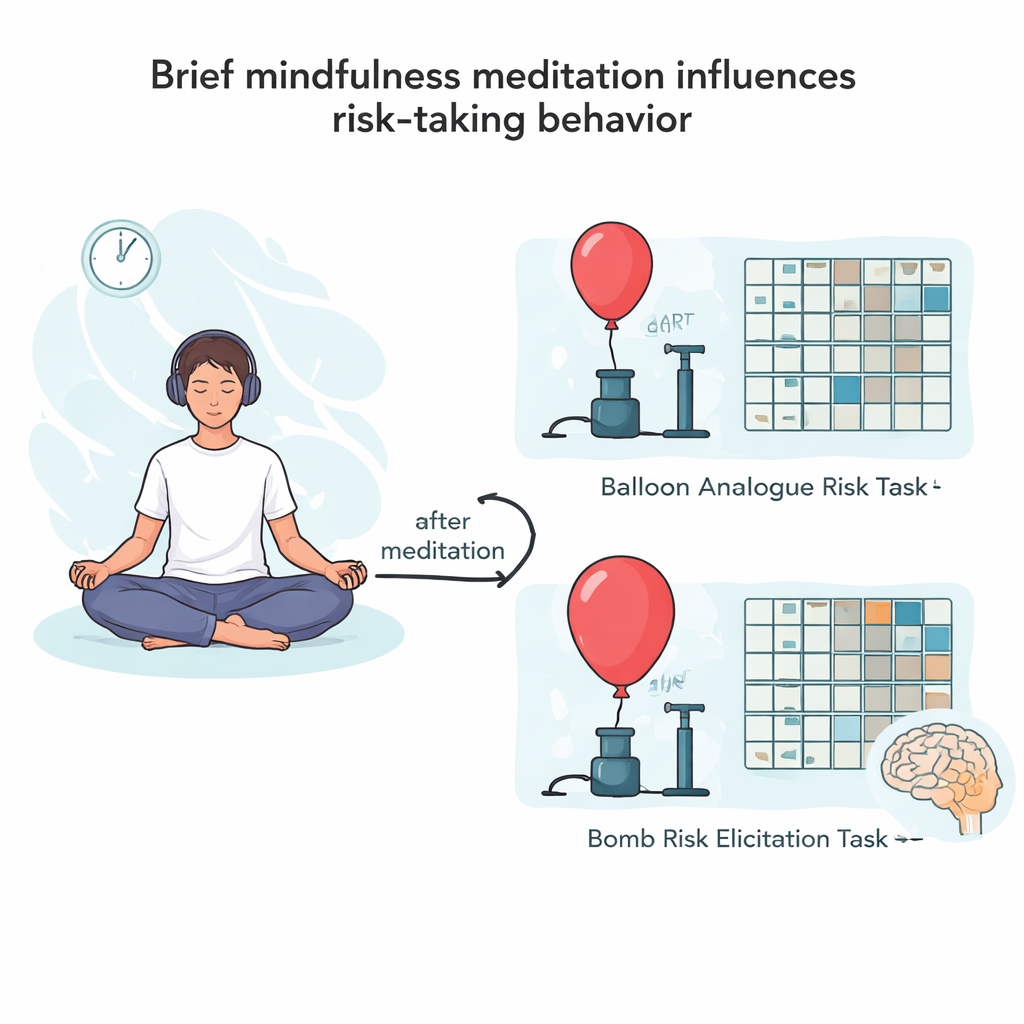
To move beyond self-help claims and simple questionnaires, the researchers ran two controlled experiments that measured real choices with real monetary stakes. In both, volunteers were randomly assigned to one of three brief activities: a five‑minute guided mindfulness meditation that asked them to notice their breathing and let thoughts pass without judgment; an equally long "mind-wandering" style audio that encouraged them to immerse themselves in whatever came to mind; or a quiet puzzle task with no guided thinking at all. Right after this, everyone completed a computerized task that involved earning small amounts of money while facing the possibility of sudden losses.
Balloon Pumps and Hidden Bombs
In the first experiment, run online with people in the United Kingdom, participants played the Balloon Analogue Risk Task. Each round, they could press a key to pump up a virtual balloon. Every successful pump added a bit of money, but at an unpredictable point the balloon could burst and wipe out that round’s earnings. Players could stop pumping at any time to “cash out.” More pumps meant more potential profit, but also a higher chance of losing everything. On average, people who had just meditated chose to pump their balloons more times than those in either control group, meaning they consistently accepted more risk to chase higher payoffs.
New Country, New Task, Same Pattern
The second experiment, conducted in person in Singapore, used a different game: the Bomb Risk Elicitation Task. Here, participants saw a grid of 100 boxes. Most boxes were worth a small amount of money, but one box hid a bomb. They could choose how many boxes to collect; if they picked the bomb, they lost the round’s earnings. Unlike the balloon game, the odds were fully transparent—one bomb in 100 boxes each trial—so people knew exactly how risky their choices were. Once again, those who had just completed the brief mindfulness meditation chose more boxes on average than the two comparison groups, showing a greater willingness to flirt with the bomb and risk losing their payoff.
Peering Under the Hood of the Mind
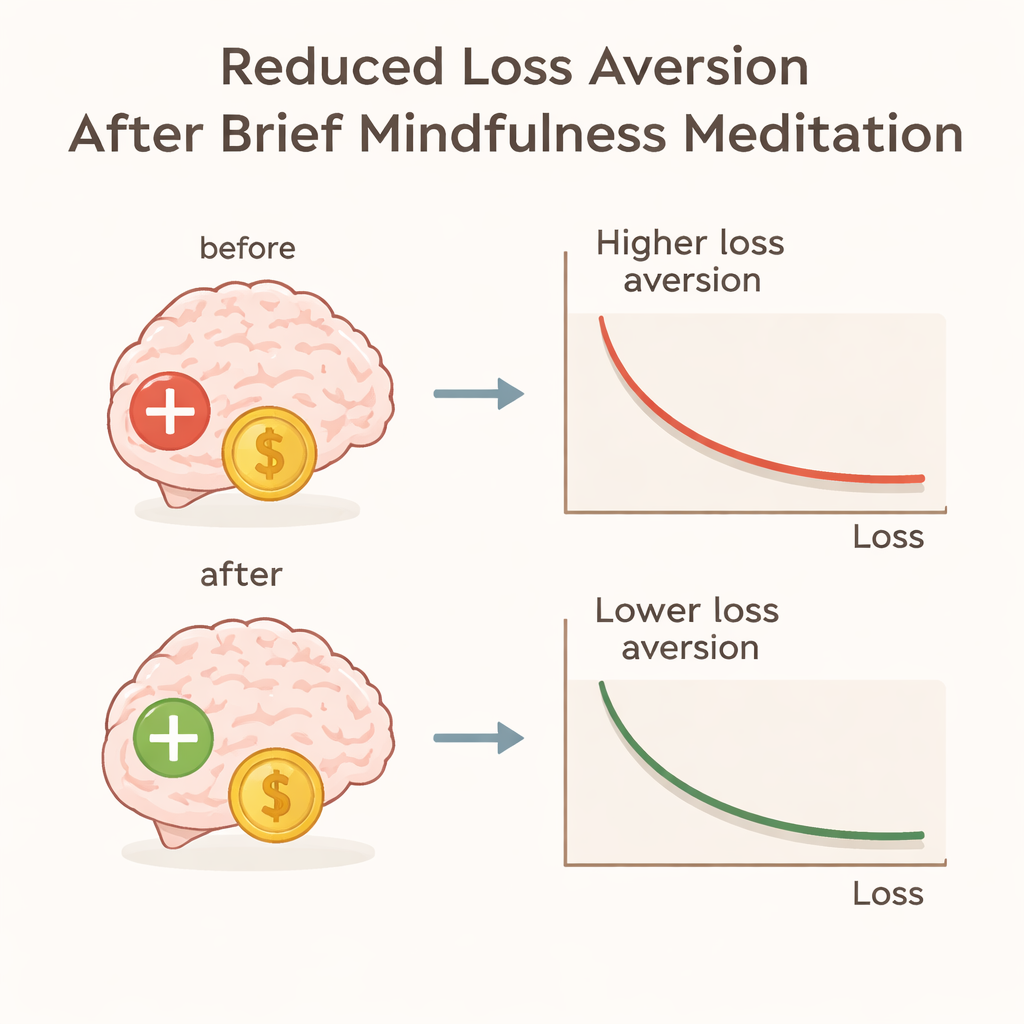
The team went beyond simple averages and used computational models—mathematical tools that infer hidden mental settings from patterns of choices—to understand what changed inside people’s decision machinery. These models separated different ingredients of risky choice, such as general caution, how quickly people learn from experience, and how strongly they react to losses compared to gains. Across both experiments, one factor stood out: after brief mindfulness meditation, people showed lower “loss aversion.” In everyday terms, losing money felt less painful relative to the pleasure of gaining it. Other parts of decision-making, such as how they learned about the odds or their basic sensitivity to risk, changed little or only modestly.
What This Means in Everyday Life
To a layperson, the core message is simple but counterintuitive: a short, five‑minute mindfulness exercise can make people less scared of losing and therefore more willing to take chances in structured tasks. That is not necessarily good or bad on its own. In some settings—like learning from repeated choices where occasional failures are inevitable—caring less about losses may actually help people stay objective and persistent. In other situations—like dangerous driving or high‑stakes financial decisions—reduced concern about negative outcomes could be risky. The study does not claim that meditation makes people reckless in everyday life, but it does show that even a brief, seemingly benign practice can subtly reshape how we weigh gains against losses when making decisions under risk.
Citation: Tan, L.B.G., Golubickis, M. & Macrae, C.N. Brief mindfulness meditation increases risk-taking behavior. Sci Rep 16, 6760 (2026). https://doi.org/10.1038/s41598-026-37597-6
Keywords: mindfulness, risk-taking, loss aversion, decision-making, meditation