Clear Sky Science · en
Intensity-dependent tACS entrainment effects in a cortical microcircuit: a computational study
Why gentle brain zaps matter
Scientists are exploring ways to nudge the brain’s natural rhythms using very weak electrical currents applied through the scalp, a technique called transcranial alternating current stimulation (tACS). These rhythmic “brain zaps” are being tested to ease symptoms of depression, schizophrenia, and Parkinson’s disease, and to sharpen memory and attention. Yet results in people have been mixed: sometimes tACS helps, sometimes it does little. This study asks a simple but crucial question: at the level of individual brain cells and tiny local circuits, what actually happens when we turn up the tACS dial?
A tiny slice of cortex in the computer
Instead of experimenting directly in animals or people, the authors built a detailed computer model of a miniature piece of human-like cortex. Their virtual circuit contained five carefully reconstructed neurons spanning the outer to the deeper layers of the brain. Three were tall, tree-like pyramidal cells that carry most of the brain’s excitatory signals; two were smaller inhibitory interneurons that help keep activity in balance. The model captured not just where these cells sit, but also their branching shapes, electrical properties, and the web of excitatory and inhibitory connections between them. The team then drove the circuit with randomly timed synaptic inputs to mimic the brain’s own rhythmic activity in the alpha (around 10 Hz) and theta (around 5 Hz) bands. 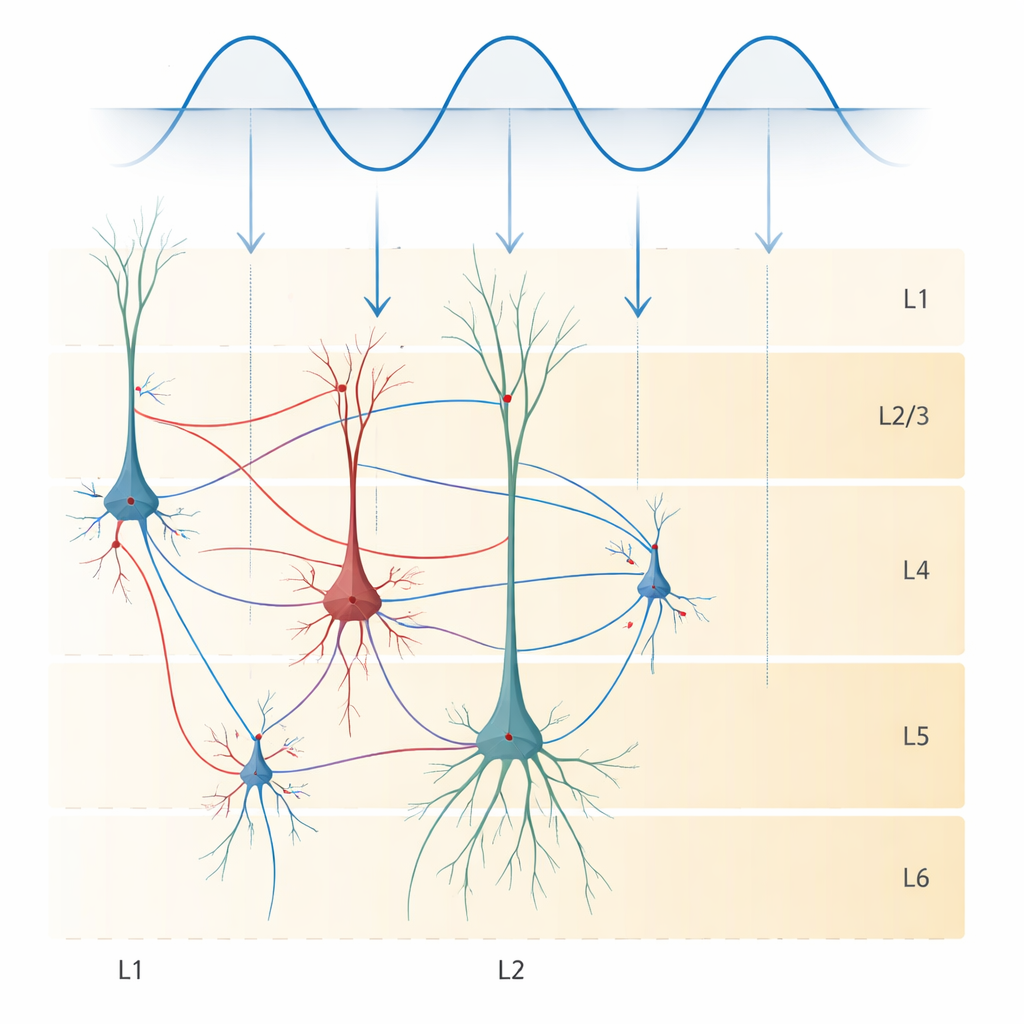
How weak currents reshape timing, not volume
Next, the researchers applied simulated tACS: a weak, uniform electric field oscillating at the same frequency as the ongoing brain rhythm, with intensities from very low up to 2 milliamps. They monitored both the “local field potential” (a proxy for what an electrode would record) and the exact timing of spikes from each neuron. A clear pattern emerged. Even as the stimulation grew stronger, the overall firing rate of the neurons barely changed—shifts stayed under about 1 percent. What did change dramatically was when neurons fired. As intensity rose, spikes increasingly clustered around a preferred phase of the stimulation waveform, especially in pyramidal cells. In other words, tACS acted less like a volume knob and more like a metronome, quietly reshaping the timing of activity without making neurons shout louder.
When weak stimulation disrupts before it synchronizes
By examining how spikes lined up with the tACS cycle, the researchers saw an “intensity-dependent” story. At very low intensities, when the brain’s own rhythm and the external drive were out of step, tACS could actually reduce synchrony, briefly scrambling the ongoing pattern. As the current increased toward clinically used levels (around 1–2 milliamps), the stimulus began to dominate: spikes locked more tightly to the rising phase of the waveform, and the model’s measure of entrainment climbed in a roughly linear fashion for pyramidal neurons. This progression—weak disruption followed by strong locking—helps explain why tACS can sometimes destabilize unhealthy rhythms at one setting or reinforce helpful ones at another. 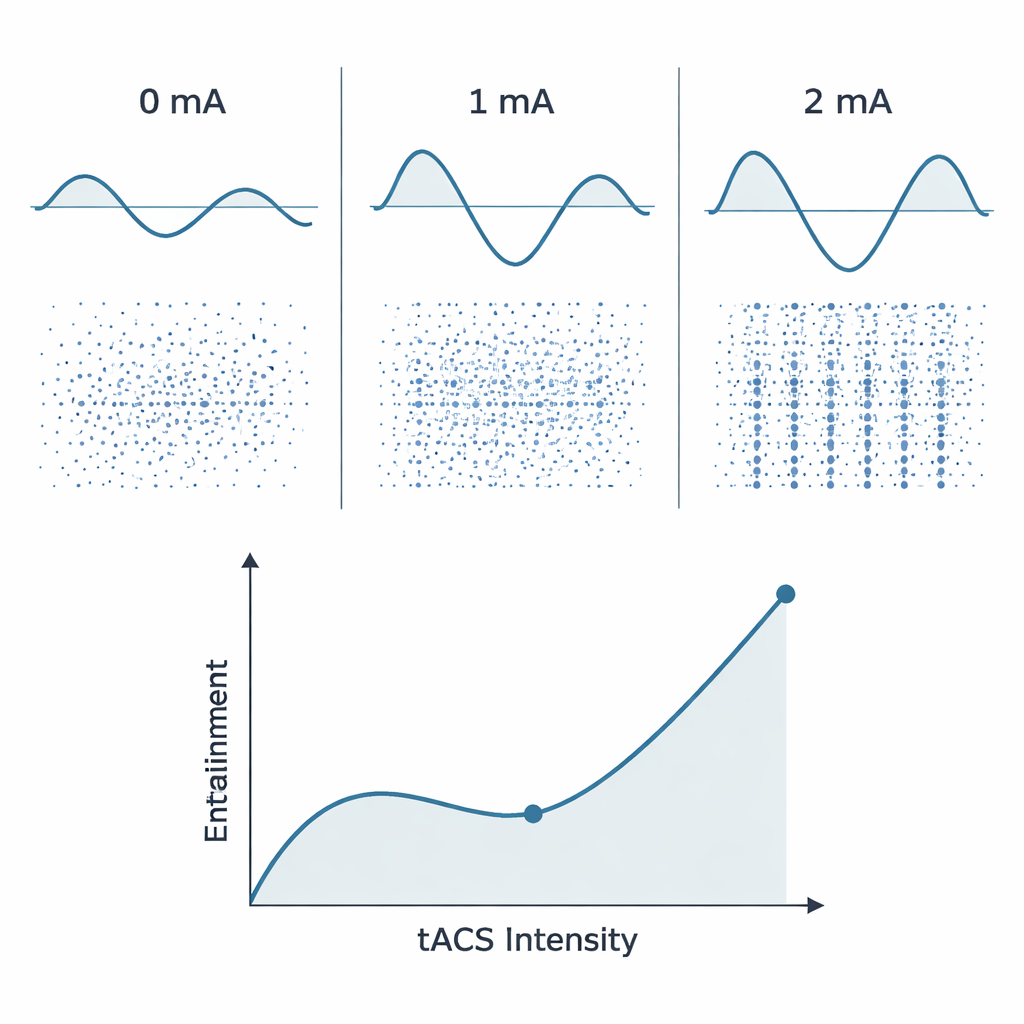
Why cell shape and connections change the outcome
Not all neurons responded equally. Pyramidal cells, with their long, vertically oriented dendritic trees, proved much more sensitive to the electric field than the more compact interneurons. Their spike timing lined up cleanly with the stimulation as intensity increased, while interneurons remained more erratic and weakly locked. When the researchers “cut” the synaptic connections in the model, pyramidal cells still entrained fairly well, but interneurons almost lost their phase locking altogether. Reintroducing connections restored some entrainment in these inhibitory cells, showing that tACS reaches them largely indirectly—through the way it reshapes the activity of pyramidal cells feeding into them. The balance of excitation and inhibition in the microcircuit, and the exact firing patterns already present, turned out to be as important as the stimulation itself.
What this means for future brain stimulation
For non-specialists and clinicians alike, the punchline is that tACS effects are subtle and highly dependent on both cell shape and network context. The same current that gently synchronizes one type of neuron may barely touch another, and a weak stimulus can either momentarily desynchronize or, at higher levels, strongly lock in the rhythm. Because pyramidal neurons are especially responsive, their branching architecture may be a key design target when planning electrode placements and choosing stimulation intensity and frequency. This work, though limited to a small model and short timescales, suggests that optimizing tACS in patients will require tuning stimulation to the brain’s existing rhythms and microcircuit structure, aiming either to soften harmful synchrony or to bolster the timing patterns that underlie healthy cognition.
Citation: Park, K., Chung, H., Seo, H. et al. Intensity-dependent tACS entrainment effects in a cortical microcircuit: a computational study. Sci Rep 16, 6825 (2026). https://doi.org/10.1038/s41598-026-37594-9
Keywords: transcranial alternating current stimulation, neural entrainment, cortical microcircuit, pyramidal neurons, brain oscillations