Clear Sky Science · en
Dual-loop proportional control for high-precision induction brazing of thin-walled aluminum waveguides
Keeping Satellite Lifelines Safe
Modern communications satellites rely on hollow metal pipes called waveguides to carry radio signals between antennas and electronics. These parts must survive years of launch vibrations, deep cold, and scorching sunlight without leaking energy or cracking. This paper explores a smarter way to “weld” together lightweight aluminum waveguides using induction brazing, so that each joint is strong, uniform, and made with minimal human guesswork.
From Torch Flames to Intelligent Heating
Traditional brazing often uses flames or furnaces that heat large areas and can distort delicate parts. Induction brazing instead uses a closely fitted copper coil to create a concentrated electromagnetic field that heats only the joint region. The authors focus on thin-walled aluminum waveguides used in space hardware, where even small temperature errors can cause warping or incomplete filling of the brazing alloy. Because direct-contact thermometers would disturb the surface and fail in the strong electromagnetic field, the system relies on non-contact infrared sensors and mathematical models to track temperature during the process.
A Smart Feedback Loop for Heating
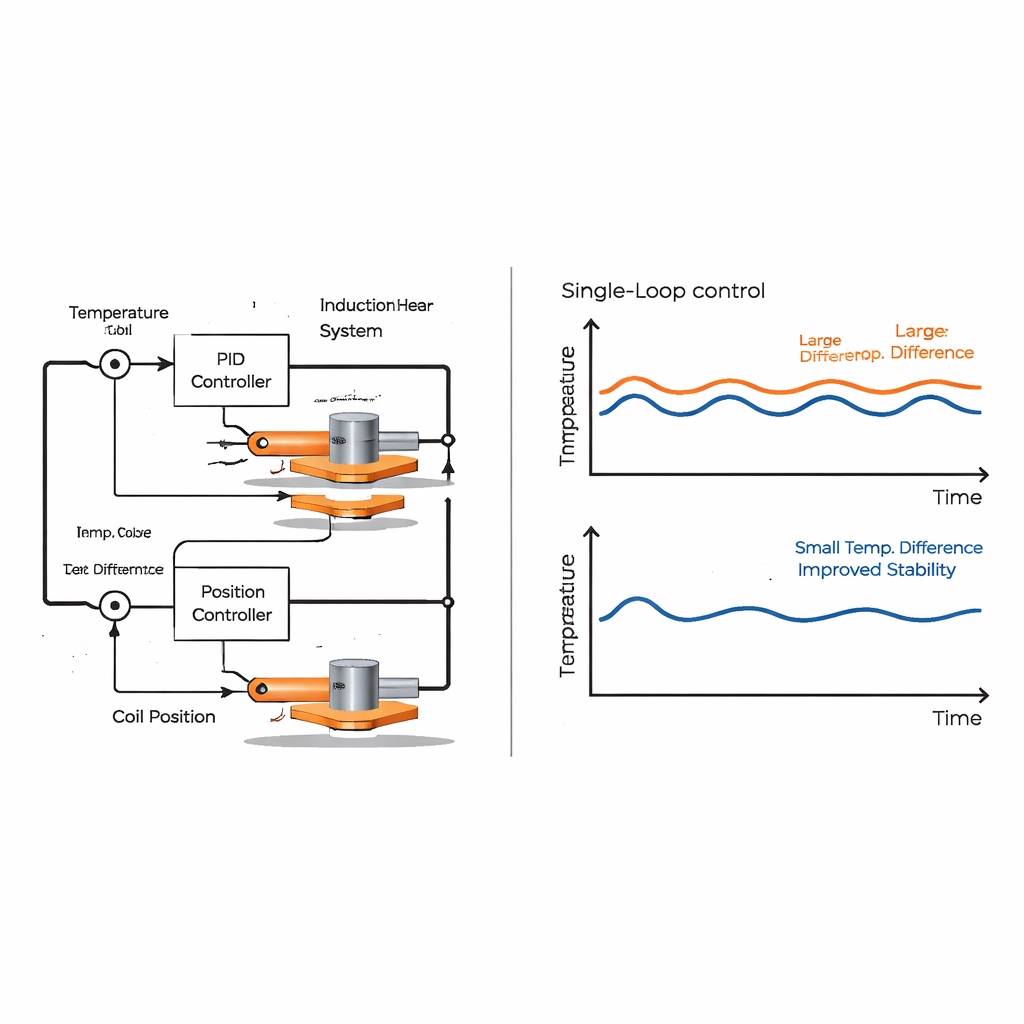
The first control strategy the team developed was a single feedback loop that looks not at temperature itself, but at how quickly the joint is warming up. A non-contact sensor measures temperature at the joint, and a simple controller adjusts the power sent to the induction coil so that the heating rate follows a programmed ramp, then holds steady at the alloy’s melting temperature. In lab tests across several waveguide shapes, this single-loop system could keep the average temperature error to about 3–4 degrees Celsius and limit overshoot, provided that a technician carefully tuned the distance between the coil and the parts beforehand. When that setup was done well, almost all joints passed metallographic inspection.
Adding a Second Loop for Balance
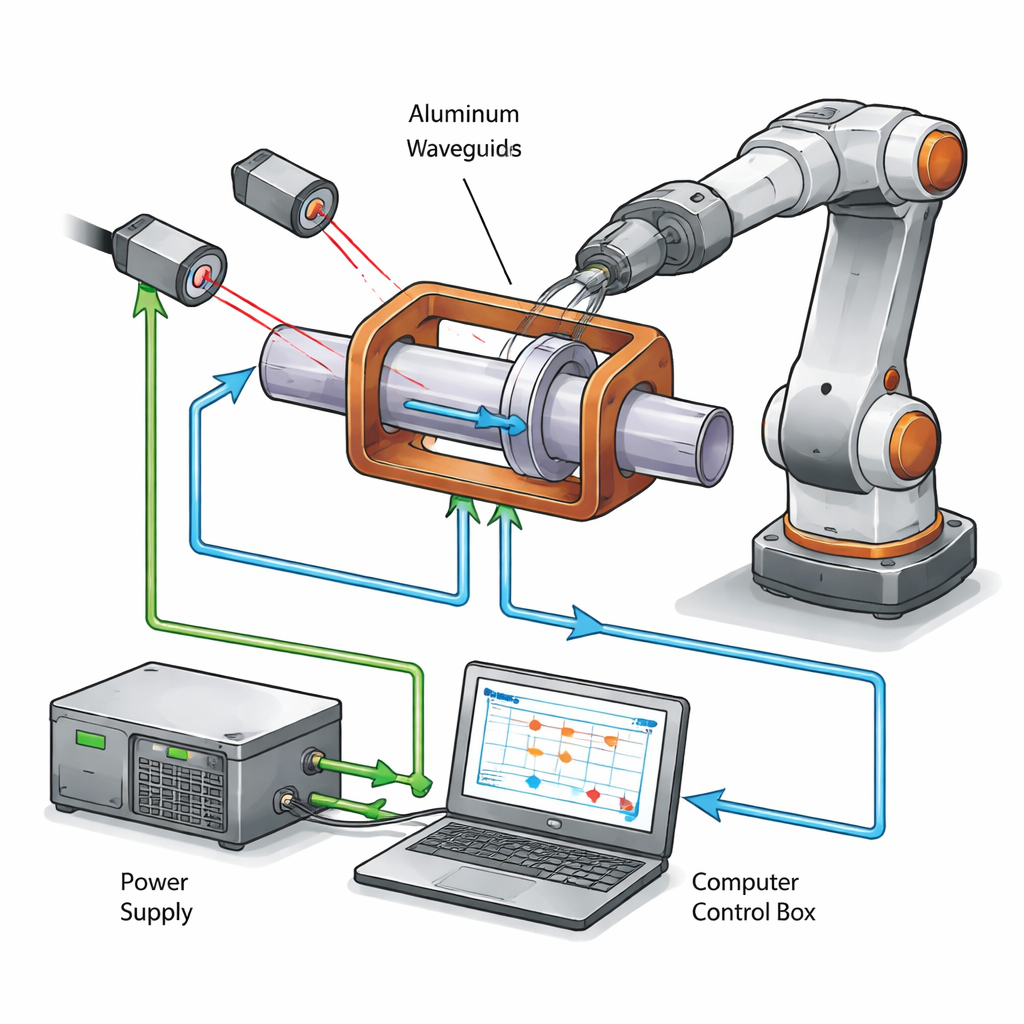
However, the researchers found that even with careful tuning, the tube and flange being joined could still differ in temperature by more than 15 degrees if the gap to the coil changed or part thickness varied from batch to batch. To solve this, they introduced a second feedback loop. Now, one infrared sensor watches the flange while another watches the tube. The first loop still controls power based on the heating profile, but the second loop slowly moves the workpiece relative to the coil whenever it detects that one side is hotter than the other. By nudging the joint closer or farther from the coil, the system actively balances temperatures across the brazing zone during preheating, ramp-up, and the final soaking stage.
From Lab Prototype to Production Line
To bring this dual-loop idea into practice, the authors built a full automated brazing cell. It includes a high-frequency power generator, water-cooled coils, a six-axis manipulator, a laser rangefinder to measure distance, dual infrared sensors, and industrial cameras for monitoring alignment. All of these devices are coordinated by modular C++ software running on an industrial PC. The program collects temperature, position, power, and video data 20 times per second, logs everything to an SQL database, and uses quality metrics such as ramp-rate deviation and temperature spread to judge each brazing cycle in real time. In extensive testing on 120 assemblies of several sizes, the dual-loop system cut the average temperature error to just over 2 degrees, halved the maximum temperature difference between tube and flange to about 8 degrees, and raised the yield of acceptable joints to 97 percent—even when operators were less precise in their initial setup.
What This Means for Future Space Hardware
For non-specialists, the key message is that the authors have turned a once artisanal, operator-dependent heating process into a more predictable, self-correcting one. By measuring not only how hot the joint is but also how evenly that heat is shared, the dual-loop controller can automatically adjust both power and position to achieve cleaner, more reliable brazed joints with fewer defects. This approach reduces rework and waste, and it points toward even smarter systems that might someday use predictive algorithms or learning methods to fine-tune heating for new materials and shapes. In practical terms, such advances help ensure that the “plumbing” carrying signals inside satellites remains robust over long missions, supporting more dependable communications back on Earth.
Citation: Tynchenko, V., Martysyuk, D., Kurashkin, S. et al. Dual-loop proportional control for high-precision induction brazing of thin-walled aluminum waveguides. Sci Rep 16, 7440 (2026). https://doi.org/10.1038/s41598-026-37593-w
Keywords: induction brazing, aluminum waveguides, feedback control, robotic manufacturing, satellite hardware