Clear Sky Science · en
Directing coral larval settlement in coral aquaculture for reef restoration
Why steering baby corals matters
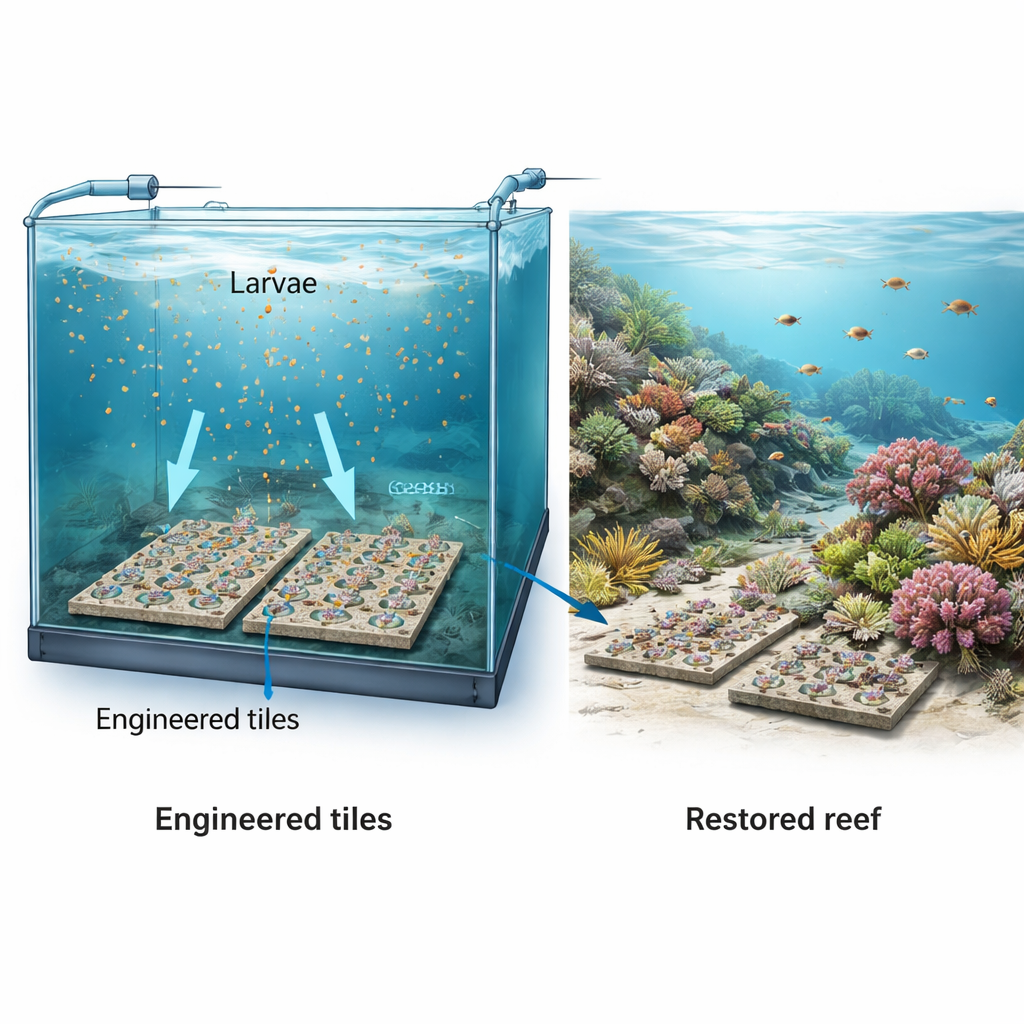
Coral reefs are in trouble worldwide, yet each adult coral can produce tens of thousands of microscopic larvae that could help rebuild damaged reefs. The catch is that these “baby corals” are very picky about where they settle down and grow. Today’s restoration efforts often rely on letting larvae choose their own spots on large, biologically aged tiles—an approach that is slow, space‑hungry, and hard to scale. This study explores a new idea: using carefully designed chemicals and tiny 3D‑printed structures to tell coral larvae exactly where to land, making coral farming more efficient and potentially cheaper.
From wild reefs to coral farms
Reef restoration programs increasingly use coral aquaculture, or coral farming, to grow young corals for outplanting onto degraded reefs. Most current operations still depend on breaking up existing colonies into fragments, which is labor‑intensive and limited by how many healthy donor corals are available. A more sustainable path is to use sexually produced larvae, which can be generated in huge numbers and preserve genetic diversity. However, getting these free‑swimming larvae to reliably “settle” on man‑made surfaces at the right place and time remains a key bottleneck. Traditionally, settlement surfaces such as concrete or ceramic tiles are left in tanks for weeks or months until they become coated with natural films of helpful algae and microbes. This “conditioning” step takes up a lot of aquarium space, demands constant maintenance, and often produces patchy, uneven settlement.
Testing chemical signals that say “settle here”
In nature, coral larvae use chemical cues from crustose coralline algae—hard, pinkish algae that grow on rocks—and microbial biofilms to decide where to attach. The researchers first tested how larvae from 14 coral species responded to a range of potential chemical inducers in small lab dishes. These included extracts and powders made from crustose coralline algae, several short protein‑like molecules called neuropeptides, and common nerve‑signaling compounds such as dopamine and epinephrine. One neuropeptide, known as Hym‑248, stood out. It triggered strong settlement in seven species of branching Acropora corals, with success rates similar to or just below those seen with live coralline algae. Other tested neuropeptides and neurotransmitters worked poorly or only in isolated cases. This showed that Hym‑248, in particular, can act as a reliable “settle now” signal for many important reef‑building corals.
Using tiny 3D‑printed parts to focus settlement
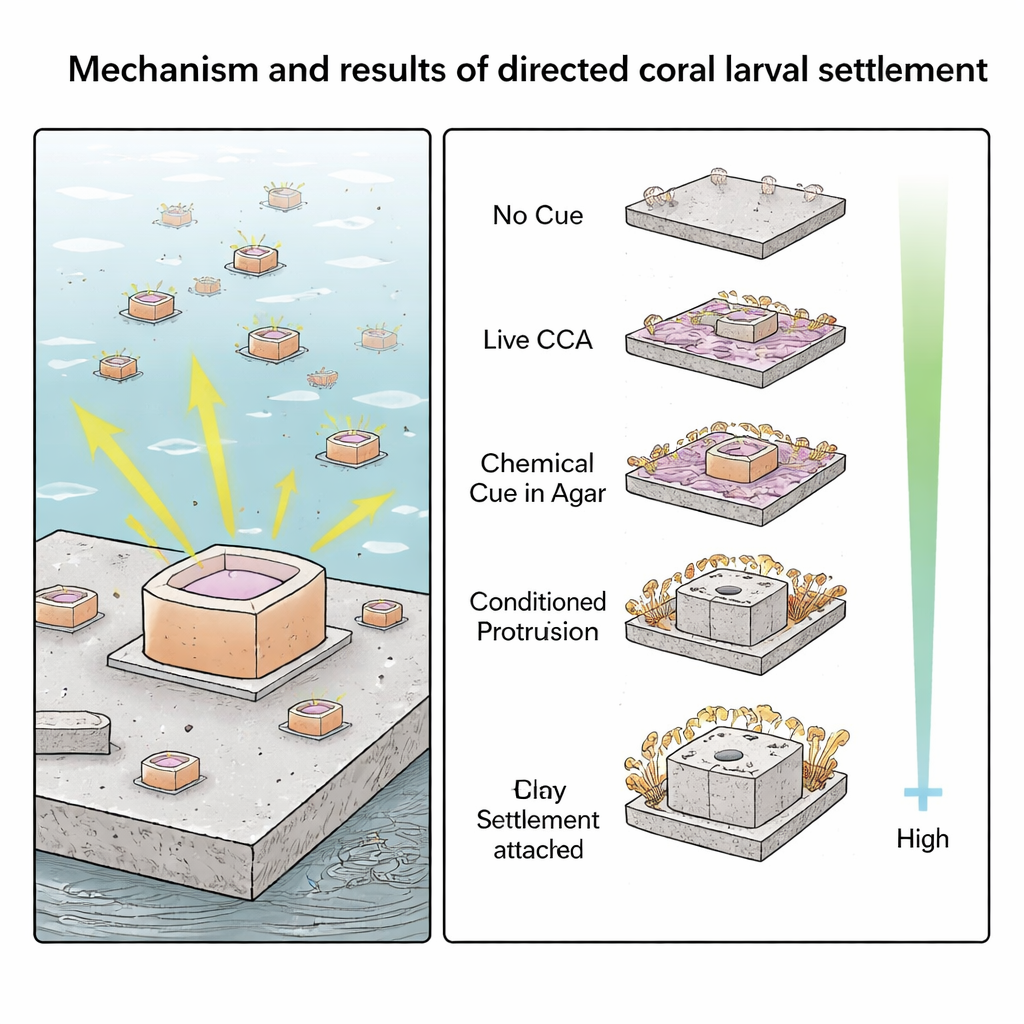
Next, the team moved beyond small dishes to more realistic flow‑through tanks and full‑size concrete tiles similar to those used in restoration. They 3D‑printed millimeter‑scale alumina ceramic cubes with internal channels and a central well, and filled these wells with gels containing either coralline algae extract, Hym‑248, or crushed algae. When these “perforated cubes” were glued onto otherwise bare concrete tiles, coral larvae strongly preferred to settle in and around cubes loaded with active chemicals, especially at higher concentrations. Settlement clustered right next to the cubes while remaining very low on the rest of the tile. Tiles with small biologically conditioned ceramic pieces—rather than fully conditioned tiles—achieved settlement rates comparable to those with live algae. In contrast, cubes that held only plain gel attracted almost no settlers, showing that both chemistry and location could be controlled.
Tiny ridges and pores as landing pads
To test how the physical shape of surfaces influences where larvae land, the researchers also created slender rectangular ceramic protrusions, some smooth and some drilled with rows of tiny pores about the size of a larva. These were glued to the center of each small “tab” on a larger concrete tile, mimicking the units used in reef‑seeding devices. When these protrusions were first allowed to grow a thin cover of natural crustose coralline algae in a separate tank, they induced about half of all larvae to settle, matching or exceeding traditionally conditioned tiles. Almost all settlers chose to attach directly on or right beside the conditioned protrusions, and many nestled inside the pores, which offered hidden, refuge‑like spaces. Unconditioned protrusions with no biological film attracted very few settlers, but the few that did settle often chose the pores—suggesting that small‑scale texture can fine‑tune where larvae attach once suitable chemistry is present.
What this means for rebuilding reefs
By combining powerful chemical “go” signals with tiny, engineered landing pads, this work shows that coral larvae can be guided to specific spots on otherwise bare construction materials. Instead of having to coat every square centimeter of every tile with living algae, restoration projects could focus their efforts on small 3D‑printed features or gel‑filled wells that occupy a fraction of the space. The study estimates that conditioning these compact parts, rather than entire tiles, can shrink the required aquarium footprint by roughly nine‑fold. For a layperson, the bottom line is simple: we can now better tell baby corals where to build their homes, using carefully placed cues instead of waiting for nature to act on its own. That extra precision could help coral farms produce more healthy young corals with less cost and effort—an important step toward restoring reefs at the scales needed in a warming, changing ocean.
Citation: Briggs, N.D., Negri, A.P., Antunes, E. et al. Directing coral larval settlement in coral aquaculture for reef restoration. Sci Rep 16, 7358 (2026). https://doi.org/10.1038/s41598-026-37592-x
Keywords: coral restoration, coral larvae, reef aquaculture, settlement cues, 3D printed substrates