Clear Sky Science · en
Two year outcomes of as needed brolucizumab therapy in exudative age related macular degeneration with or without pachychoroid phenotype
Why this matters for aging eyes
As people live longer, more of us develop age-related macular degeneration (AMD), a disease that slowly robs central vision and makes reading, driving, and recognizing faces difficult. Many patients now rely on frequent eye injections to keep their sight, which can be stressful, time‑consuming, and costly. This study asks a practical question with real-world impact: for a certain subgroup of AMD patients, can a newer drug called brolucizumab preserve vision with fewer injections over two years?
A closer look at two kinds of AMD
AMD is not a single disease; it has several forms. In the “wet” or exudative type, fragile new blood vessels grow under the retina and leak fluid or blood, causing rapid vision loss. Some patients also have a “pachychoroid” pattern, where the layer of blood vessels beneath the retina is unusually thick and leaky. Doctors have suspected that this pachychoroid form might respond differently to treatment, but until now, no one had clearly compared long‑term outcomes using a modern anti‑VEGF drug like brolucizumab in patients with and without this feature.
How the study was carried out
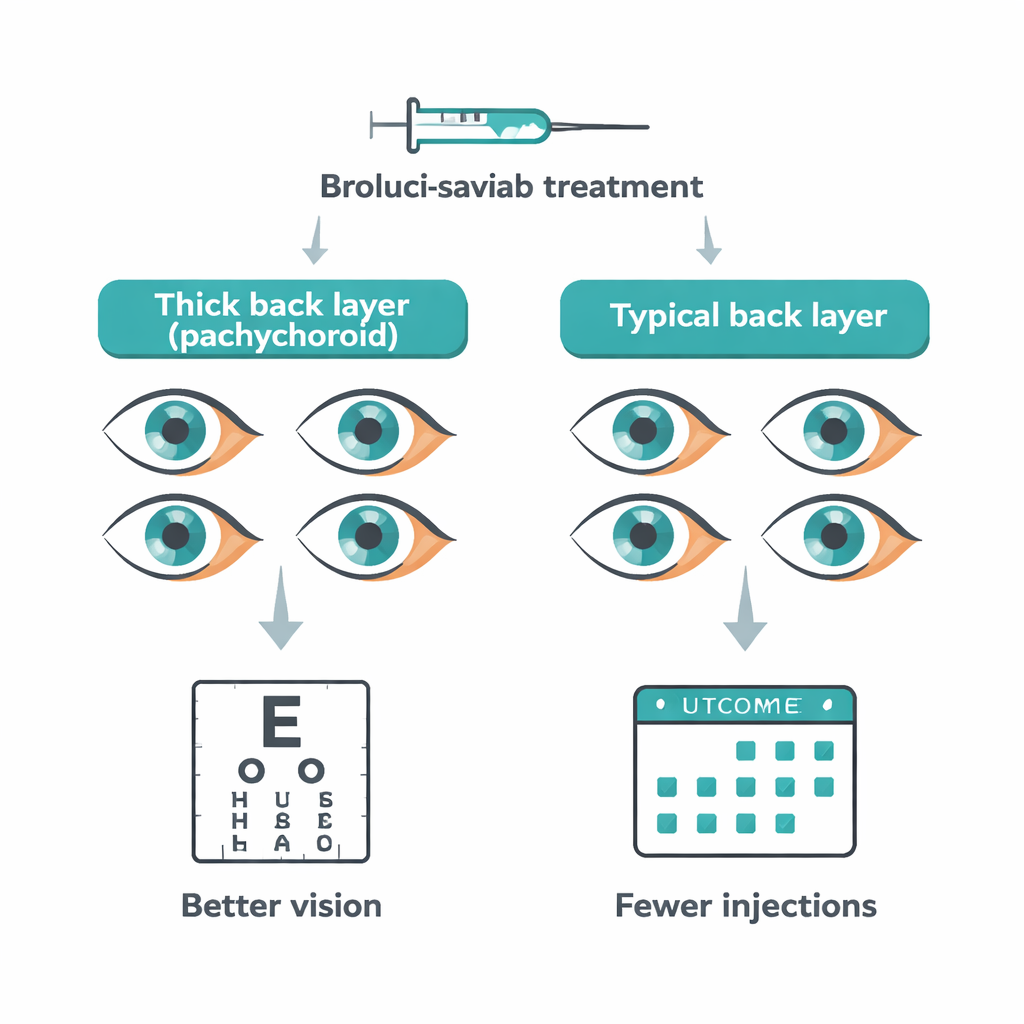
Researchers in Japan followed 66 people (66 eyes) with newly diagnosed wet AMD for two full years at a single university clinic. Everyone received the same basic treatment plan: three monthly injections of brolucizumab to get the disease under control, followed by “as‑needed” injections whenever scans or eye exams showed new fluid or bleeding. Fourteen eyes had the pachychoroid pattern, and 52 did not. At every visit, doctors measured sharpness of vision (best‑corrected visual acuity), and used advanced imaging to check the thickness of the retina and the deeper choroidal layer, as well as to look for signs of recurring leakage.
Vision gains and how often injections were needed
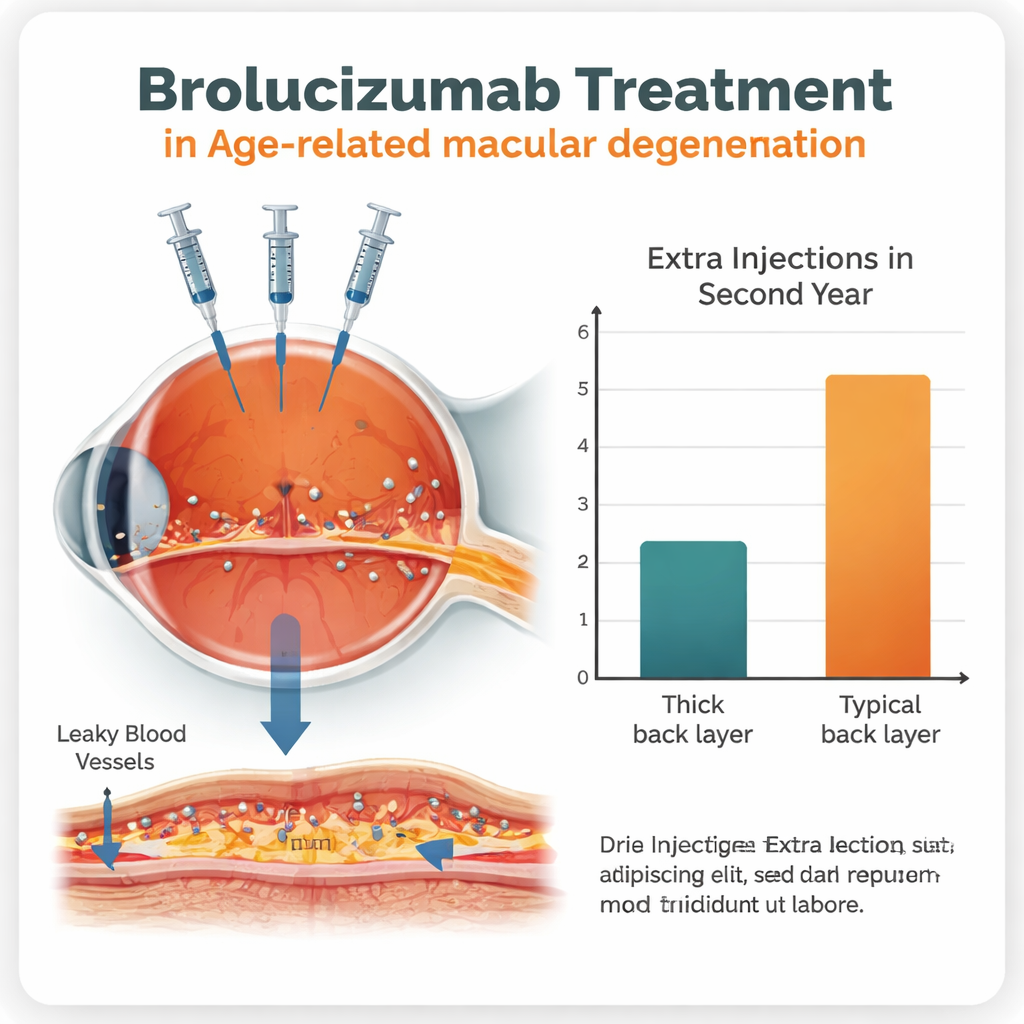
Both groups saw meaningful improvement in vision that was maintained over the full two‑year period. On average, patients started with moderate vision loss and improved to roughly the driving‑license range or better after treatment. Just as important for patients, the team counted how many extra injections were needed beyond the initial three. In the first year, eyes with and without pachychoroid needed a similar number of additional injections. In the second year, however, a clear difference emerged: the pachychoroid group needed roughly half as many extra injections as the non‑pachychoroid group. By the end of two years, half of the pachychoroid eyes had required no retreatment at all after the initial series, compared with less than one in five in the other group.
What might explain the difference
The authors suggest that the way pachychoroid‑type disease develops could make it particularly responsive to strong VEGF‑blocking drugs. In pachychoroid eyes, enlarged deeper vessels and local changes seem to drive the abnormal growth of new vessels. Laboratory work has shown that VEGF levels in this form can be lower than in more classic, drusen‑driven AMD. Because brolucizumab delivers a relatively high drug dose in a small molecule that penetrates tissue well, it may be especially effective at calming this specific pattern of leakage and thickening, allowing longer stretches without recurrence.
What this means for patients and doctors
For people living with wet AMD, fewer injections without sacrificing vision is a major win. This study suggests that patients who show the pachychoroid pattern on imaging may be good candidates for an “as needed” approach with brolucizumab, potentially reducing the burden, risks, and costs of frequent injections. However, the work was retrospective and involved a modest number of patients, so larger, carefully controlled trials are still needed. Taken together, the results point toward a future in which treatment for AMD can be tailored more precisely to the eye’s underlying structure, helping more patients keep clear vision with the least intrusive care.
Citation: Fukuda, Y., Sakurada, Y., Kotoda, Y. et al. Two year outcomes of as needed brolucizumab therapy in exudative age related macular degeneration with or without pachychoroid phenotype. Sci Rep 16, 6183 (2026). https://doi.org/10.1038/s41598-026-37591-y
Keywords: age-related macular degeneration, brolucizumab, pachychoroid, anti-VEGF injections, retinal disease