Clear Sky Science · en
Mitoxantrone alters CD24/Siglec-10 expression in malignant brain tumor models
Why turning off a tumor’s “don’t-eat-me” signal matters
Brain tumors in both children and adults are among the hardest cancers to treat, often resisting surgery, radiation, and chemotherapy. This study explores a subtle but powerful way these tumors hide from the immune system: a surface signal called CD24 on tumor cells that tells nearby immune cells, through a receptor called Siglec-10, not to attack. The researchers asked whether an older chemotherapy drug, mitoxantrone, could disrupt this protective signal and nudge the immune system to recognize and fight malignant brain tumors more effectively.
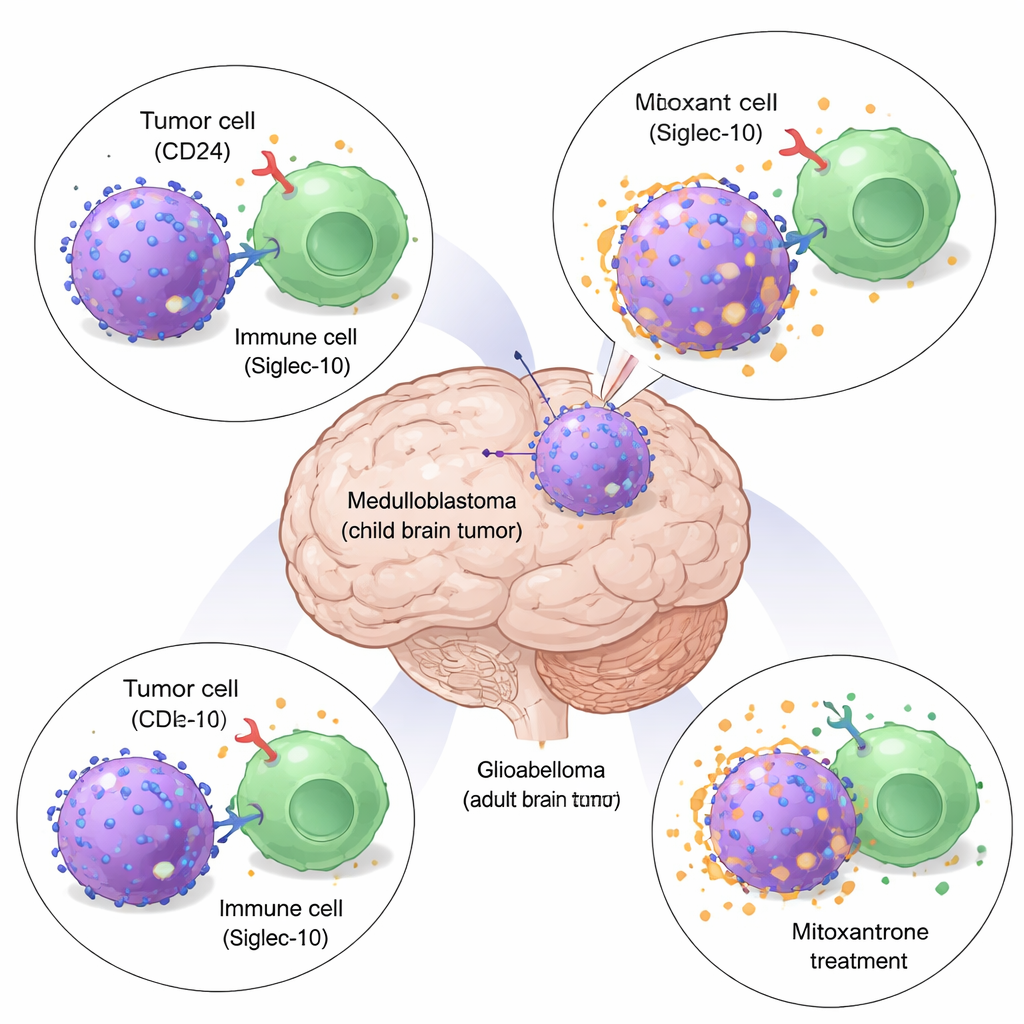
Hidden warning signs on brain tumor cells
Medulloblastoma, a common malignant brain tumor in children, and glioblastoma, the most aggressive adult brain tumor, are both notoriously difficult to cure. By analyzing large public gene databases, the authors found that many of these tumors, especially certain subgroups, show high activity of the CD24 gene. High CD24 levels tended to travel together with sets of genes previously linked to poor outcomes and rapid cell division, particularly in sonic hedgehog (SHH) and Group 4 medulloblastomas and in specific glioblastoma subtypes. Single-cell analyses showed that CD24 is mainly found on tumor cells themselves, with some expression on immune cells, suggesting that it could serve both as a disease marker and as a potential treatment target.
Immune cells caught in a peace treaty
The “don’t-eat-me” message requires a partner on the immune side: Siglec-10, carried by certain brain-resident immune cells called microglia and by tumor-associated macrophages. The team examined how the SIGLEC-10 gene tracked with known markers of these immune cells. In both medulloblastoma and glioblastoma, SIGLEC-10 was strongly tied to microglia markers and to genes associated with a more suppressive, tumor-supporting state. Microscopic images of human tumor samples confirmed this: tumor cells rich in CD24 sat in close contact with Siglec-10–positive immune cells that also carried other microglia markers such as TREM2. These patterns indicate that, inside the tumor, CD24 on cancer cells engages Siglec-10 on nearby immune cells to dampen inflammation and prevent the immune system from clearing the tumor.
Testing an old drug in new ways
To see whether this axis could be shifted, the researchers turned to mitoxantrone, a chemotherapy drug known to kill cells in a way that can alert the immune system. They worked with mouse glioma models, focusing on SB28 tumors that have very high CD24 levels, similar to aggressive human tumors. When mitoxantrone was delivered directly into these brain tumors using tiny implanted pumps, the treated mice lived slightly longer and their tumors were significantly smaller compared with untreated or saline-pump controls. At the same time, the number of Siglec-10– and TREM2–positive immune cells in the tumor dropped, while cancer-killing CD8 T cells became more abundant, suggesting a shift from an immune-silent environment to one more capable of attack.
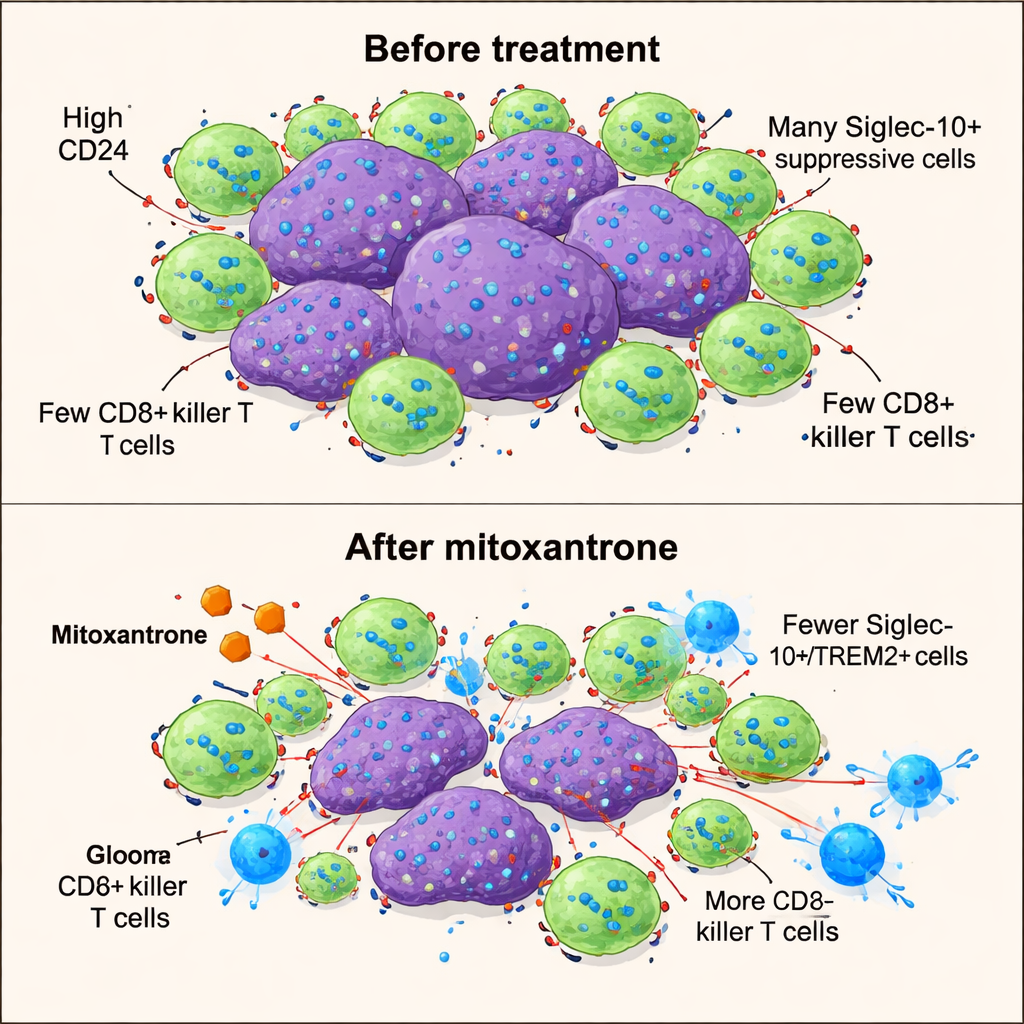
Rewiring the tumor’s surface signals
The team then examined how mitoxantrone affected tumor cells grown in the lab, using both mouse glioma cells and human medulloblastoma and glioblastoma cells. Increasing doses of the drug caused dose-dependent cell death, with human glioblastoma cells particularly sensitive. Importantly, even at doses that did not kill all cells, mitoxantrone consistently reduced CD24 levels on the cell surface. Imaging and flow cytometry showed fewer CD24-positive cells and a change in how CD24 was arranged inside the cells, with a loss of the characteristic vesicle-like pattern on the outer surface. These findings suggest that mitoxantrone not only kills tumor cells but also strips away some of their protective “don’t-eat-me” coating, potentially making surviving cells more visible to immune attack.
What this could mean for future brain tumor care
Altogether, the study demonstrates that CD24 and Siglec-10 form an important immune escape route in malignant brain tumors, and that mitoxantrone can both damage tumor cells and weaken this shield. The benefits seen in mice were modest but clear: smaller tumors, fewer suppressive immune cells, and more tumor-killing T cells. Because CD24 and Siglec-10 are also active in normal tissues, the authors suggest that carefully targeted or local delivery, and combinations with other immunotherapies, will likely be needed. Still, the work points toward a new strategy: rather than just trying to poison brain tumors, future treatments may also focus on switching off their “don’t-eat-me” signal so that the body’s own defenses can help finish the job.
Citation: Kopecky, J., Pérez, J.E., Jonathan, S. et al. Mitoxantrone alters CD24/Siglec-10 expression in malignant brain tumor models. Sci Rep 16, 3696 (2026). https://doi.org/10.1038/s41598-026-37588-7
Keywords: brain tumors, immunotherapy, CD24, Siglec-10, mitoxantrone