Clear Sky Science · en
QSPR analysis of the drugs used to treat renal failure and its complications using degree and modified reverse degree indices
Why kidney drug structure matters
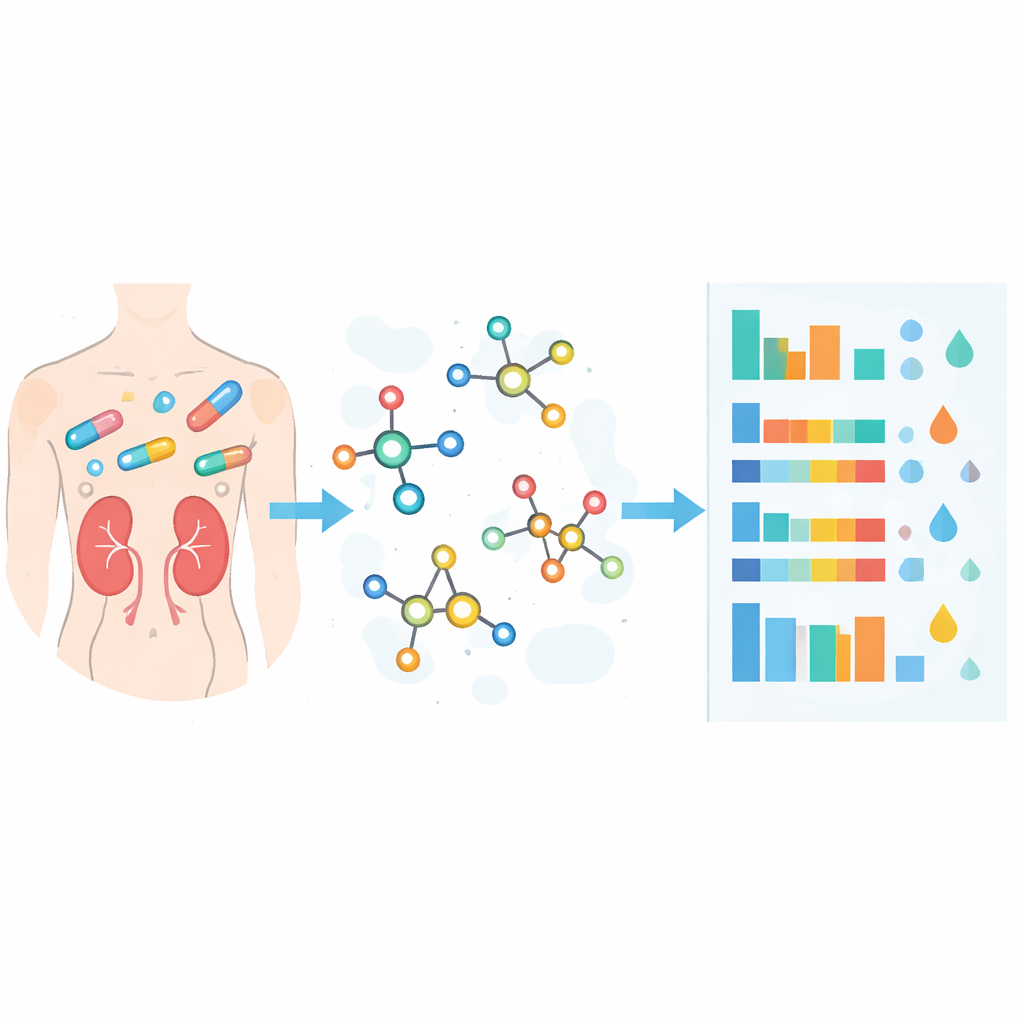
Kidney failure is a growing global health problem, and many people with damaged kidneys rely on complex drug combinations to control blood pressure, hormones, minerals, and fluid balance. But designing and improving such drugs is slow and expensive if every promising molecule must be made and tested in the lab. This study shows how the shapes and connections within drug molecules for chronic kidney disease can be turned into numbers that reliably forecast key physical properties, helping researchers screen and fine-tune medicines on a computer before they ever reach a test tube.
From drawing a molecule to predicting its behavior
Chemists often sketch molecules as networks of atoms joined by bonds. In this work, those sketches are treated like mathematical graphs: atoms become points, and bonds become lines. The authors focus on nineteen real drugs used to manage chronic kidney disease and its complications, including medicines that lower blood sugar, cholesterol, blood pressure, or parathyroid hormone, and drugs that treat anemia or high blood phosphate. For each drug, they translate the chemical drawing into a graph and then compute several numerical descriptors that capture how connected and branched the molecule is. These descriptors, known as topological indices, serve as structural fingerprints that can be compared across many compounds.
Simple counting rules with powerful reach
A key idea in the study is the “degree” of an atom, which is simply how many bonds touch it. Building on this, the researchers define families of degree-based indices that summarize patterns such as how often atoms of certain connectivity are joined to one another. They also introduce “modified reverse degree” indices, which re-map these connectivities using a simple rule controlled by a small parameter. By adjusting this parameter, they generate several related fingerprints from the same molecular graph, emphasizing different aspects of the molecule’s layout. Using the edge-partition method and computer algebra software, they systematically compute these indices for all nineteen kidney drugs.
Linking structure to real-world properties
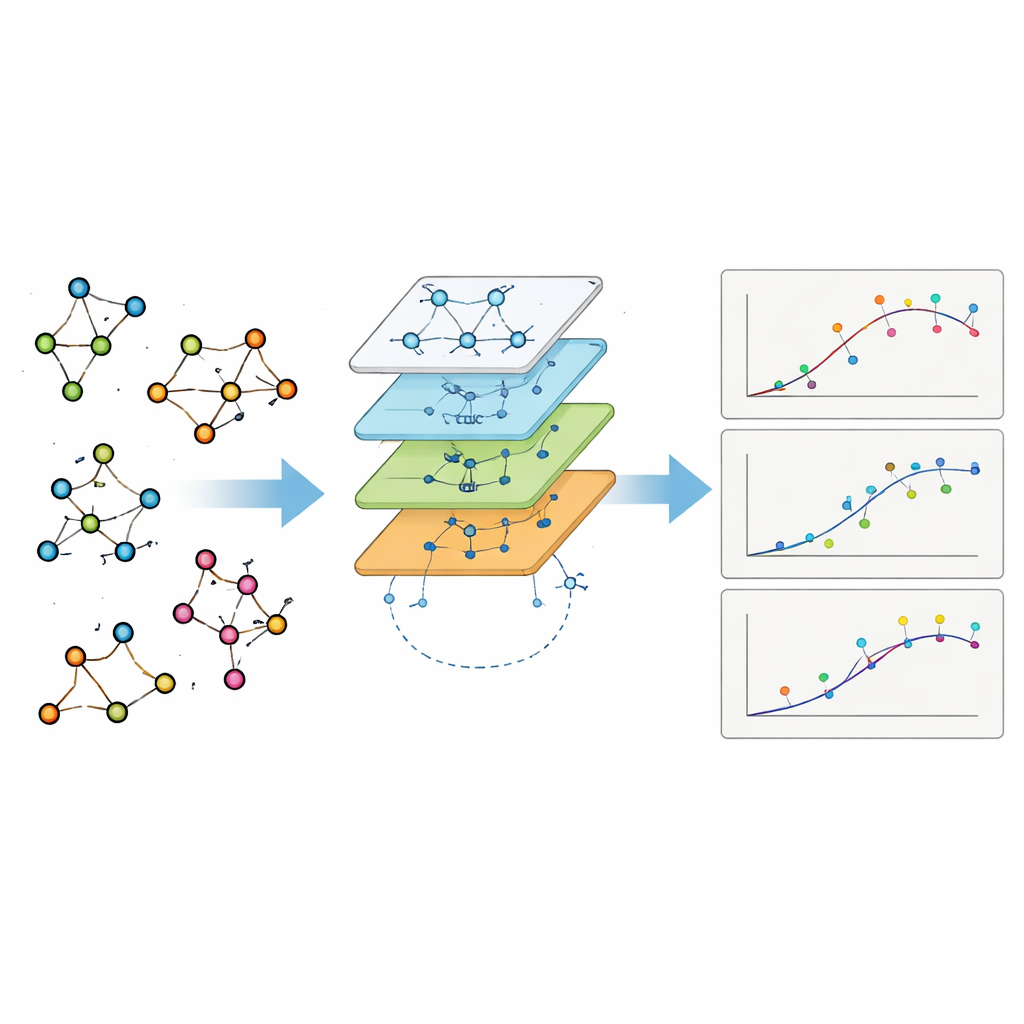
To test whether these fingerprints are truly useful, the authors compare them with measured physico-chemical properties drawn from public databases. These include molecular weight, surface area that can interact with water, number of heavy atoms, overall structural complexity, boiling point, how strongly the molecule bends light (molar refractivity), how easily its electrons distort (polarisability), and the space it occupies (molar volume. They then fit three kinds of statistical models—straight-line, curved cubic, and logarithmic relationships—between each index and each property. The strength of the match is measured by correlation coefficients, indicating how well the index-based formula can reproduce the experimental data.
Finding the best numerical fingerprints
The analysis shows that some indices clearly outperform others. A traditional degree-based index called redefined Zagreb-1 predicts the number of heavy atoms almost perfectly with a simple linear equation. For most other properties, however, curved cubic relationships work better than straight lines or logarithmic forms. In these cases, modified reverse degree indices shine. With a particular setting of the modification parameter (l = 2), the atom–bond connectivity index closely tracks molecular weight, and the harmonic–geometric index captures how much of a molecule’s surface can interact with water. Likewise, other modified reverse degree indices at different parameter values best describe complexity, boiling point, and molar volume, while a degree-based arithmetic–geometric index successfully links structure to molar refractivity and polarisability.
What this means for future kidney treatments
For a non-specialist, the takeaway is that the authors have built a set of mathematical shortcuts: by looking only at how atoms are hooked together in a proposed kidney drug, they can accurately estimate many important physical features without laboratory measurements. Among the tools tested, the modified reverse degree indices—especially at one preferred parameter value—proved most versatile, providing the best predictions for most properties. Such models do not directly treat kidney disease, but they can greatly speed the early stages of drug discovery and optimization, focusing experimental efforts on the most promising candidates and ultimately helping new therapies for renal failure reach patients more efficiently.
Citation: Godlin, J.J.J., Radha, S. QSPR analysis of the drugs used to treat renal failure and its complications using degree and modified reverse degree indices. Sci Rep 16, 8889 (2026). https://doi.org/10.1038/s41598-026-37586-9
Keywords: chronic kidney disease drugs, molecular structure modeling, topological indices, QSPR prediction, drug design for renal failure