Clear Sky Science · en
Ultrasound effectively destabilizes and disrupts the structural integrity of enveloped respiratory viruses
Sound Waves as Virus Fighters
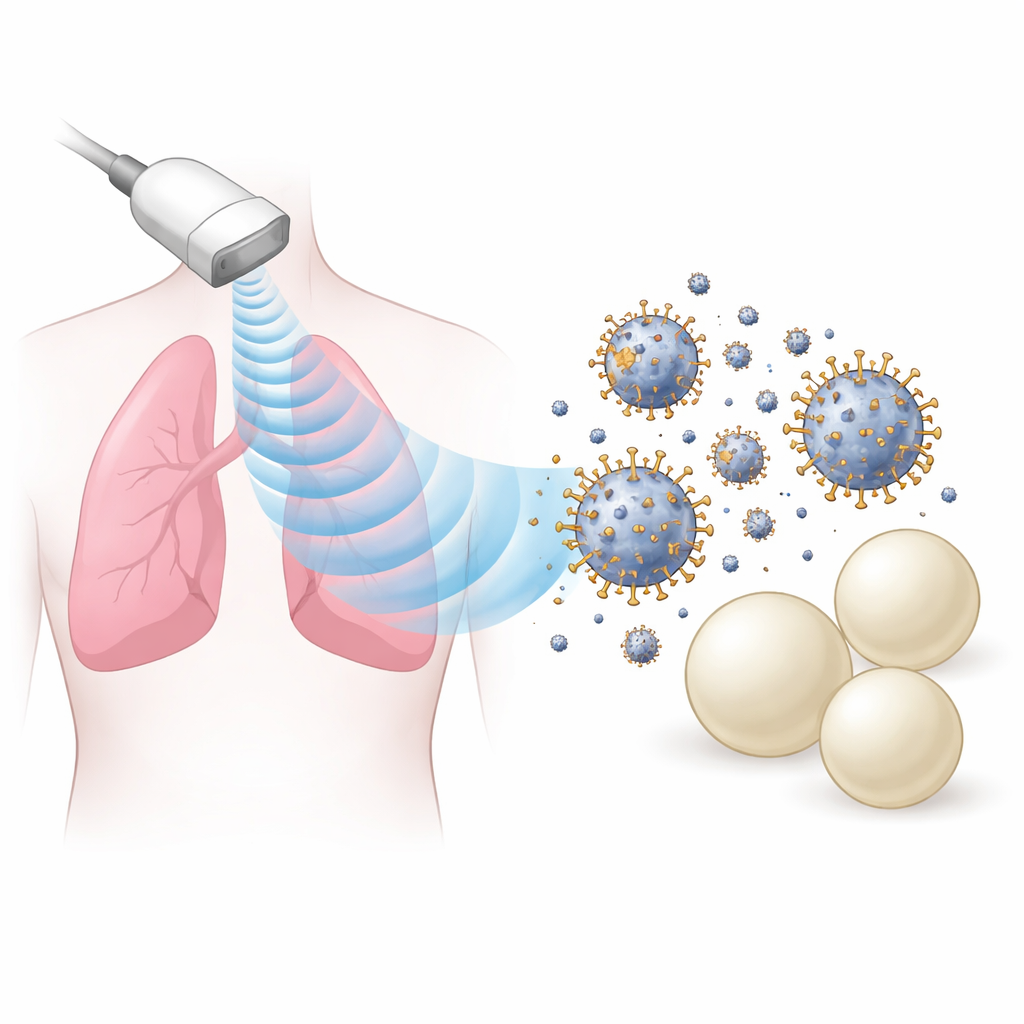
Most of us know ultrasound as the safe imaging tool used in pregnancy scans and heart exams. This study asks a bold question: could the very same kind of sound waves also be used to knock apart dangerous viruses, such as the one that causes COVID-19 or seasonal flu, without harming our own cells? The researchers show that at certain medical frequencies, ultrasound can physically shake these viruses until their outer shells fail, hinting at a surprising, non-drug way to fight future outbreaks.
How Tiny Invaders Meet Gentle Sound
Viruses like SARS-CoV-2 (the coronavirus behind COVID-19) and Influenza A (H1N1) are wrapped in a fragile, fatty coat called an envelope. Current tools to kill viruses often rely on chemicals, heat, or harsh radiation, which can also damage human tissue. The team behind this work turned instead to physics. They asked whether high-frequency ultrasound, already proven safe for medical imaging, could be tuned so that the viruses themselves absorb the sound energy and start to shake in a way that weakens their structure—much like a crystal glass that can crack if it vibrates at just the right note.
Seeing Viruses Physically Break Apart
To test this idea, the researchers exposed lab-grown samples of SARS-CoV-2 and H1N1 to ultrasound in the same general frequency range used by hospital scanners (3–20 megahertz), focusing on a sweet spot around 7.5 megahertz. They then measured how the sizes of viral particles changed in solution and imaged them at extremely high magnification. In untreated samples, both viruses appeared as fairly uniform spheres with a narrow range of sizes, matching what is known about intact viral particles.
From Smooth Spheres to Popcorn-Like Ruins
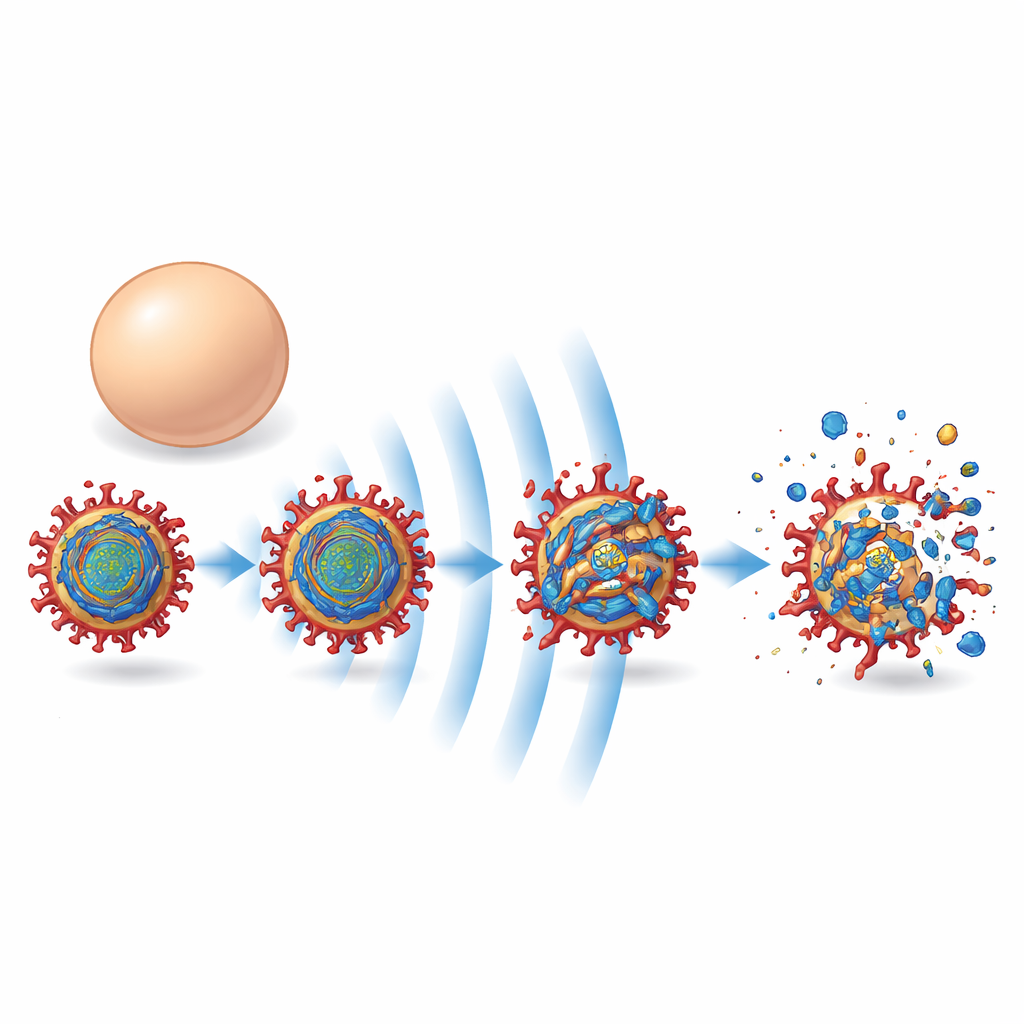
After ultrasound exposure under these conditions, the picture was dramatically different. For SARS-CoV-2, size measurements revealed that many large particles had vanished, replaced by a mixture of much smaller fragments, suggesting that the viral shells had broken into pieces. For H1N1, the signal of intact particles nearly disappeared, indicating even more severe breakdown. Electron and atomic force microscopy showed once-smooth viral spheres collapsing, denting, and cracking, their surfaces turning rough and irregular. Some particles took on a “popcorn-like” appearance, consistent with their envelopes rupturing and inner material spilling out.
Less Viral Infection Without Heat or Chemicals
Structural damage is meaningful only if it makes the virus less able to infect cells. To check this, the team treated coronavirus samples with ultrasound and then used them to infect cultured cells. Compared with untreated virus, ultrasound-exposed samples produced far fewer infected cells and much weaker signs of viral replication. This was true for the original Wuhan strain and, to a lesser degree, for Gamma and Delta variants. The effect depended strongly on frequency: modes near 7.5 megahertz were far more effective than lower ones. Crucially, careful monitoring showed that the liquid containing the viruses barely warmed and its acidity did not change, ruling out simple heating or chemical damage as explanations for the loss of infectivity.
A New Way Sound Acts on Viruses
To explain these results, the authors distinguish between two very different ways ultrasound can act on matter. At low frequencies, such as those used in industrial cleaning baths, ultrasound creates and collapses tiny bubbles, generating heat, pressure shocks, and reactive molecules that damage everything nearby—virus and healthy tissue alike. At the higher, medical frequencies used here, the team argues that a different process dominates: resonance. Because of their size, shape, and stiffness, viral particles can absorb sound energy and vibrate strongly, while neighboring cells do not. Over many rapid vibration cycles, stress builds up in the viral envelope until it fails, breaking the virus apart without boiling or burning the surroundings.
What This Could Mean for Future Treatments
In plain terms, this work suggests that we may be able to “tune” ultrasound devices so that they shake certain viruses to pieces while leaving human cells largely untouched. The study is still at the laboratory stage—no patients were treated, and many questions remain about how well this would work inside the body. But because ultrasound equipment is already common in clinics and considered safe, this resonance-based approach hints at a future in which doctors might add carefully chosen sound waves to their toolkit, either as a stand-alone antiviral method or as a way to weaken viruses so that drugs and the immune system can finish the job.
Citation: Veras, F.P., Nakamura, G., Pereira-da-Silva, M.A. et al. Ultrasound effectively destabilizes and disrupts the structural integrity of enveloped respiratory viruses. Sci Rep 16, 8612 (2026). https://doi.org/10.1038/s41598-026-37584-x
Keywords: ultrasound antiviral, SARS-CoV-2, influenza, viral envelope, resonance