Clear Sky Science · en
Influence of paper mill sludge ash on mechanical, microstructural and durability properties of metakaolin based geocrete
Turning Paper Waste into Stronger Concrete
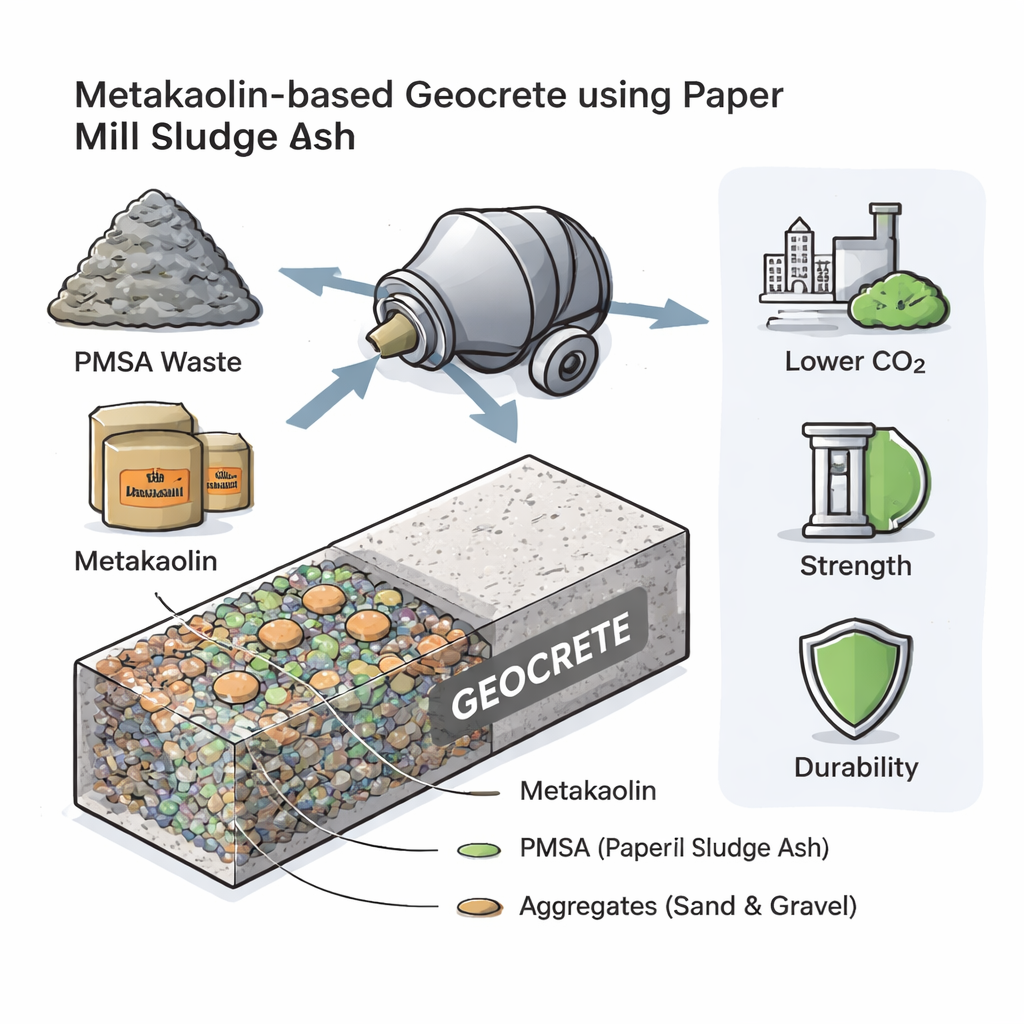
Modern cities are built on concrete, but traditional cement comes with a heavy environmental cost, releasing large amounts of carbon dioxide during production. At the same time, paper mills generate mountains of waste that often end up in landfills. This study explores a way to tackle both problems at once: using ash from paper mill sludge to help make a new kind of low‑carbon concrete, called "geocrete," that could someday replace ordinary cement in buildings and infrastructure.
A New Kind of Building Block
Instead of relying on cement, geocrete is made by activating minerals rich in silica and alumina with a strongly alkaline solution, forming a hardened stone-like material. In this work, the researchers used metakaolin, a refined clay, as the main ingredient and partly replaced it with paper mill sludge ash. The ash comes from burning paper industry sludge at high temperature and contains plenty of calcium, along with silica and alumina. Eight different mixtures were prepared, with the ash replacing between 5% and 20% of the metakaolin and with two different levels of alkaline liquid, to see how these changes affected strength and durability under normal room‑temperature curing.
How the Test Concrete Performed
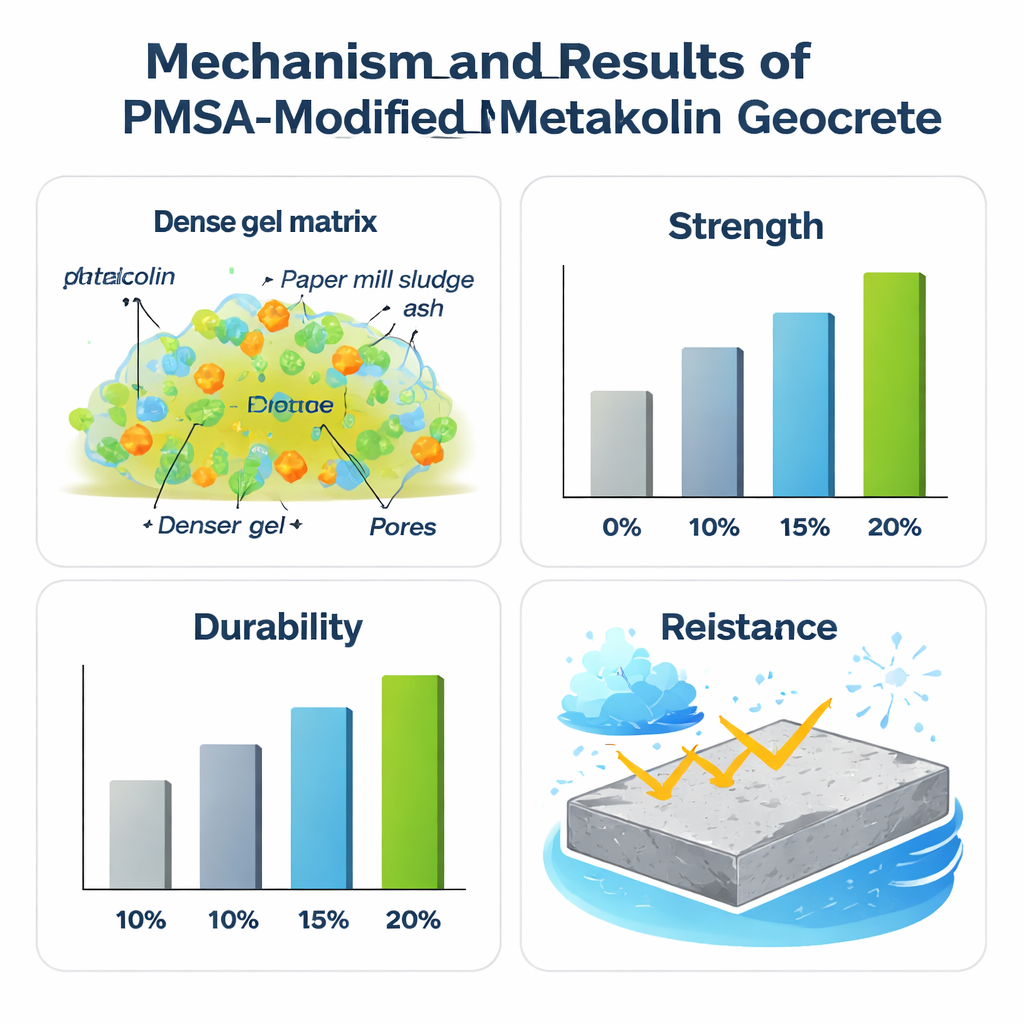
The team tested the concrete for three key types of mechanical strength: how much load it can carry when squeezed, pulled apart, or bent. They measured these properties after 7, 28, and 90 days of curing. Across the board, the mixtures containing 10% paper mill ash outperformed the others. For both levels of alkaline liquid, this 10% blend produced higher compressive, tensile, and flexural strengths than mixes with no ash or with larger ash contents. When the ash level was pushed to 15% or 20%, strength began to fall sharply, showing that there is a clear sweet spot rather than a simple “more is better” relationship.
Looking Inside the Material
To understand why 10% ash worked best, the researchers examined the hardened geocrete under a scanning electron microscope. In the most successful mixes, the images showed a dense, tightly packed internal structure, with few visible pores. The minerals had reacted to form interlocking gel phases that bind the particles together and fill in empty spaces. In mixes with too much ash, the internal structure looked more porous, with fewer of these binding gels. This suggested that the chemistry was no longer well balanced: excess ash changed the ratio of key elements so that not all of the material could react and lock into the network, leaving weak spots behind.
Standing Up to Water and Salt
Strength alone is not enough for a durable building material. Structures must also resist water and chloride salts, which can penetrate concrete and corrode steel reinforcement. The team used standard tests to measure how easily chloride ions could pass through the geocrete, as well as how much water it absorbed and how porous it was. Again, the 10% ash mixes came out on top. They allowed less electrical charge to pass in the chloride test, absorbed less water, and showed lower overall porosity than the other blends. Mixes with higher ash contents were more open and absorbent, making them less suitable for long‑lasting construction in harsh environments.
What This Means for Future Construction
Put simply, the study finds that replacing 10% of metakaolin with paper mill sludge ash in geocrete can produce concrete‑like blocks that are stronger and more durable than mixes without the ash, while also reducing reliance on traditional cement. The right balance of ingredients creates a dense internal network that resists cracking, water, and salt attack. Because the material can be cured at room temperature and uses an industrial waste product, it offers a promising pathway toward lower‑carbon, resource‑efficient construction, provided that production and handling can be scaled up safely and economically.
Citation: Yuvaraj, K., Arunvivek, G.K., Kumar, P. et al. Influence of paper mill sludge ash on mechanical, microstructural and durability properties of metakaolin based geocrete. Sci Rep 16, 6109 (2026). https://doi.org/10.1038/s41598-026-37581-0
Keywords: geopolymer concrete, paper mill sludge ash, low-carbon construction, metakaolin, concrete durability