Clear Sky Science · en
Ablation of cancer cell secreted neuropeptide PTHLH/PTHrP provokes anti-tumor immunity in murine tongue squamous cell carcinoma
Why nerves matter in mouth cancer
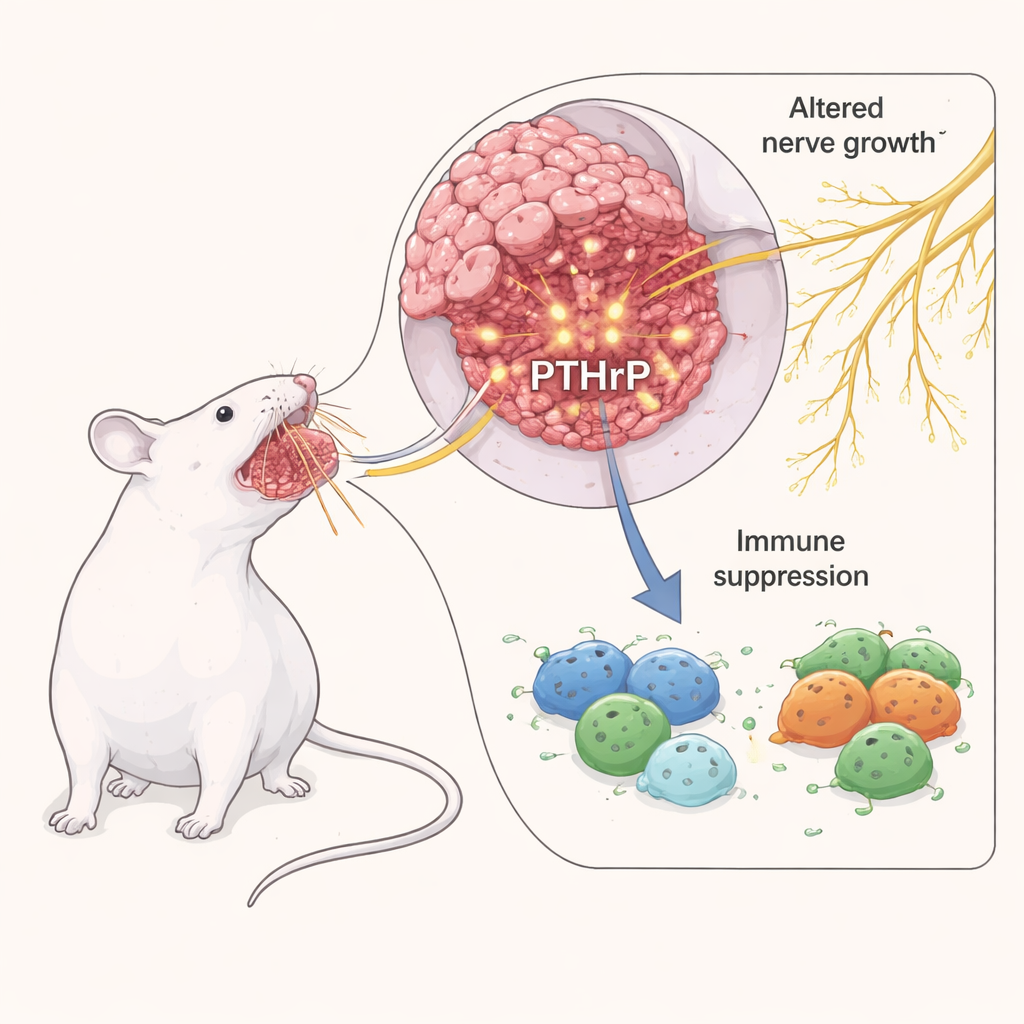
Head and neck cancers grow in some of the most densely wired parts of the body, packed with nerves that help us speak, chew and taste. That wiring is not just a bystander: cancer cells can "talk" to nearby nerves and immune cells, shaping how tumors grow and how they respond to treatment. This study zooms in on a nerve‑linked signal called PTHrP, asking whether shutting it off in tongue cancer cells can tilt the balance from tumor growth toward immune attack.
A hidden messenger inside tumors
The researchers focused on head and neck squamous cell carcinoma, a common and often aggressive type of mouth and throat cancer. By mining large public cancer gene databases, they found that the gene PTHLH, which produces the protein PTHrP, is switched on more strongly in these tumors than in healthy tissue. Tumors with higher PTHLH tended to have fewer cancer‑killing CD8 T cells and lower levels of several other helpful immune cells, hinting that this messenger might help tumors keep the immune system at bay. High PTHLH was also tied to molecules that promote nerve growth and immune dampening, and to worse survival in patients receiving modern immunotherapy drugs.
Editing cancer cells to cut the signal
To test what happens when cancer cells lose this signal, the team used CRISPR gene editing to knock out PTHLH in a mouse tongue cancer cell line. In lab dishes, the result was surprising: cells without PTHrP actually divided faster and moved more readily, behaviors usually linked with more aggressive disease. At the same time, removing PTHrP scrambled the pattern of nerve‑nourishing factors the cells produced, raising some and lowering others. This showed that PTHrP sits near the center of a complex network that controls how tumors communicate with nerves, even if the direct effect on raw cancer cell growth is not straightforward.
Immune‑deficient versus immune‑intact mice
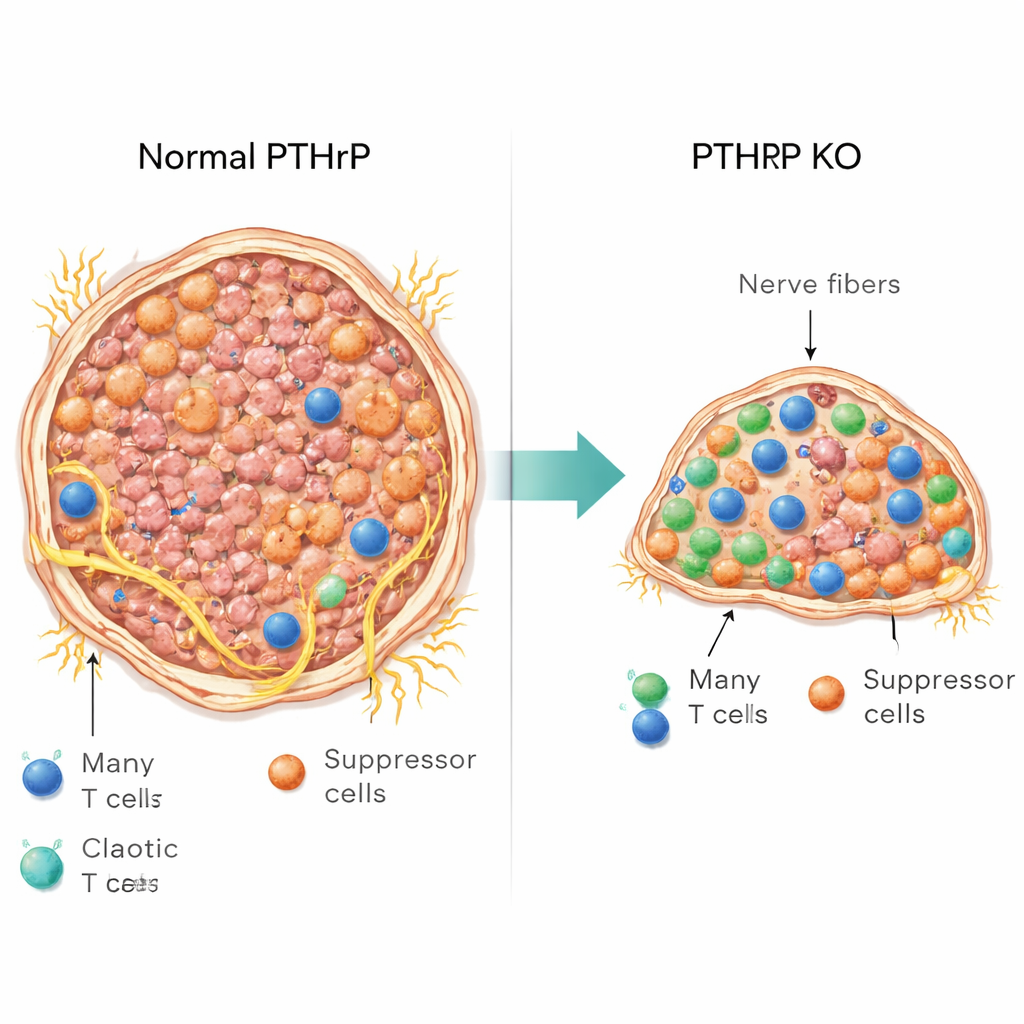
The real test came in living animals. When researchers implanted normal and PTHrP‑deficient cancer cells into the tongues of mice lacking a working adaptive immune system, both types of tumors grew to similar sizes. Under the microscope, there was no meaningful difference in cell division or nerve content. But when the same experiment was repeated in normal mice with intact immunity, the picture flipped. Tumors lacking PTHrP stayed much smaller, and the mice maintained or even gained more body weight, an indirect sign that the tongue tumors were less disruptive to eating and drinking.
Waking up the body’s defenses
Detailed tissue staining explained why size alone did not tell the whole story. PTHrP‑deficient tumors in immune‑intact mice contained more cancer‑killing CD8 T cells and more helper CD4 T cells, both crucial for strong anti‑tumor responses. At the same time, there were fewer regulatory T cells, which normally act as brakes on immunity, and lower levels of PD‑L1 and TNF‑α, molecules linked to T‑cell exhaustion and immune escape. The tumors also showed more signs of cancer cell death and fewer cells caught in the act of dividing. Nerve‑related markers tended to be lower as well, suggesting that turning down this single cancer‑derived signal can weaken a broader nerve‑driven support system inside the tumor.
What this could mean for future treatments
Put simply, this work shows that a nerve‑related protein released by tongue cancer cells can help them hide from the immune system, even if it is not strictly required for their growth in the lab. Removing PTHrP wakes up immune attack and shrinks tumors in mice whose immune systems are intact, pointing to a new way to make mouth cancers more vulnerable to the body’s defenses and to immunotherapy. While more research is needed to translate these findings to patients and to understand the exact switches and pathways involved, PTHrP now stands out as a promising target at the crossroads of nerves, cancer and immunity.
Citation: Kishan, R., Zhang, G., Yang, W. et al. Ablation of cancer cell secreted neuropeptide PTHLH/PTHrP provokes anti-tumor immunity in murine tongue squamous cell carcinoma. Sci Rep 16, 6920 (2026). https://doi.org/10.1038/s41598-026-37580-1
Keywords: head and neck cancer, tongue squamous cell carcinoma, tumor immunity, neuroimmune crosstalk, PTHrP