Clear Sky Science · en
Efficacy of electronic travel aids for the blind and visually impaired during wayfinding
Smarter Tools for Safer, More Independent Walking
For many people who are blind or have low vision, getting around town can feel like navigating a maze full of hidden hazards—especially obstacles at chest or head height that a traditional white cane might miss. This study explores whether new electronic travel aids can make everyday walking safer and less stressful, and what kinds of cues—vibrations versus 3D sound—actually work best for real users rather than in lab demos.
Why the White Cane Is Not Always Enough
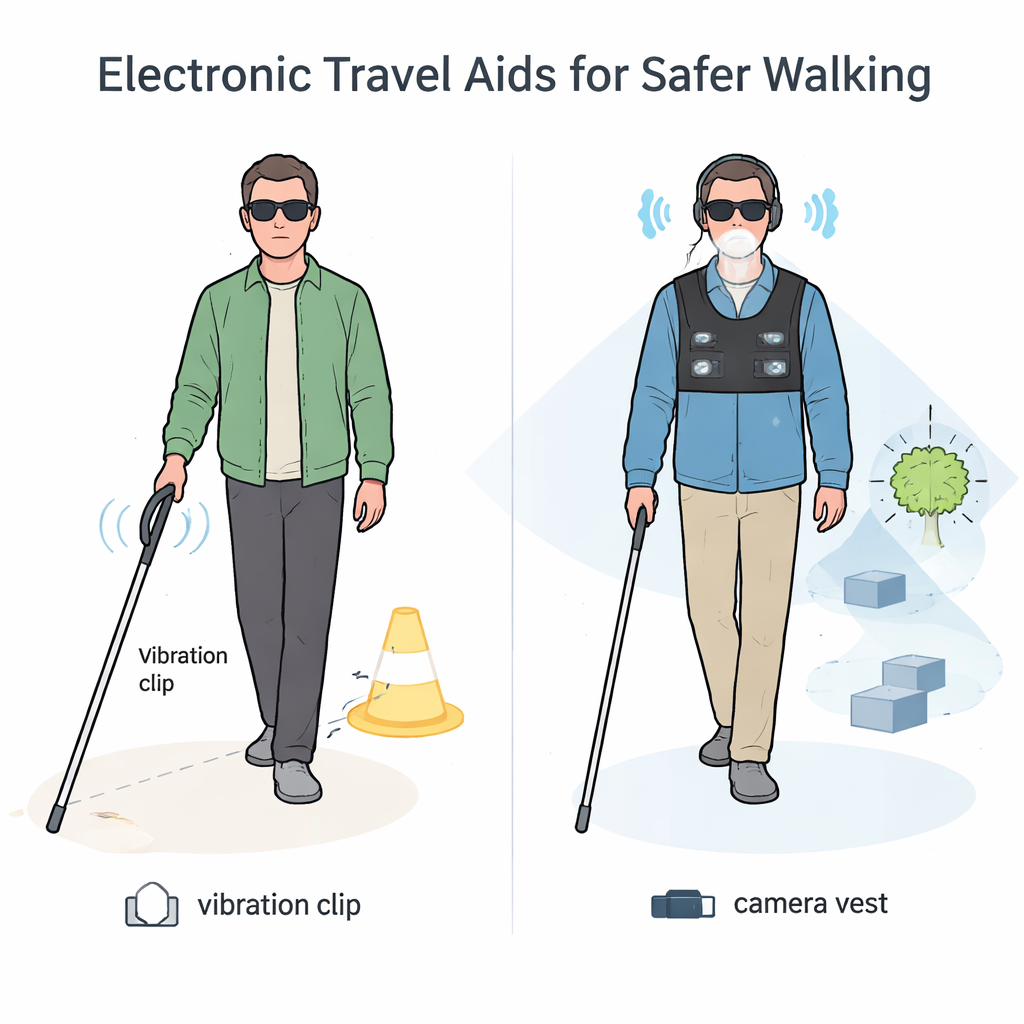
The white cane is inexpensive, familiar, and remarkably effective at revealing what is on the ground. But it has blind spots: it rarely detects objects at upper-body or head level, and it cannot describe what an obstacle is or how far away it is beyond the length of the cane. It also does not give turn-by-turn route guidance. To fill these gaps, engineers have built electronic travel aids that add sensors—like ultrasound or cameras—and deliver information through sounds or vibrations. Despite decades of prototypes, many devices have never been carefully tested with blind and visually impaired (BVI) people themselves, which means we know little about how well they actually work in everyday life.
Putting Two High-Tech Helpers to the Test
The researchers invited 13 blind or low-vision adults to complete walking tasks in a controlled indoor corridor. Everyone already used a white cane. Each person walked the course three times: with their cane alone, with a small ultrasonic clip-on device called the BuzzClip attached to the cane, and with a shoulder-worn camera vest called NOA that provides 3D, spatialized audio through bone-conduction headphones. The team counted how often participants hit obstacles with their cane or their body, tracked walking speed and heart rate, and asked detailed questions about how demanding or frustrating each condition felt using a standard workload survey (NASA-TLX) and follow-up interviews.
How the Devices Changed Walking and Confidence
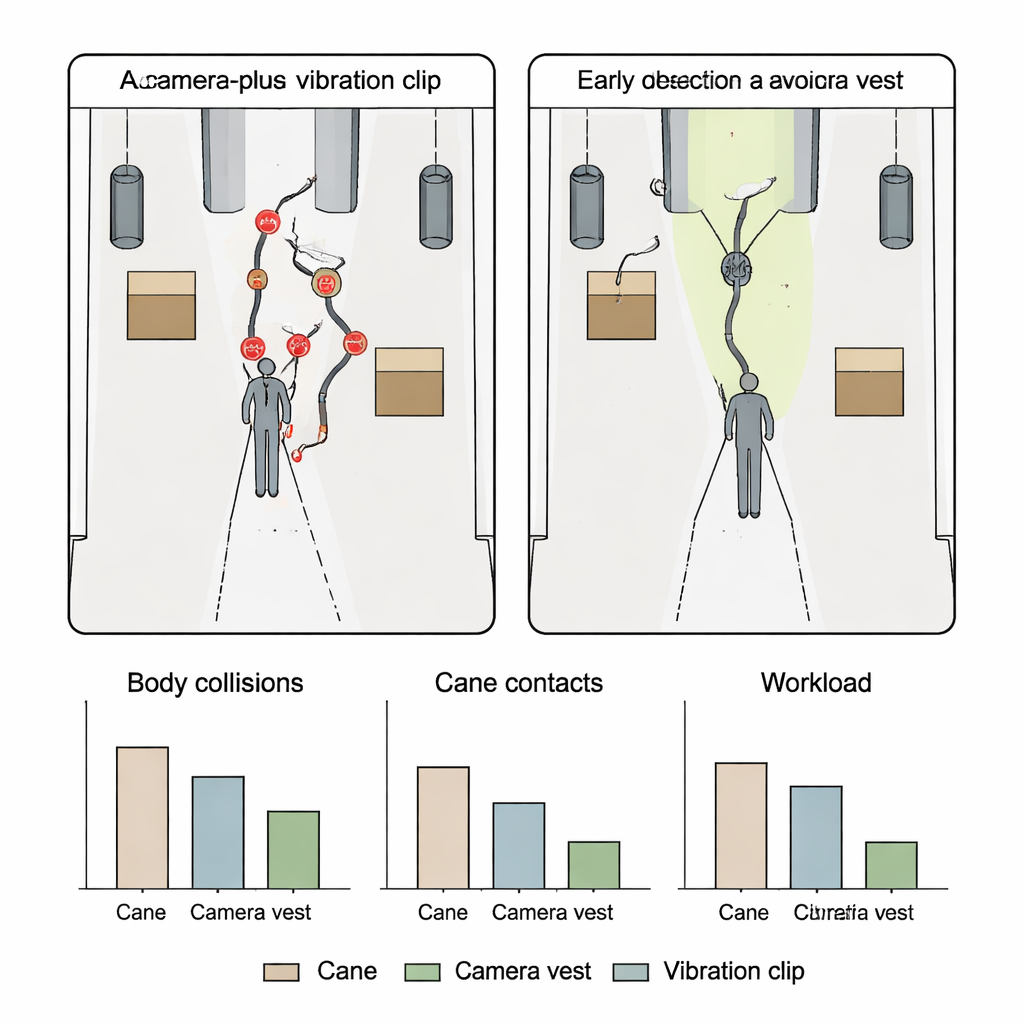
NOA clearly improved safety. When participants used NOA along with their cane, they had fewer body collisions and made fewer cane contacts with obstacles than when using the cane alone or the cane plus BuzzClip. While people walked fastest with the cane alone, the slower speed with both electronic aids likely reflected extra caution and time spent interpreting new signals. Importantly, NOA did not increase mental workload compared with the cane, even though it delivers rich 3D sound cues. In contrast, the BuzzClip did not reduce collisions and was rated as more frustrating, with lower perceived performance and higher overall workload. Many users said its vibrations were too weak, too frequent, and hard to distinguish from the natural feedback of the cane, and they often could not tell how high or exactly where an obstacle was located.
Finding People and Objects: What Kind of Guidance Helps Most?
In a second task, the team tested a new “object-finding” feature built into NOA. Participants stood in a small room and were asked to walk toward a person after hearing spoken directions from the device. Two versions of this feature were compared. One used a cloud-based generative AI system that gave a short, natural-sounding description (for example, “There is a person slightly to your left, a few steps away”). The other used a local deep-learning system that gave more precise, clock-face and distance instructions and added a spatialized “beep” sound that stayed locked onto the person as long as they were in view. Both versions led to similar completion times, but the deep-learning version tended to yield higher success rates and was rated as clearer, more precise, and less demanding. Every participant preferred this more structured, concise guidance, though some felt the richer language of the AI description might be better for broader scene understanding in other situations.
What This Means for Everyday Travel
From a layperson’s perspective, the message is straightforward: adding smart technology to traditional mobility tools can make walking safer for blind and visually impaired people—if the device is precise, well designed, and tested with real users. In this study, nearly all participants said they would consider adopting NOA as a companion to their cane, especially for unfamiliar routes, even though it is bulkier and has a learning curve. They valued its accurate, spatial audio cues and the feeling of increased safety more than the simplicity of the smaller BuzzClip. At the same time, the work highlights that lighter hardware, intuitive feedback, and flexible modes (brief, precise guidance versus rich descriptions) will be crucial for long-term use. With further refinement and testing in outdoor, real-world environments, such electronic travel aids could help many more people move through the world with confidence and autonomy.
Citation: Pittet, C.E., Ortega, E.V., Fabien, M. et al. Efficacy of electronic travel aids for the blind and visually impaired during wayfinding. Sci Rep 16, 6423 (2026). https://doi.org/10.1038/s41598-026-37578-9
Keywords: blindness, assistive technology, navigation, electronic travel aids, spatial audio