Clear Sky Science · en
Quartz porosity in amorphous SiO2 of granitic shear bands
Hidden Cavities Deep Beneath Our Feet
Far below Earth’s surface, in rocks that flow slowly over millions of years, tiny empty spaces can quietly change how the crust breaks, moves and channels fluids. This study looks inside quartz-rich rocks from the Greek island of Naxos and shows that countless microscopic pores form not by simple chemical “dissolving,” as long believed, but through a more surprising pathway: stress turning parts of quartz into a glassy, amorphous state that later releases trapped fluid. These hidden cavities could help control everything from how ore deposits concentrate to how and where earthquakes start.
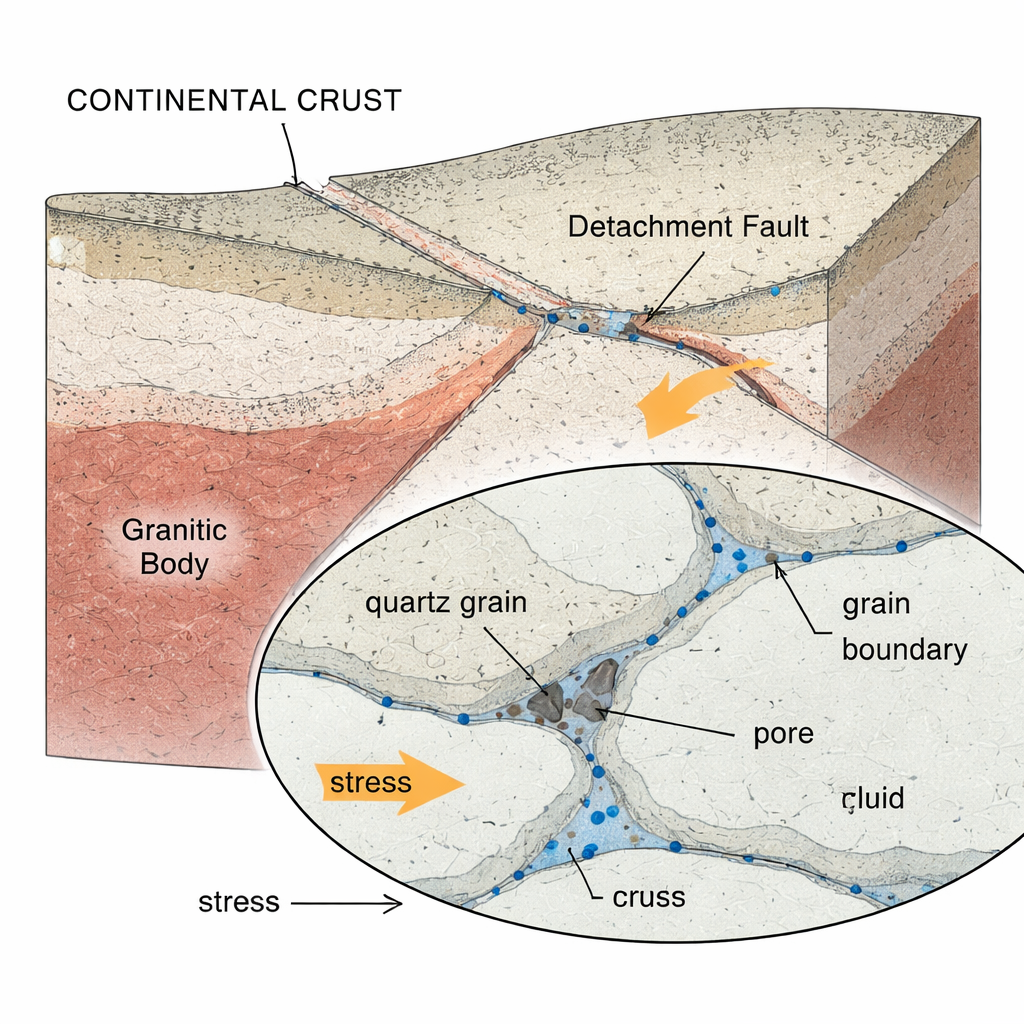
Tiny Voids in a Solid Stone World
Geologists have known for more than a century that deformed quartz-rich rocks often contain micrometer- to nanometer-sized pores, many with sharp, pyramidal outlines. These rocks come from shear zones in the middle and lower crust, where temperatures are high enough for rock to deform like warm plastic rather than shatter like cold glass. The pores, perched along quartz grain boundaries and within subtle internal “substructures,” act as micro-plumbing: they host fluids, influence rock strength and may focus the movement of metals. Until now, most scientists assumed these pores were etched out by reactive fluids dissolving quartz along dislocation trails—tiny defects in the crystal lattice—during deformation.
A Natural Laboratory in the Aegean
The authors turned to a natural experiment: a Miocene granite on western Naxos, Greece, deformed beneath a major extensional fault known as the central Cycladic detachment. As the granite was exhumed from several kilometers depth, it cooled from near-melting temperatures to around 350 °C while being sheared. This history produced bands of nearly pure quartz that flowed and recrystallized, recording a progression from vigorous grain-boundary migration to rotation of smaller subgrains, with grain-boundary sliding also accommodating strain. These quartz-rich shear bands are riddled with pores of various shapes and sizes, making them an ideal place to test how such porosity forms in nature.
Seeing in Three Dimensions and at the Nanoscale
Using electron backscatter diffraction, the team mapped crystal orientations in the quartz and estimated how many dislocations would be required to bend the lattice as observed. They found high predicted dislocation densities along subgrain boundaries but also noted that many pores sat on boundaries that did not intersect obvious dislocation-rich structures in two dimensions. Focused ion beam techniques then allowed the researchers to slice and reconstruct three-dimensional volumes at nanometer resolution. These 3D views revealed both elongated pyramidal pits aligned along boundary traces and “pancake-like” faceted pores whose shapes were symmetric with respect to the boundary, inconsistent with a simple etching of isolated dislocation lines. Crucially, transmission electron microscopy showed that many pore-bearing boundaries are coated by a roughly 50-nanometer-thick layer of amorphous SiO2—chemically quartz, but structurally glassy—within which angular pores sit like bubbles in frozen syrup.
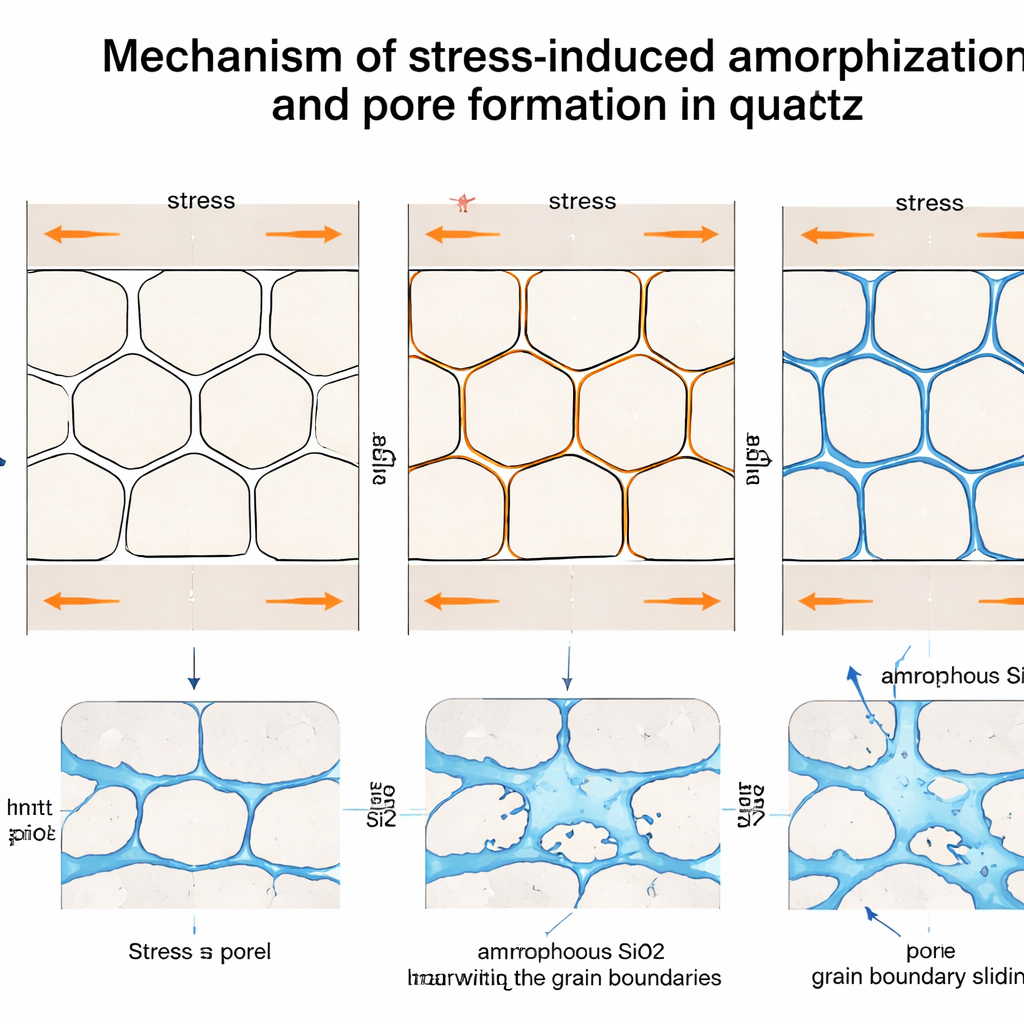
Stress That Turns Crystals Glassy
These observations challenge the classic picture of pores carved by aggressive fluids far from equilibrium. Instead, the authors argue that as quartz grains deform plastically, they drive water and other volatiles from their interiors toward grain and subgrain boundaries. Where stresses concentrate and conventional crystal plasticity can no longer keep up, the quartz locally loses its ordered structure and becomes amorphous SiO2. This glassy film can host significantly more dissolved fluid than the surrounding crystal. When stress later drops—either because grain boundaries become fully lubricated and slide, or because quartz recrystallizes—the stressed amorphous layer becomes unstable and exsolves fluid as tiny bubbles. These bubbles coalesce and grow, eventually pushing into the crystal and adopting shapes controlled by quartz’s internal geometry, producing both pyramidal and faceted pores.
Why These Micropores Matter
In simple terms, this work suggests that deep in the crust, stress can briefly “melt” tiny layers of quartz into a glassy state that soaks up fluid and then spits it back out as pores when the stress relaxes. These stress-born cavities can link up to form networks that weaken rocks, lubricate faults and pump fluids through shear zones. Because amorphous SiO2 is relatively soft and an excellent solvent for water, repeated cycles of stress build-up, amorphization and fluid release could help localize deformation and eventually trigger brittle failure where the crust is otherwise flowing. The study thus reframes seemingly solid quartz as a dynamic, partially glass-forming material whose hidden porosity plays a quiet yet powerful role in shaping Earth’s deep, deforming crust.
Citation: Précigout, J., Prigent, C., McGill, G. et al. Quartz porosity in amorphous SiO2 of granitic shear bands. Sci Rep 16, 6996 (2026). https://doi.org/10.1038/s41598-026-37576-x
Keywords: quartz porosity, amorphous silica, deep crustal shear zones, stress-induced amorphization, fluid-rock interaction