Clear Sky Science · en
Happy and angry human pictures differentially affect dogs’ postural stability
Why Your Dog’s Balance Matters
Most dog lovers know that their pets can read human faces surprisingly well. But could simply looking at a smiling or scowling person quietly change how a dog’s body holds itself up against gravity? This study explored whether pictures of happy and angry human faces subtly alter how steadily dogs stand, offering a fresh window into how deeply our emotions may be woven into dogs’ bodies as well as their minds.
Dogs, Screens, and Stillness
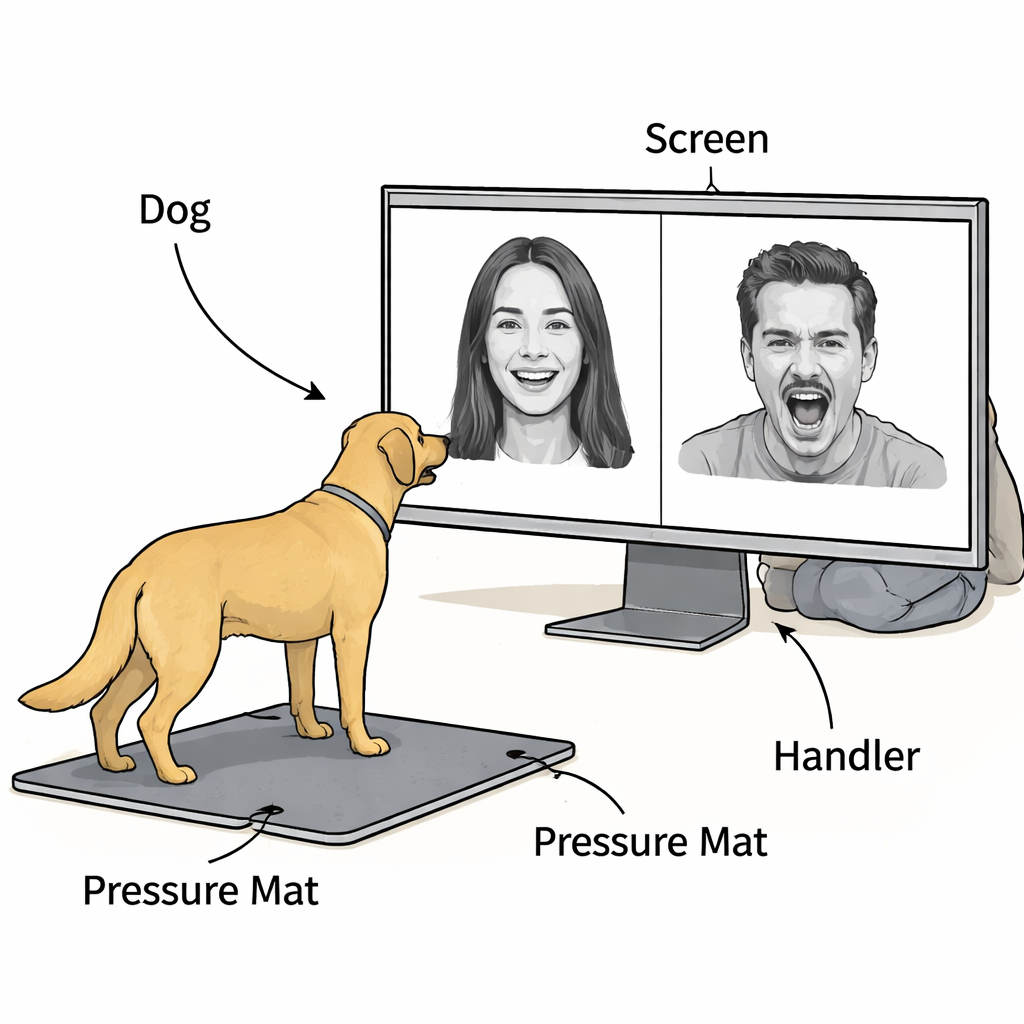
The researchers worked with seventeen healthy pet dogs who were trained to stand quietly on a sensitive pressure mat that measures tiny shifts in weight under their paws. While the dogs stood still, a large screen in front of them showed one of three things: a happy human face, an angry human face, or a blank “no-picture” screen. The dogs’ owners hid silently behind the screen so they could not cue their animals. The team focused on how the point of pressure under the dogs’ feet moved over time, a standard way to estimate how stable or wobbly someone’s standing posture is without making them walk or jump.
Measuring Invisible Wobbles
Even when a dog looks motionless, its body makes constant micro-adjustments to stay upright. The pressure mat recorded how far the center of pressure shifted side-to-side and front-to-back, how long the path of that shifting was, how fast it moved, and how large an area it covered. Smaller, tighter movements generally mean steadier balance; larger, faster excursions suggest the body is working harder to keep from tipping. The researchers first compared all dogs together across the three viewing situations to see if happy or angry faces made the group, on average, more or less stable than the no-picture condition.
When Averages Hide Individual Dogs
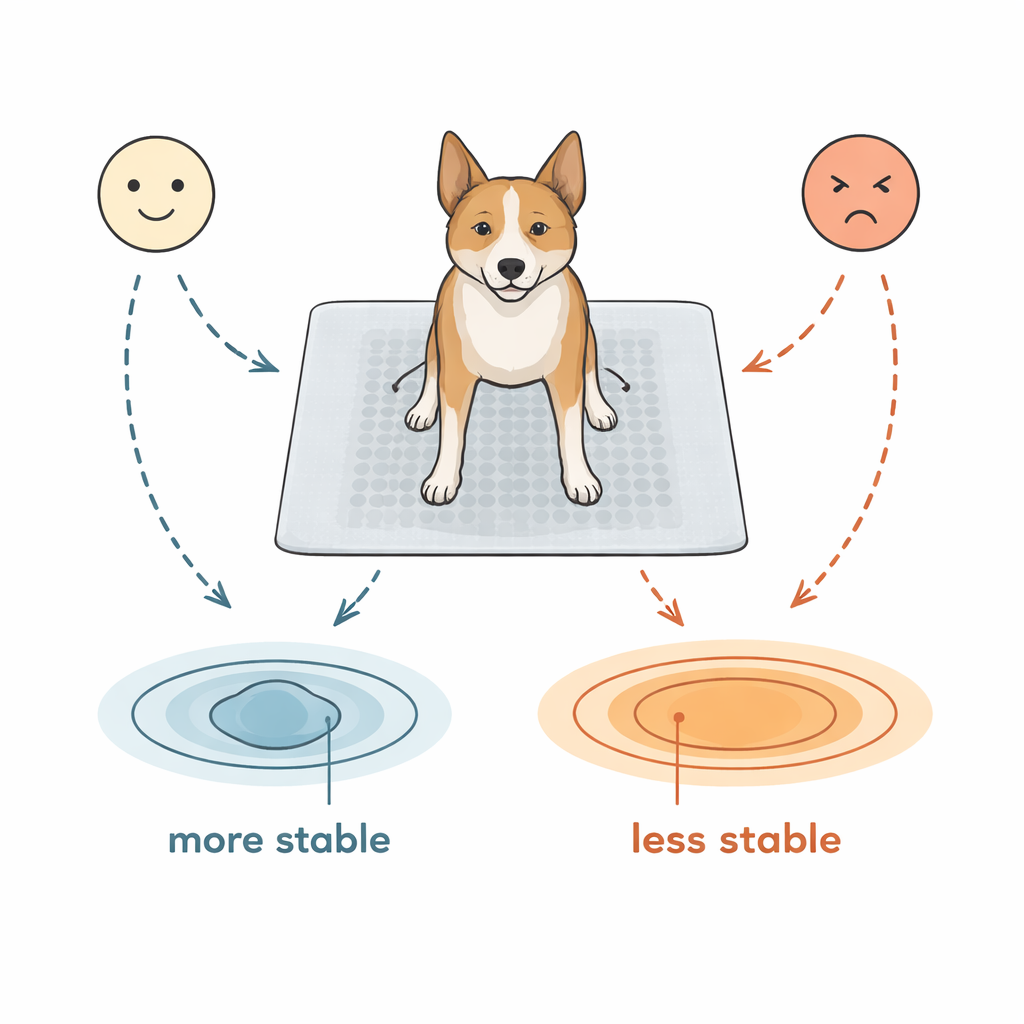
Looking only at group averages, the answer seemed simple: there were no clear differences in balance between happy faces, angry faces, and the blank screen. But when the team examined each dog individually, a very different story appeared. Some dogs became noticeably more stable when viewing emotional faces, with reduced sway and smaller pressure areas. Others became less stable, showing larger, more restless shifts in weight. To make sense of this pattern, the scientists used a clustering method that grouped dogs by how their balance changed relative to the no-picture condition, separately for happy and angry faces.
Two Hidden Types of Responders
In both the happy and angry conditions, the dogs consistently fell into two broad reaction types. One cluster showed increased sway across the balance measures, interpreted as a destabilizing effect: emotional human faces, regardless of being positive or negative, seemed to make these dogs’ bodies less steady. The other cluster showed decreased sway, interpreted as a stabilizing effect: these dogs held themselves more firmly when looking at the faces. Importantly, dogs who tended to stabilize with happy faces often did the same with angry faces, and likewise for dogs who tended to destabilize. This suggests that each dog’s own temperament, past experiences, and way of processing emotional information may matter more than whether a face looks pleasant or threatening.
What It Means for Life with Dogs
For non-specialists, the key takeaway is that dogs do not just notice our faces on a mental level. Our emotional expressions can quietly shape how their bodies organize balance in space, even when they are simply standing still. Some dogs may brace and steady themselves, possibly anticipating interaction, while others may become subtly more restless or on edge. Although this was a small, exploratory study, it adds to growing evidence that a dog’s bond with humans reaches deep into how its nervous system links feelings, perception, and movement. Understanding these hidden physical responses may one day help caregivers and trainers better support dogs in emotionally charged situations, from veterinary visits to everyday home life.
Citation: Affenzeller, N., Lutonsky, C., Aghapour, M. et al. Happy and angry human pictures differentially affect dogs’ postural stability. Sci Rep 16, 7103 (2026). https://doi.org/10.1038/s41598-026-37571-2
Keywords: dog emotion, human–dog interaction, postural stability, facial expressions, canine cognition