Clear Sky Science · en
Talin1 is downregulated in testicular germ cell tumors according to combined bioinformatics and experimental approaches
Why a tiny testicular protein matters
Testicular cancer is the most common cancer in young men, and although treatments are often successful, they can leave lasting side effects and do not work for everyone. This study focuses on a little-known protein called Talin1, which helps cells stick to their surroundings. By looking at large genetic datasets and real tumor samples, the researchers asked a simple but important question: when this "molecular grip" loosens, does testicular cancer become more aggressive?
How cells hold on—or let go
Every cell in the body needs a firm but flexible grip on the tissue around it. Talin1 is one of the key components of this grip, linking receptors on the cell surface to internal scaffolding made of protein fibers. Through this linkage, Talin1 helps control how tightly a cell attaches, how it senses mechanical forces, and how easily it can move. In many cancers, changes in Talin1 levels have been tied to either increased or decreased tumor growth, depending on the organ. Until now, however, its role in testicular germ cell tumors—cancers arising from the cells that normally produce sperm—was largely unknown.
Mining big datasets to spot a suspect
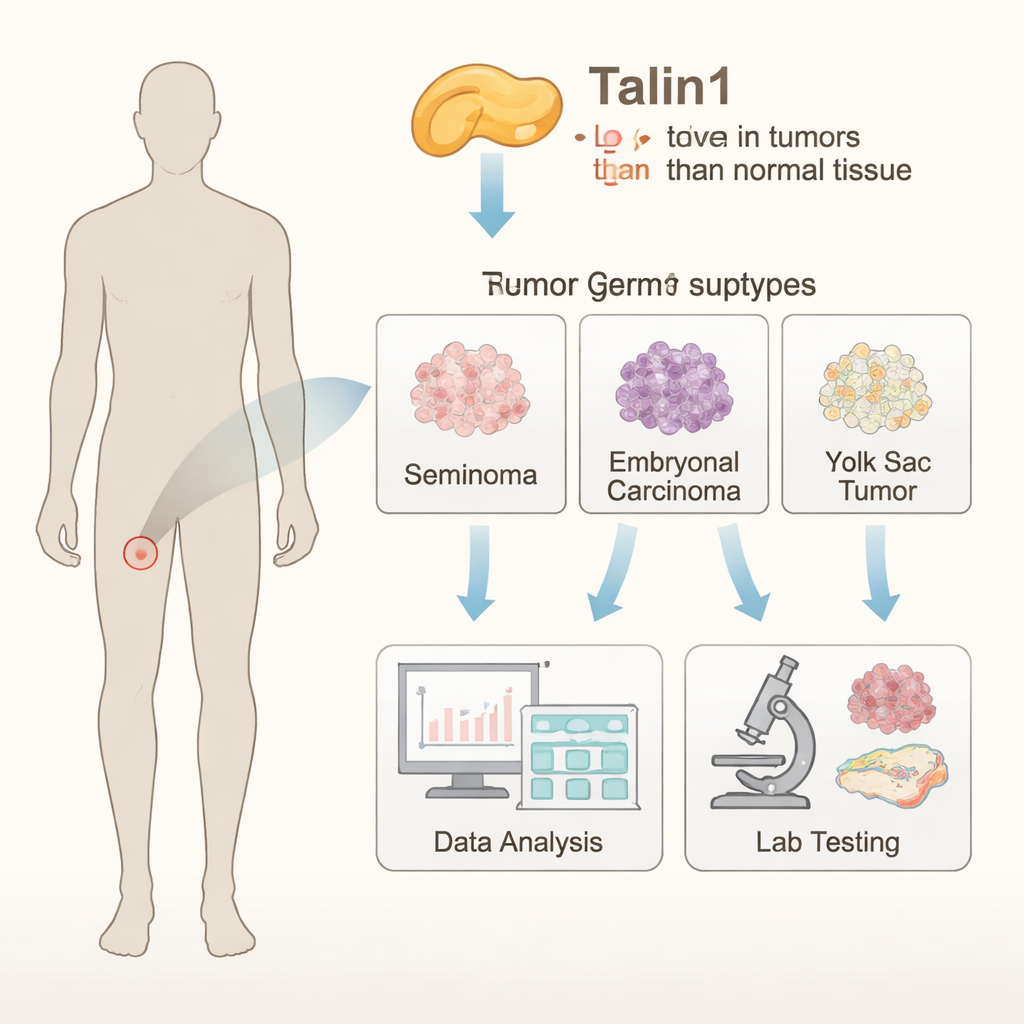
The authors first turned to public gene and protein databases containing information from testicular cancer samples and healthy testis tissue. By comparing thousands of genes across several independent studies, and then cross-checking those findings against large protein surveys, they narrowed down a list of candidates linked to cell adhesion and movement. Talin1 stood out as a repeatedly altered gene sitting at the center of a network that connects adhesion receptors to the cell’s internal skeleton. When the researchers examined combined tumor and normal testis data from large cancer consortia, they found that Talin1 was generally expressed at lower levels in testicular tumors than in normal tissue, and that its levels tended to drop further as cancers advanced in stage.
Putting the protein under the microscope
To test whether these database hints held up in real patients, the team examined Talin1 protein directly in tissue samples from 191 individuals with testicular germ cell tumors. These samples covered the main subtypes: seminoma, embryonal carcinoma, yolk sac tumor, and teratoma, along with nearby noncancerous tissue. Using a staining method that makes Talin1 visible under the microscope, they measured how strongly tumor cells expressed the protein and how many cells in each sample were positive. Overall, both the inner (cytoplasmic) and surface (membrane) forms of Talin1 were clearly lower in tumor tissue than in the adjacent normal testis, confirming the pattern suggested by the computational analyses.
Linking weaker grip to more aggressive disease
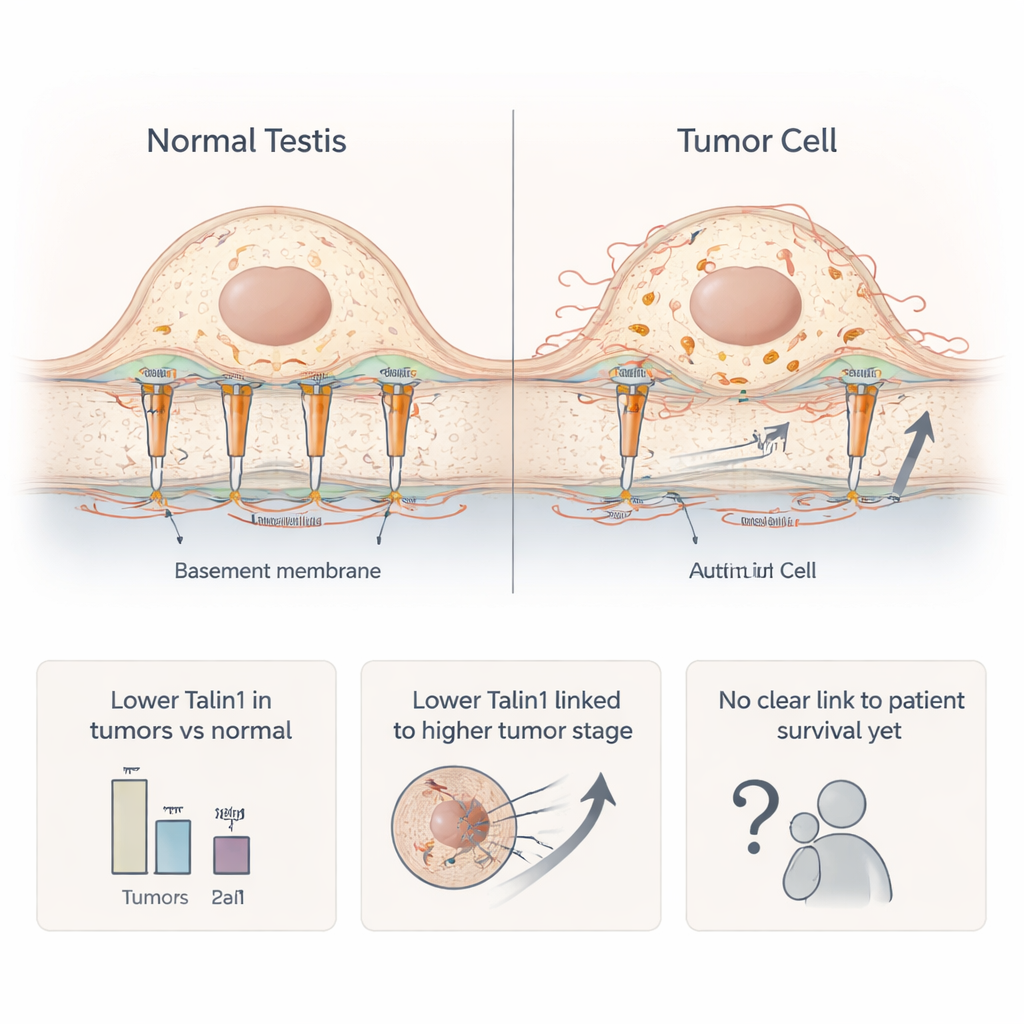
The most striking finding emerged when Talin1 levels were compared with standard pathological features that indicate how far a tumor has progressed. In several tumor subtypes—seminomas, embryonal carcinomas, yolk sac tumors, and teratomas—lower Talin1 inside the cell was tied to more advanced local tumor stage, and in embryonal carcinoma it was also linked to invasion into nearby veins and tissue layers. In yolk sac tumors, low Talin1 was associated with involvement of delicate structures in the testis and with specific patterns of immune cells infiltrating the tumor, suggesting a possible connection to how the cancer interacts with the body’s defenses. Despite these associations with aggressive features, differences in Talin1 did not yet translate into clear differences in patient survival during the roughly five-year follow-up, likely because deaths from this highly treatable cancer were relatively rare in the study group.
What this means for patients and future tests
For a layperson, the takeaway is that testicular tumors in this study tended to lose some of their Talin1 "grip," and this loss was consistently linked to cancers that had grown further and invaded more deeply. That makes Talin1 a promising tissue biomarker that could, in the future, help pathologists and oncologists judge how aggressive a testicular tumor is likely to be, possibly alongside existing blood tests. The study does not yet show that Talin1 levels predict who will live longer, and it does not prove cause and effect. Still, by combining big-data analysis with careful examination of real tumors, the work lays important groundwork for understanding how changes in cell adhesion may drive testicular cancer progression, and it points to Talin1 as a candidate for more detailed functional and therapeutic research.
Citation: Razmi, M., Yazdanpanah, A., Vafaei, S. et al. Talin1 is downregulated in testicular germ cell tumors according to combined bioinformatics and experimental approaches. Sci Rep 16, 6557 (2026). https://doi.org/10.1038/s41598-026-37569-w
Keywords: testicular germ cell tumor, Talin1, cell adhesion, biomarker, cancer progression