Clear Sky Science · en
Design and simulation of a solar array deployment mechanism for a small satellite using implicit time-stepping
Why unfolding solar panels in space is a big deal
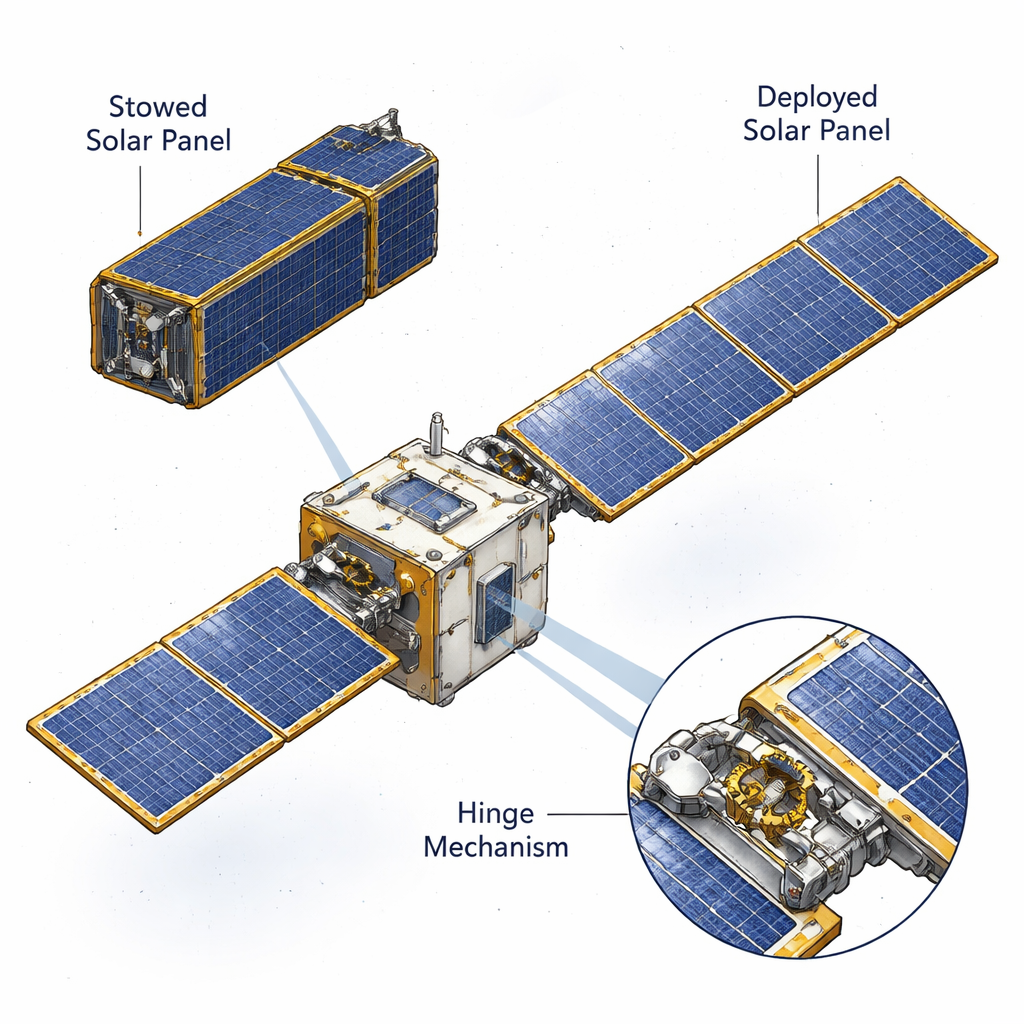
When a satellite rides to orbit, its solar panels—the spacecraft’s main power source—have to be folded up tightly to fit inside the rocket. Once in space, those panels must swing out and lock into place. If this deployment fails or slams too hard, the entire mission can be lost. This study focuses on designing and digitally testing a safer, smoother way for a small satellite’s solar panels to unfold and lock, using a combination of clever mechanics and advanced computer simulation.
From folded to open without a jolt
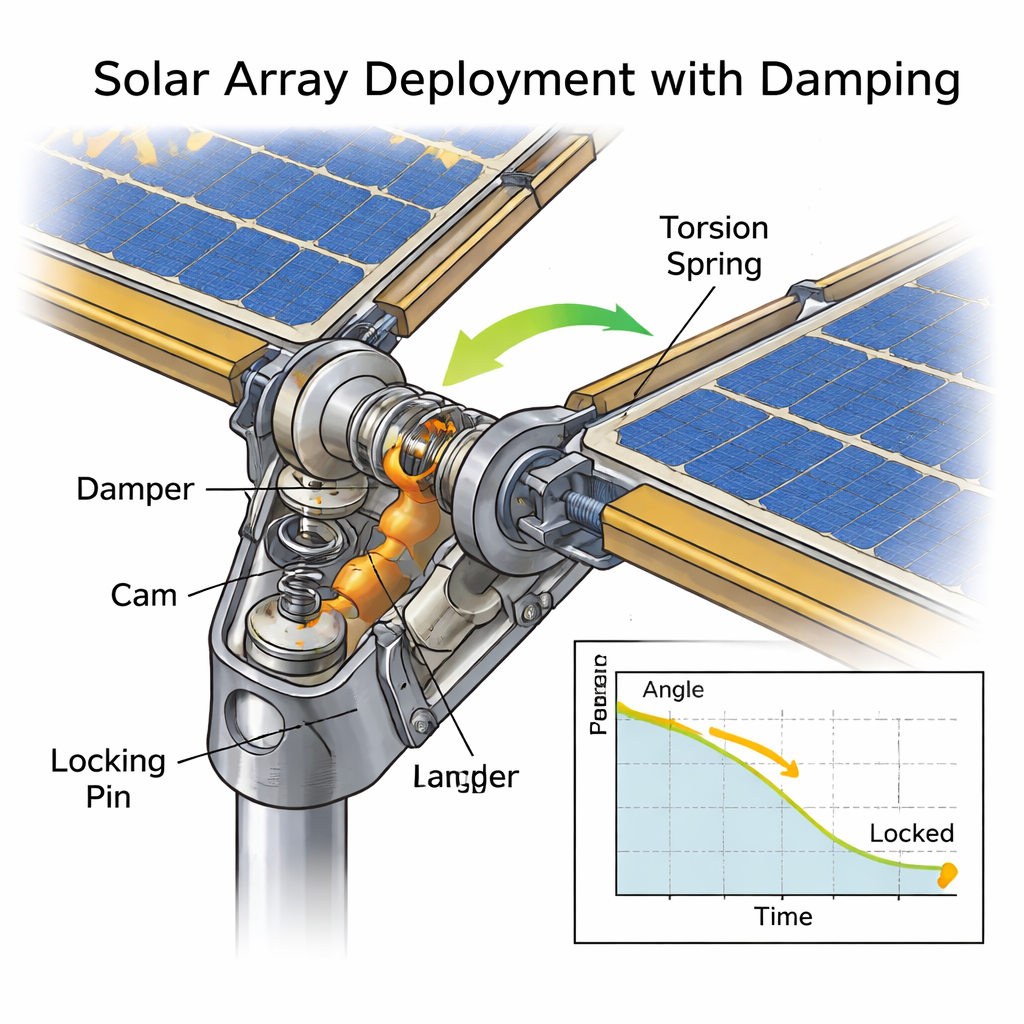
The authors examine a solar array deployment mechanism, or SADM, that rotates a solar panel from a folded “stowed” position against the satellite body to a “locking” position about 90 degrees away. The motion is driven by a torsion spring—essentially a twisted metal coil that wants to unwind—and controlled by a cam, a locking pin, and a small rotary damper that resists fast motion. The goal is to make the panel move in a few seconds, but slow it down before the final latch so that the impact does not crack fragile solar cells or stress the satellite’s structure.
Building a simple math model of the motion
To shape this behavior, the team first creates an analytical model, treating the moving panel and hinge as a rotating mass attached to a spring and a damper, with friction resisting motion near the lock. Using standard equations of motion, they calculate how the rotation angle and angular speed change over time for different levels of damping. By scanning through commercially available damper values, they find a setting that keeps deployment time to at least five seconds while limiting the peak speed and the speed right at the instant of locking. A particular high damping value yields a deployment in about 5.7 seconds, with modest angular velocity at lock—promising conditions for a gentle latch.
Putting the design into a virtual crash test
Next, the authors move beyond the simple math and build a full 3D computer model of the mechanism in a finite element analysis (FEA) program. They include realistic geometry, material properties, contact between the cam and locking pin, and a concentrated mass that represents the solar panel. Because the motion is relatively slow, they choose an “implicit” time-stepping method, which is numerically efficient for gradual changes but can struggle when motion becomes highly nonlinear—such as when the locking pin suddenly drops into its groove. To keep the virtual solver from stalling, they design an adaptive time-stepping algorithm that automatically shrinks the time step during the fast, complex locking phase and enlarges it when motion is smooth.
Tuning damping, friction, and computation
The study tests several combinations of damping and friction. With low damping, the mechanism moves quickly and the numerical solver is forced to take tiny time steps near locking, driving up computing time and producing sharp, potentially damaging impacts. When the chosen higher damping is used, the motion slows, the solver converges more easily, and total runtime drops. Adding realistic friction between the cam and locking pin further tames the motion, reduces the peak speed at lock, and makes the simulations more stable. Comparing the analytical solution with the detailed FEA results shows excellent agreement up to the locking moment, giving confidence that the simple model can guide design choices early on.
Keeping stresses and safety margins in check
Beyond motion, the authors examine how much mechanical stress the locking event creates in the metal parts. Their simulations track von Mises stress—an engineering measure that predicts yielding—throughout deployment. Stresses stay fairly constant while the pin slides, then spike and fluctuate as the pin settles into the groove. Even at their highest, these stresses reach less than half the yield strength of the chosen aluminum alloy, giving a safety factor of about two. This indicates that, with the selected damping and geometry, the mechanism can lock firmly without risking permanent deformation.
What this means for future small satellites
In practical terms, the work shows that it is possible to design a compact solar panel hinge that deploys smoothly, slows itself before latching, and remains structurally safe—all while being validated on the ground through detailed simulation rather than trial-and-error hardware testing alone. The adaptive simulation approach is especially valuable: it allows engineers to model slow mechanisms that still contain brief, violent events, such as locks and latches. Although this study targets a specific solar array hinge, the same design and simulation strategy can be applied to many space mechanisms that must unfold reliably after launch.
Citation: Saad, G.B., Desoki, A.R. & Kassab, M. Design and simulation of a solar array deployment mechanism for a small satellite using implicit time-stepping. Sci Rep 16, 7178 (2026). https://doi.org/10.1038/s41598-026-37568-x
Keywords: solar array deployment, small satellite, space mechanisms, finite element simulation, damping and locking