Clear Sky Science · en
Source identification and probabilistic health risk systematic assessment of soil metals and metalloids pollution in a typical coal-industrial city in Weibei, China
Why Coal Town Soils Matter to Public Health
Across many parts of the world, coal-fueled industry has powered economic growth while quietly altering the ground beneath our feet. In Hancheng, a coal-industrial city in northern China, scientists set out to answer a deceptively simple question: what exactly is building up in the soil, where does it come from, and what does it mean for the health of local families—especially children? Their findings shed light on how modern industry and natural geology together shape invisible risks in everyday environments.
Taking the Measure of a Coal City’s Soil
To peer into this hidden world, researchers collected 121 samples of surface soil across Hancheng, carefully chosen to span busy industrial belts, coal mines, farming areas, and quieter upland zones. They tested for eight metals and metalloids—arsenic, cadmium, chromium, copper, lead, mercury, nickel, and zinc—using high-precision instruments in an accredited laboratory. While average levels did not exceed China’s national screening thresholds for immediate danger, nearly all of these elements, except chromium, were higher than natural background levels for the region. Cadmium and mercury stood out in particular, reaching nearly double their typical background values and showing very uneven, “hot spot” patterns that hinted at strong human-driven contamination.
Where the Pollution Comes From
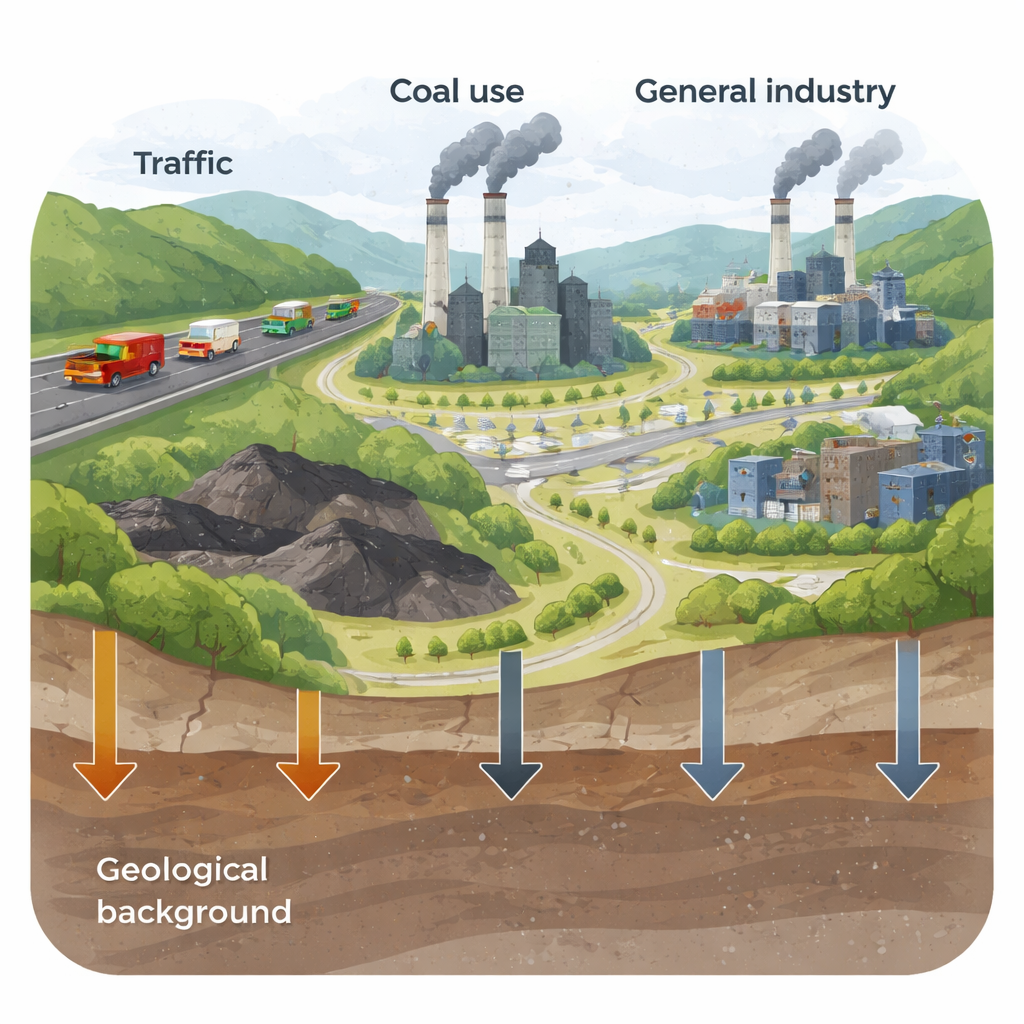
Identifying the culprits behind such patterns is not straightforward: metals can arise from both natural rock and human activity. The team used a statistical “fingerprinting” method to tease apart four main source types. One group linked to traffic and certain industries was rich in copper, nickel, arsenic, and zinc, and clustered along busy roads and populated areas. A second group, tied to coal burning in power plants and metal smelters, carried high shares of mercury, cadmium, lead, and zinc. A third source reflected the region’s geology—bedrock and mountain soils that naturally contain chromium and arsenic. The final source pointed to concentrated emissions from industrial parks, where cadmium, mercury, and lead from smelting, fuel use, and material handling accumulate in nearby soils. Together, the three human-related sources accounted for about 71% of the soil contamination, highlighting how strongly modern activity overlays the natural background.
From Soil to People: How Risk Is Shared
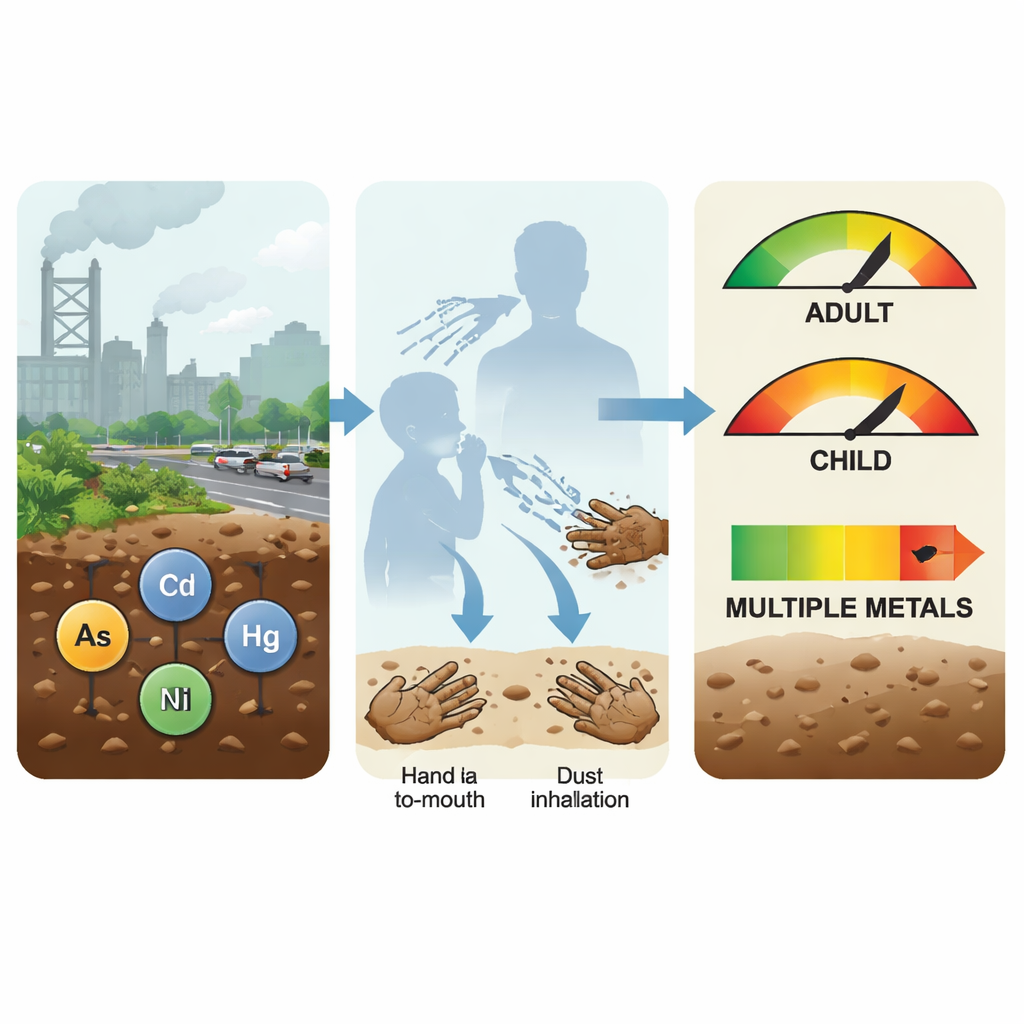
Contaminated soil does not stay put in a risk sense. Fine particles can be breathed in as dust, swallowed accidentally—particularly by children at play—or absorbed through the skin. To estimate what these exposure routes mean for real people, the researchers combined standard health risk formulas with Monte Carlo simulations, a technique that runs thousands of “what-if” scenarios using realistic ranges for body weight, breathing rate, and other factors. They found that, considered one by one, none of the metals posed an unacceptable cancer or non-cancer risk for either adults or children. However, when the effects of multiple metals were added together, the picture became more concerning for younger residents. Children consistently showed higher predicted risks than adults at the same contamination levels, especially for arsenic, nickel, and cadmium, which emerged as priority pollutants despite modest average concentrations.
Nature and Industry Working in Tandem
An important insight from the study is that risk does not come solely from smokestacks or tailpipes. In Hancheng, the local geology already contains elevated levels of some metals in the underlying rock and soils. Coal mining, coal transport, and industrial processing then mobilize and redistribute these elements, concentrating them along transportation corridors, industrial belts, and downwind areas. This “synergistic” effect—natural enrichment amplified by human activity—means that even if emissions are brought under control, legacy soils and parent rock can continue to feed metals into the landscape. The analysis showed that natural sources alone contributed more than one-third of the estimated health risks, nearly as much as the combined human sources in some scenarios.
What It Means for Communities and Policy
For residents of coal-industrial cities, the study’s bottom line is both cautionary and hopeful. Current metal levels in Hancheng’s soils do not point to an immediate public health crisis, but they do reveal a clear pattern: traffic, coal burning, and industrial emissions are steadily loading soils with toxic elements that particularly threaten children over a lifetime. The authors argue for a suite of practical responses—regular soil monitoring around coal corridors and industrial parks, stricter control of industrial emissions, limits on heavy truck traffic near schools, promotion of cleaner vehicles, and planting vegetation to trap dust and slow erosion. By focusing especially on arsenic, nickel, and cadmium and on the neighborhoods where children live, play, and learn, cities like Hancheng can reduce long-term health risks while still managing the economic realities of coal-dependent development.
Citation: Li, X., Kang, C., Xi, J. et al. Source identification and probabilistic health risk systematic assessment of soil metals and metalloids pollution in a typical coal-industrial city in Weibei, China. Sci Rep 16, 6453 (2026). https://doi.org/10.1038/s41598-026-37561-4
Keywords: soil contamination, coal mining, heavy metals, health risk, children exposure