Clear Sky Science · en
Uncertainty and reward histories have distinct effects on decisions after wins and losses
Why wins and losses don’t teach us equally
Every day we make choices based on past wins and losses, from picking a stock to choosing a route to work. Yet people and animals famously learn more from success than from failure. This article explores why that imbalance is not just a quirk, but an adaptive strategy shaped by how our brains track reward history and uncertainty. By studying rats in a changing, partly unpredictable environment, the researchers uncover hidden rules that determine when wins matter more than losses—and how those rules differ between males and females.
A shifting world for thirsty rats
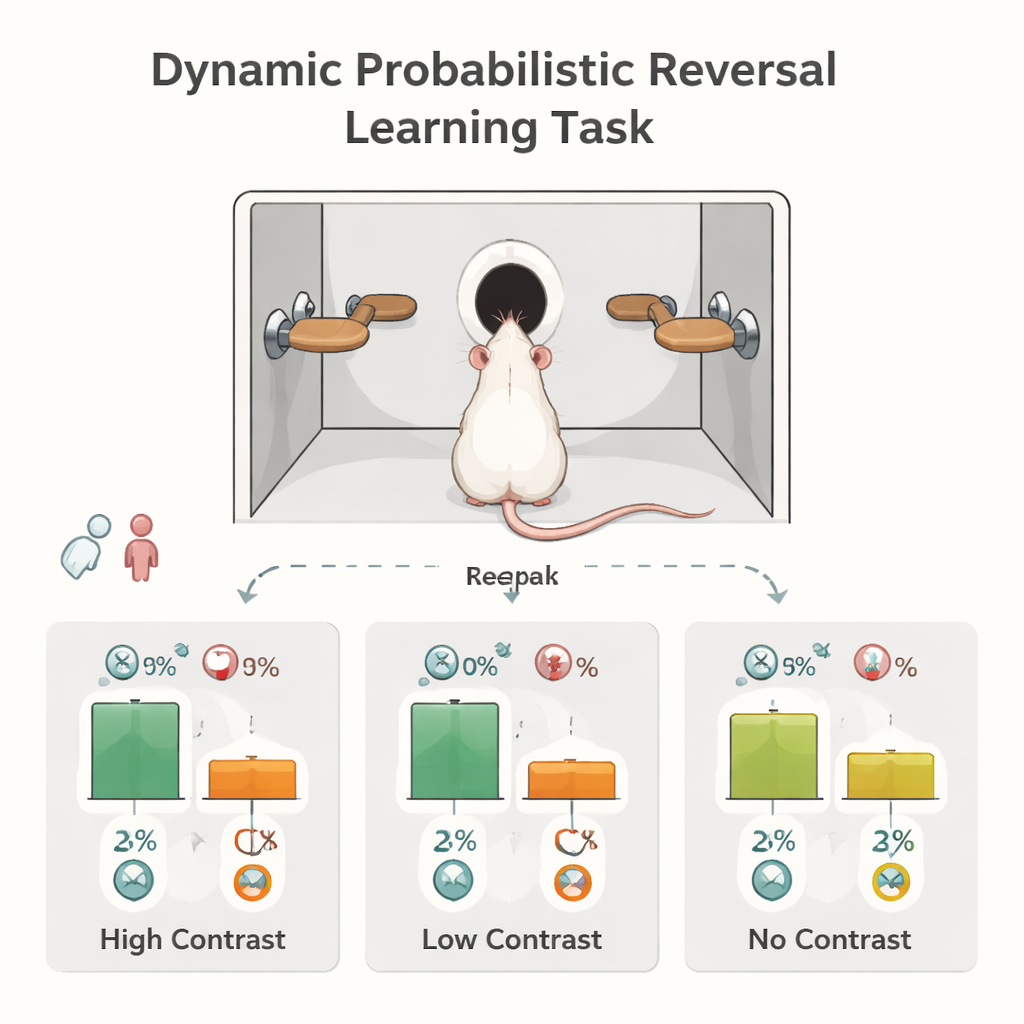
To probe these rules, the team trained water-restricted rats on a dynamic choice task. On each trial, rats initiated a round, then chose between two levers. One lever was more likely to deliver a drop of sugary water, but which lever was “better” and how much better kept changing in blocks throughout the session. Some blocks made the better lever very obvious (one side paid off most of the time, the other almost never), while other blocks were more confusing, with closer or even equal chances of reward on the two levers. This constantly shifting setup mimics real life, where what worked yesterday may not work today.
Sticking with winners, shrugging off some losses
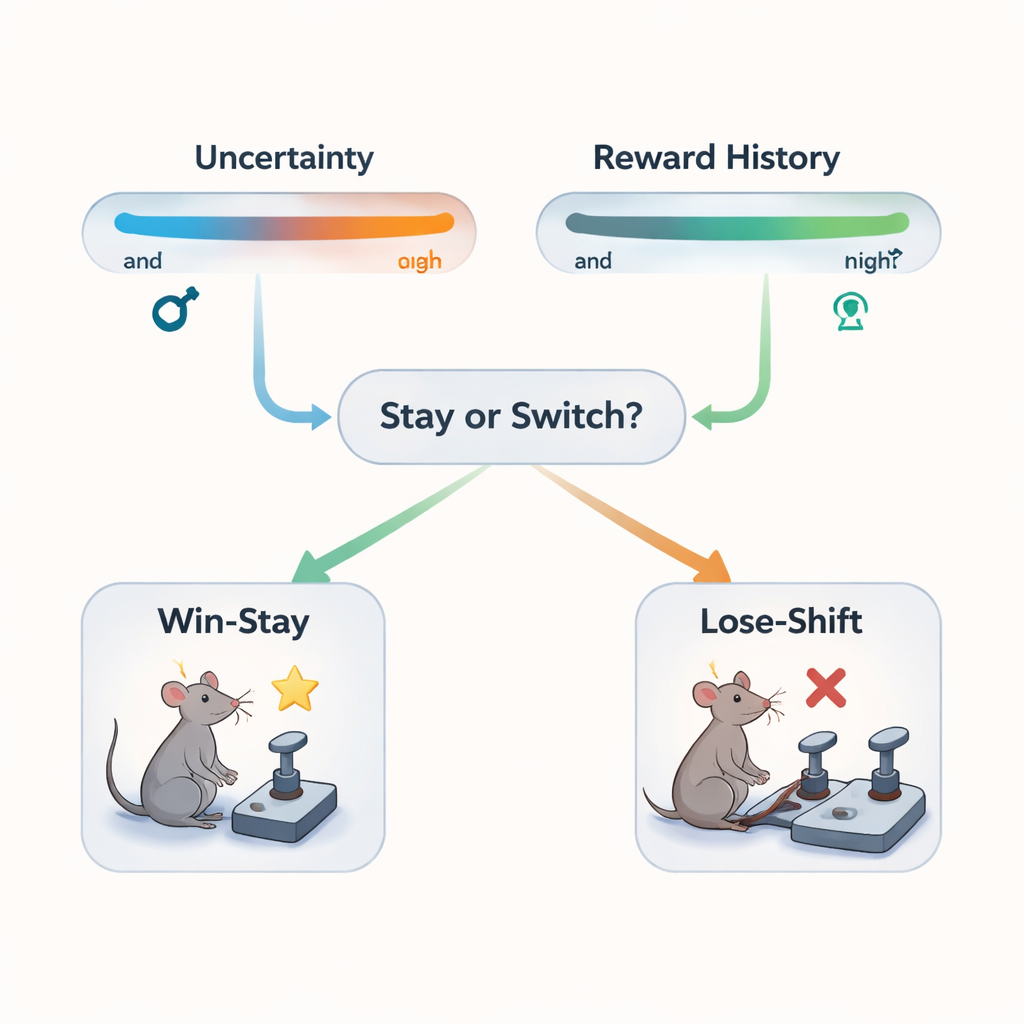
Across hundreds of sessions, rats tended to repeat a choice after a win (“win-stay”) more often than they switched after a loss (“lose-shift”). This confirmed a strong tilt toward learning from success. The pattern was especially clear once rats had time within a block to figure out which lever was usually better. In these later trials, they not only stayed more after wins but were also less likely to abandon the better lever after a rare loss. This strategy helped them keep exploiting the more rewarding option instead of being misled by the occasional bad outcome that can happen even with a good choice. Males showed this bias more strongly than females: they were more likely to stay after wins and less likely to shift after losses.
Hidden signals: uncertainty and reward history
To understand the invisible calculations behind this behavior, the authors used reinforcement learning models—computer algorithms that update expectations based on feedback. They focused on two internal signals. The first was an “uncertainty history” measure: an average of recent surprise levels, capturing how unpredictable outcomes had been. When this number was high, the environment was effectively murkier. The second was a “global reward state,” a smoothed summary of how rich or poor the recent environment felt overall. Together, these signals allowed rats to estimate both how noisy the world was and how well things had been going lately, and to adjust how much weight to give the latest win or loss.
When unpredictability and richness shape choices
The two internal signals influenced behavior in distinct and sometimes sex-specific ways. Rats were more likely to stay after a win and less likely to abandon the better lever when uncertainty was low—that is, when the environment’s pattern was clearer. Under high uncertainty, they were more prone to switch away from a good lever after a loss, suggesting that confusing conditions can trigger more cautious behavior. Meanwhile, a high global reward state, reflecting a generally good run of outcomes, encouraged rats to keep staying after wins and reduced their tendency to switch after losses, even when the environment was somewhat noisy. Males’ win-based decisions were especially shaped by their uncertainty history, whereas females relied more consistently on the overall reward state.
What this means for everyday decisions
To a layperson, the central message is that “learning more from wins than from losses” is not simply being overly optimistic. The study shows that rats—and likely humans—dynamically tune how much they listen to wins and losses based on how predictable and how rewarding their world has felt recently. When the rules seem clear and rewards are plentiful, it can be smart to trust wins and discount occasional failures. When things feel chaotic or lean, giving more weight to losses may help avoid bad choices. The work also reveals that males and females can follow the same task rules using slightly different internal balances of uncertainty and reward history, an insight that may help explain sex differences in vulnerability to conditions like addiction or depression, where learning from reward and punishment goes awry.
Citation: Kalhan, S., Magnard, R., Zhang, Z. et al. Uncertainty and reward histories have distinct effects on decisions after wins and losses. Sci Rep 16, 6795 (2026). https://doi.org/10.1038/s41598-026-37554-3
Keywords: reinforcement learning, decision making, uncertainty, reward history, sex differences