Clear Sky Science · en
Bifidobacterium longum CBi0703 lysate modulates oxidative stress induced apoptosis and cartilage related gene expression in SW1353 chondrocytes: in vitro insights into the gut joint axis in Osteoarthritis
Why Your Gut Might Matter to Your Aching Joints
Osteoarthritis is often thought of as simple “wear and tear” in the knees, hips, or hands. But scientists are discovering that what happens in your gut may influence how fast your joints break down. This study explored whether a preparation made from a beneficial gut bacterium, Bifidobacterium longum CBi0703, can help protect cartilage cells under stress in the lab, and how it might work alongside familiar joint supplements like collagen, glucosamine, and chondroitin. 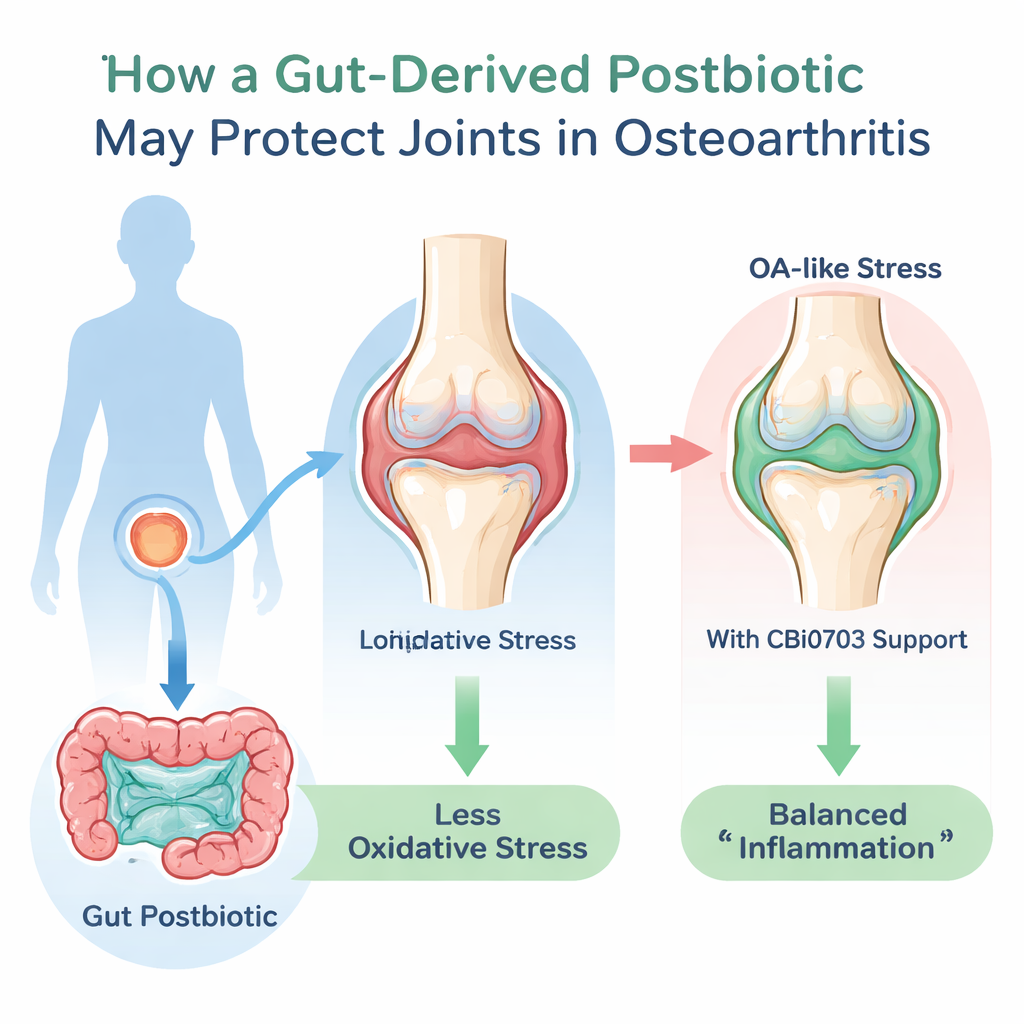
A Fresh Look at Joint Wear and Tear
Osteoarthritis develops when the balance in cartilage tips from building up to breaking down. Standard treatments focus on easing pain and, in some cases, nudging cartilage to rebuild. Nutritional supplements such as vitamin C, collagen, glucosamine, chondroitin, and eggshell membrane are widely used to support this rebuilding side. Yet many patients still see their joints gradually worsen, suggesting that slowing the “destruction” side of the equation is just as important. The authors of this paper asked whether a gut-derived product—called a postbiotic, because it is made from inactivated bacteria and their metabolites—could help calm damage signals inside cartilage cells.
Testing Cartilage Cells Under Attack
To probe this idea, the researchers used a human cartilage-like cell line grown in dishes. They exposed these cells to hydrogen peroxide, a chemical that generates oxidative stress similar to what joint cells experience in osteoarthritis. This treatment pushed the cells toward injury and programmed cell death (apoptosis), creating an “OA-like” state. After this stress, the cells were treated with the B. longum CBi0703 lysate alone or combined with common joint nutraceuticals, including vitamin C, collagen, chondroitin sulfate, glucosamine sulfate, a multi-ingredient mix, and natural eggshell membrane. The team then measured how well the cells survived and divided, how many were undergoing apoptosis, and which genes linked to cartilage breakdown and repair were turned on or off.
More Resilient Cells and Calmer Damage Signals
The gut-derived lysate showed promising protective effects. On its own and in several combinations, it boosted cell proliferation without harming overall viability. It reduced activation of caspases—molecular executioners of apoptosis—and in some combinations, especially with glucosamine, cut the proportion of cells in late-stage cell death. At the genetic level, treatments with B. longum CBi0703 tended to dial down “catabolic” markers tied to cartilage breakdown, such as MMP1, MMP13, ECM1, and GBL1, while helping maintain or increase “anabolic” and matrix-protective markers like COL2A1, SOX9, AGC1, and TIMP1. For example, pairing the lysate with vitamin C boosted protective genes SOX9 and TIMP1 while lowering genes linked to scar-like collagen and excessive matrix remodeling. 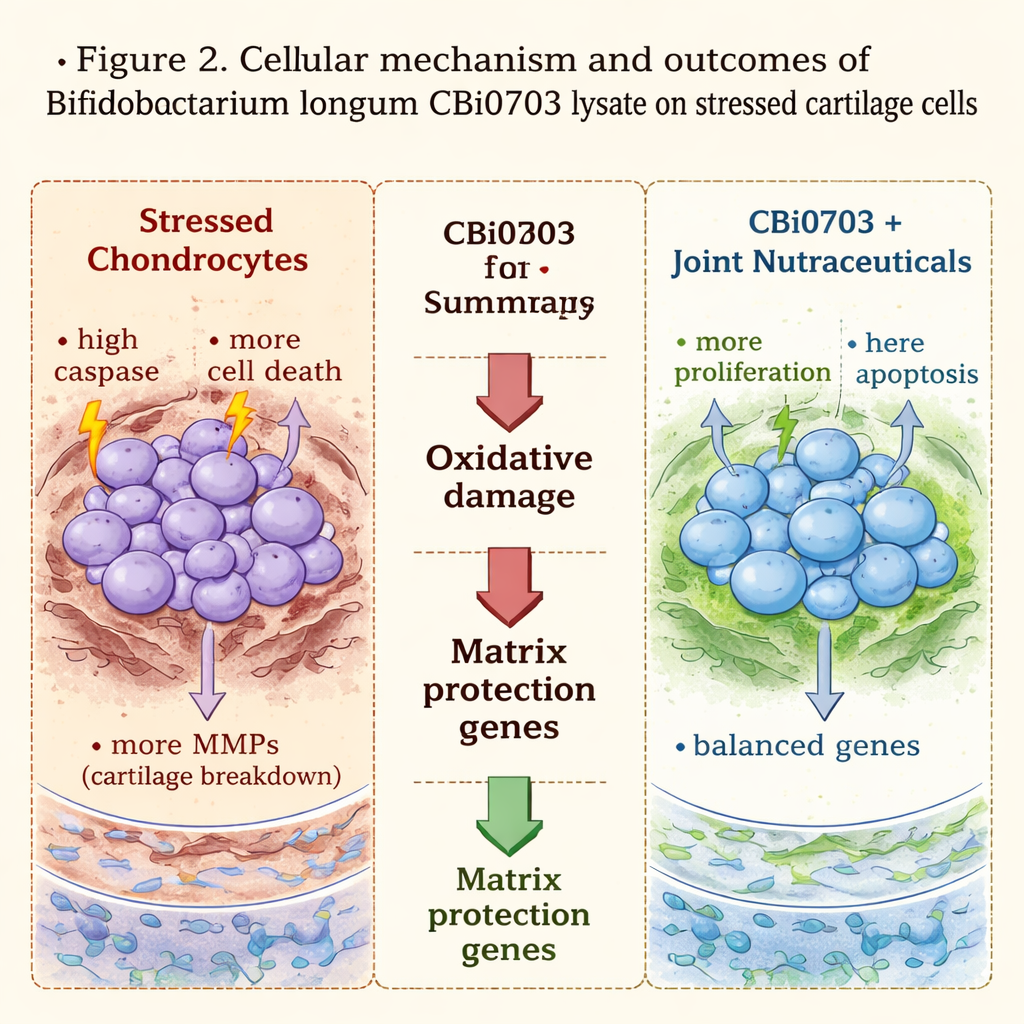
Teaming Up With Familiar Supplements
One key message from the study is that the postbiotic may complement, rather than replace, existing joint supplements. Chondroitin paired with B. longum CBi0703 increased expression of COL2A1, a marker of healthy cartilage, while glucosamine in combination with the lysate reduced late apoptosis and lowered a hypertrophy-related gene, COL10A1. Other combinations with collagen, eggshell membrane, and a chondrocyte-targeted mix also showed favorable shifts in markers of cartilage integrity and cellular aging. These effects were observed at the level of gene activity rather than direct tissue repair, but together they paint a picture of a more balanced environment inside stressed cartilage cells—less push toward breakdown and cell death, and more support for maintenance and renewal.
What This Could Mean for People With Osteoarthritis
For now, these findings come from cartilage-like cells in a dish, not from patients, so they should be viewed as early mechanistic clues, not proof that a particular product will stop joint damage. The study shows that a postbiotic derived from Bifidobacterium longum CBi0703 can nudge stressed cartilage cells toward survival and a healthier pattern of gene activity, especially when combined with established nutraceuticals. This supports the emerging idea of a “gut–joint axis,” where gut-derived molecules help shape joint health. The authors argue that targeting both sides of cartilage balance—building and breaking down—may offer a more complete strategy for osteoarthritis. Future animal studies and clinical trials will be needed to confirm whether these lab-based benefits translate into less pain, better function, and slower joint wear in real life.
Citation: Mas-Capdevila, A., Carrera-Marcolin, L., Balaguer-Trias, J. et al. Bifidobacterium longum CBi0703 lysate modulates oxidative stress induced apoptosis and cartilage related gene expression in SW1353 chondrocytes: in vitro insights into the gut joint axis in Osteoarthritis. Sci Rep 16, 6640 (2026). https://doi.org/10.1038/s41598-026-37552-5
Keywords: osteoarthritis, cartilage, probiotics and postbiotics, joint supplements, oxidative stress