Clear Sky Science · en
Proton pump inhibitor use is not independently associated with colonic diverticulosis in an asymptomatic screening population
Everyday Heartburn Pills and a Hidden Gut Condition
Millions of people take acid-suppressing drugs called proton pump inhibitors (PPIs) for heartburn and ulcers, often for years. At the same time, more and more adults, including younger ones, are being found to have small pouch-like bulges in the colon wall, known as diverticulosis. Because PPIs can change gut bacteria, doctors have wondered: could these common pills be quietly promoting these colon changes? This study set out to test that idea in a large group of symptom-free adults undergoing routine colonoscopy screening.
What the Researchers Wanted to Know
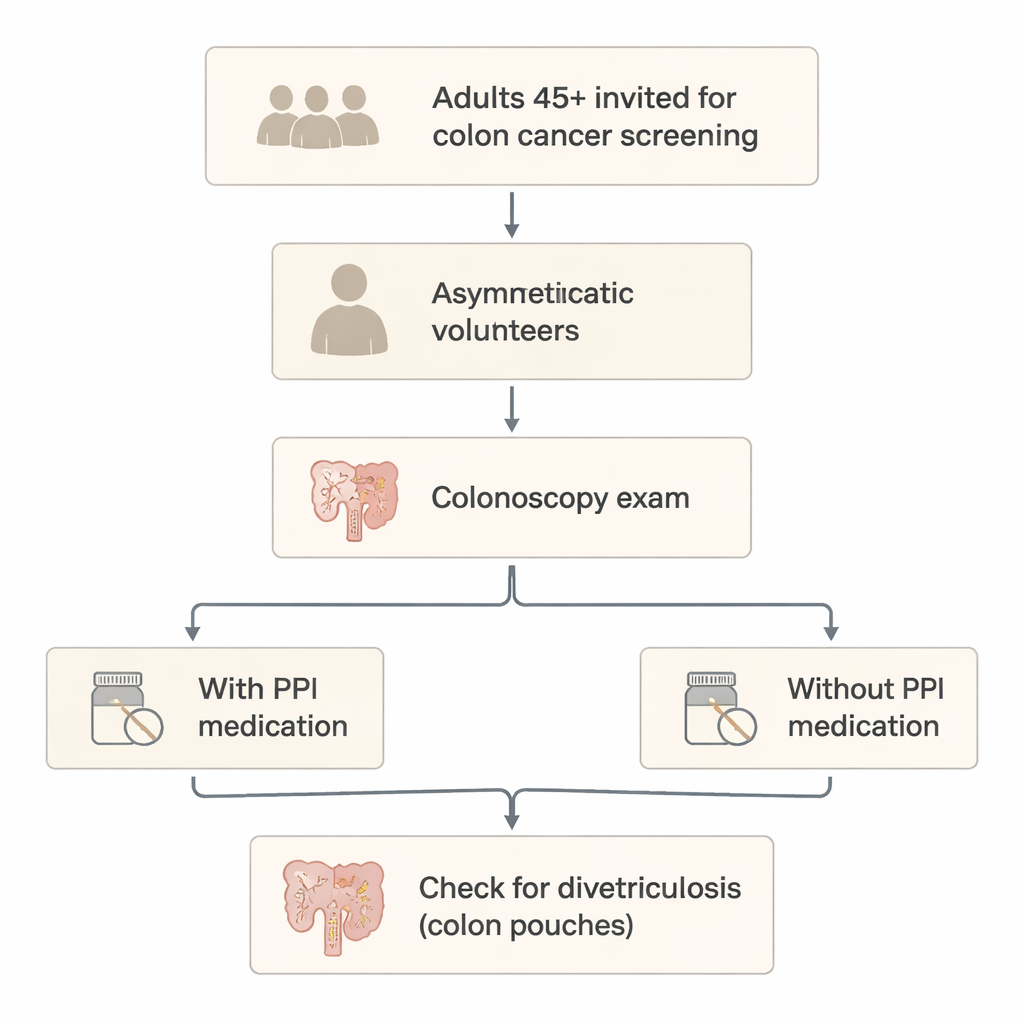
The team worked with more than 6,100 adults in Austria who came for colonoscopy as part of a colorectal cancer screening program. None had bowel symptoms that would have triggered the exam; they were there purely for prevention. During colonoscopy, doctors checked whether people had diverticulosis and where in the colon the pouches were located. At the same visit, participants reported all regular medications, including whether they were currently using a PPI for stomach or esophagus problems.
Who Took PPIs and Who Had Colon Pouches
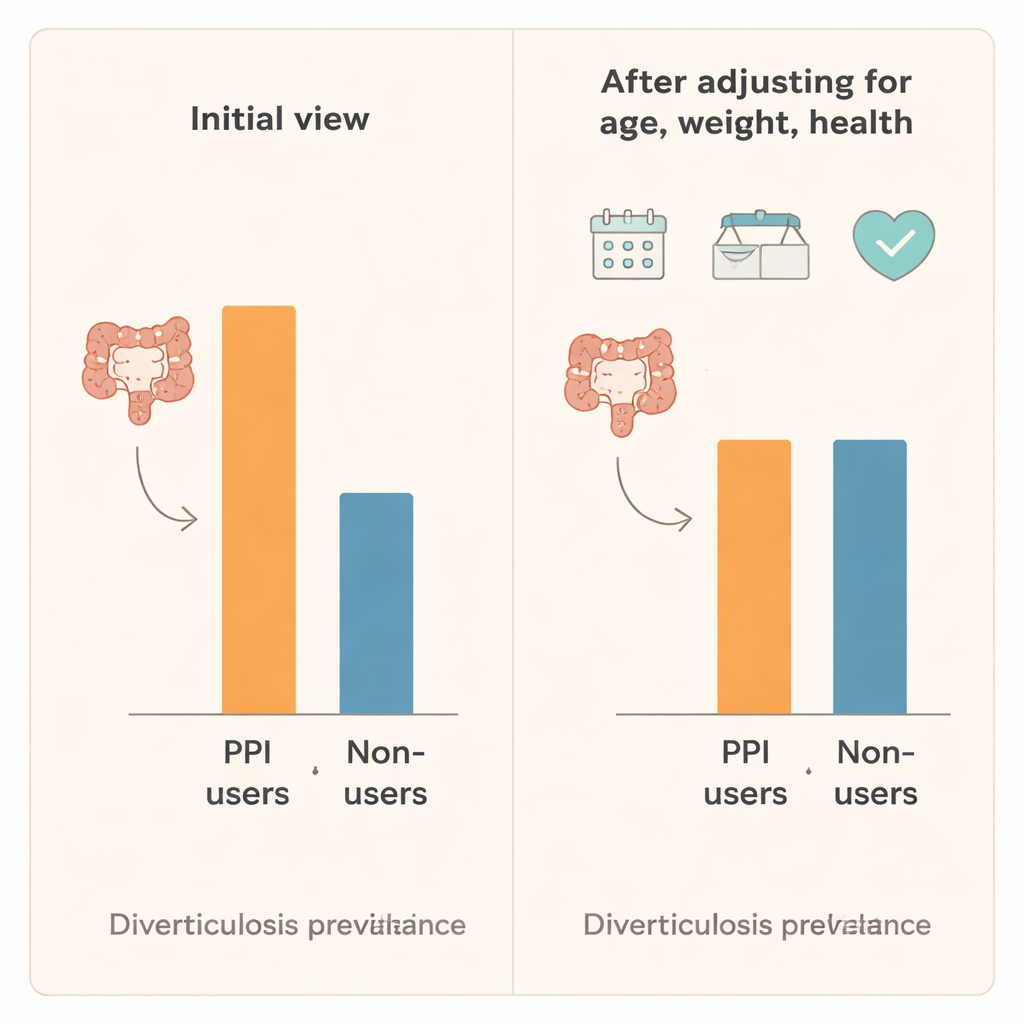
Only about 8% of participants were PPI users, but they differed in important ways from non-users. On average, people taking PPIs were older, had a higher body mass index, and were more likely to have high blood pressure, diabetes, and features of the metabolic syndrome. They also tended to have lower levels of formal education and were less physically active. Overall, 37% of all screened participants had diverticulosis, but the simple, side-by-side comparison showed a higher rate in PPI users (48%) than in non-users (36%). At first glance, this looked as though PPIs might be linked to the development of colon pouches.
Looking Below the Surface with Statistics
Because PPI users were clearly less healthy in other ways that already raise the risk of diverticulosis—such as older age, higher weight, and more heart and metabolic problems—the researchers used statistical models to separate the effect of PPIs from these overlapping factors. In an initial model that adjusted only for age and sex, PPI use still appeared modestly related to diverticulosis. But once the analysis added body weight, diabetes, blood pressure, cholesterol, diet, and education level, the link disappeared. In other words, after accounting for who PPI users are, PPIs themselves no longer showed an independent connection to the presence of colon pouches.
What This Means for Patients and Doctors
The findings suggest that the higher rate of diverticulosis in PPI users is not because the pills are directly causing damage to the colon wall. Instead, people who use PPIs are often older and have more cardiometabolic and lifestyle risk factors—exactly the same features that are already known to favor the formation of diverticula over time. The study did not find any sign that taking a stronger standard dose of PPIs carried more risk than a half-dose. While the work cannot prove cause and effect—because exposure and outcome were measured at a single point in time—it strongly argues that previously reported links between PPIs and diverticula may mainly reflect confounding rather than a harmful drug effect.
Take-Home Message
For people who need PPIs for well-established reasons, this study offers some reassurance: in a large, symptom-free screening population, PPI use was not independently associated with having diverticulosis once age, weight, health conditions, and lifestyle were taken into account. That does not mean PPIs are risk-free, and they should still be used at the lowest effective dose and duration. But when it comes to the development of silent colon pouches, this research suggests the pills themselves are unlikely to be the main culprit; instead, broader aspects of aging, metabolism, and everyday habits appear to play the leading roles.
Citation: Völkerer, A., Wernly, S., Semmler, G. et al. Proton pump inhibitor use is not independently associated with colonic diverticulosis in an asymptomatic screening population. Sci Rep 16, 6260 (2026). https://doi.org/10.1038/s41598-026-37547-2
Keywords: proton pump inhibitors, diverticulosis, colon health, gut microbiome, colonoscopy screening