Clear Sky Science · en
Metagenomic analysis revealed the presence of novel Actinomycetota “Candidatus Solincola uaceae” sp. nov., obtained from a hot spring
A Hidden World in Boiling Waters
Hot springs may look like quiet pools of steaming water, but they are teeming with microscopic life specially adapted to heat and harsh chemicals. These tiny residents are not only windows into how life survives in extreme places on Earth today, they also offer clues to early life on our planet and potential new sources of useful molecules, including antibiotics. In this study, researchers used modern DNA tools to discover and describe a new kind of heat‑loving bacterium from an Indian hot spring and to explore how it powers itself and stays alive under such punishing conditions.
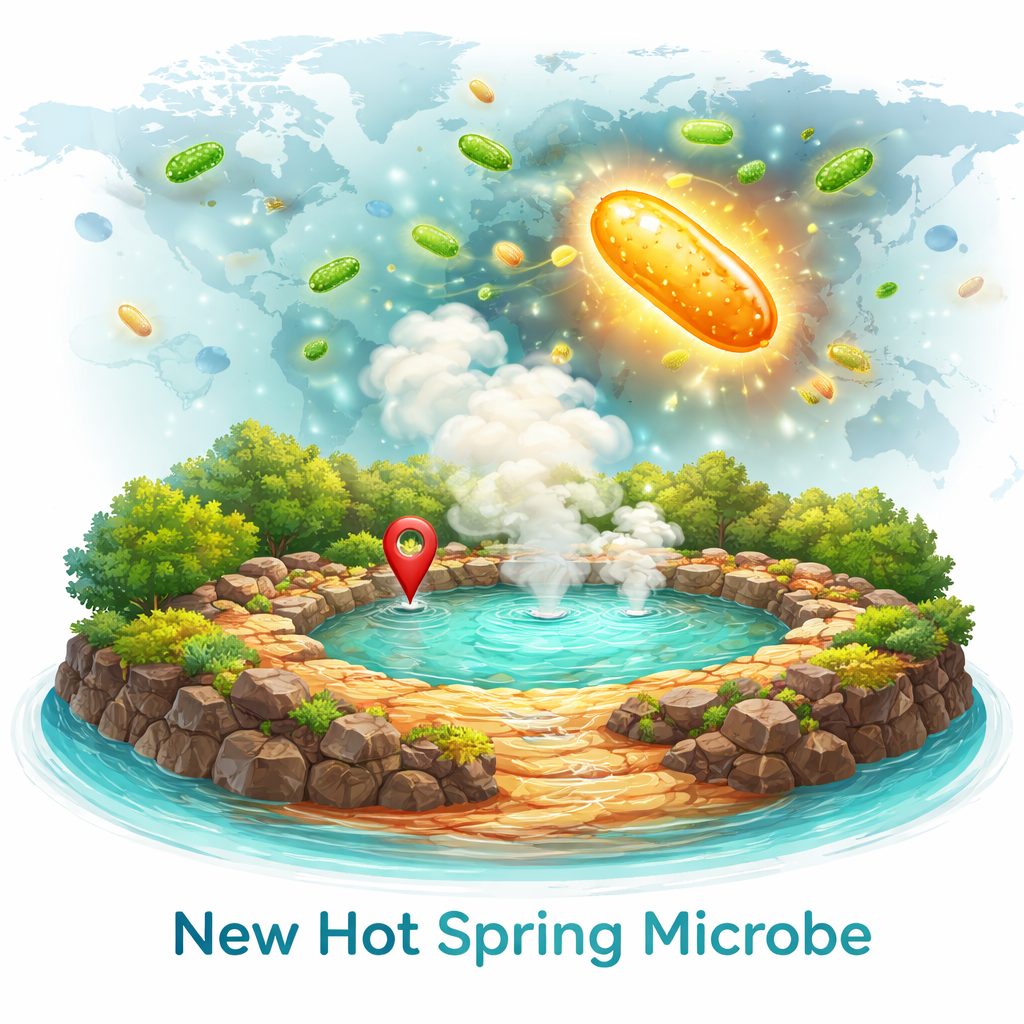
Life in a Natural Pressure Cooker
The team focused on the Tuwa hot spring in Gujarat, India, where the water reaches about 55 degrees Celsius and has a neutral pH, conditions that would kill many familiar microbes. Instead of trying to grow these organisms in the lab—a method that often misses most of the species present—they collected sediment from the spring and sequenced all the DNA in the sample. By carefully piecing together the resulting fragments, they reconstructed a nearly complete genome of a single bacterial type, called a metagenome‑assembled genome. This high‑quality genome, named MPNR_HS_01, belonged to a group of bacteria known as Actinomycetota, famous as a rich natural source of antibiotics.
A New Member of a Little‑Known Clan
Detailed comparison of the new genome with existing bacterial genomes showed that MPNR_HS_01 is closely related to a little‑studied group called “Candidatus Solincola,” previously found in hot environments. Yet the genetic overlap fell below current cut‑off values that scientists use to define a species, meaning this microbe is distinct enough to be considered new. The researchers also searched a global database of DNA from many environments and found relatives of this organism not just in hot springs, but also in wastewater, marine and freshwater systems, sediments, and even animal guts. This suggests that members of this clan are widespread and able to adapt to very different habitats, even though they were first noticed in hot, mineral‑rich settings.
How the Microbe Fuels and Protects Itself
By examining its genes, the scientists could infer how the new bacterium makes a living. Its genome holds the full set of instructions for breaking down sugars (glycolysis) and for another key sugar‑related pathway, while a major energy‑producing cycle is incomplete—an unusual feature shared with its closest relatives. Strikingly, it carries the toolkit for the Wood–Ljungdahl pathway, a sophisticated route that lets microbes turn carbon dioxide into useful building blocks. It also encodes several molecular “machines” that move electrons and ions across its membrane and generate ATP, the cell’s energy currency. Other genes help build and repair the cell wall and make amino acids like arginine and proline. Together, these systems form an efficient survival package for turning simple ingredients into energy and cell material.
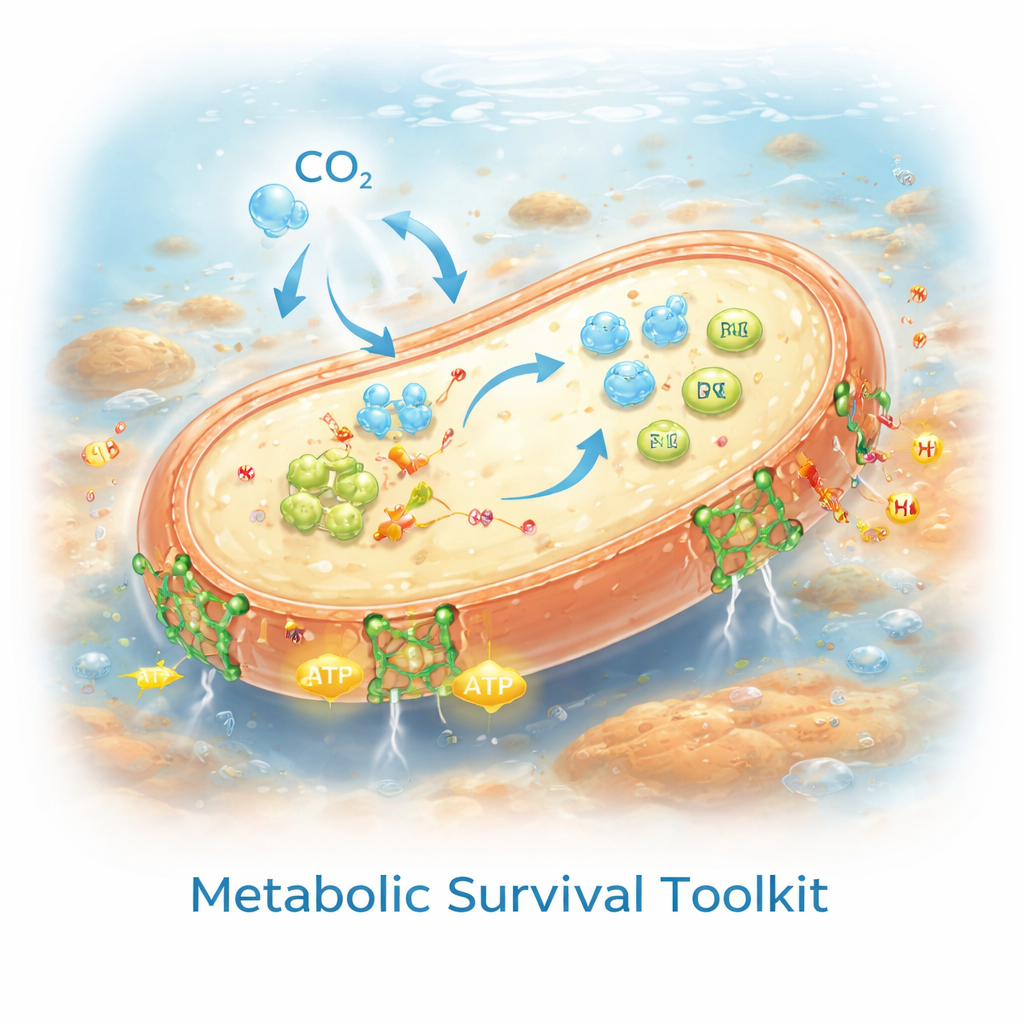
Built for Heat and Harsh Conditions
Living in a hot spring means coping with both high temperature and changing salt levels. The new bacterium’s genome reveals an array of heat shock proteins and chaperones that act like tiny repair crews, refolding damaged proteins and keeping them functional. It also carries transport systems and pumps that juggle sodium, potassium, and other ions to keep the cell’s internal environment stable. While it lacks the usual spinning tails (flagella) that many bacteria use to swim, it does have genes for type IV pili—thin, retractable filaments that can pull the cell along surfaces in a jerky motion known as twitching. On top of this, the genome contains a cluster of genes for making a compound in the betalactone family, a type of molecule often linked to antibiotic or other bioactive properties.
Why This Tiny Discovery Matters
Altogether, the genetic evidence shows that this hot‑spring microbe is both clearly related to, and clearly different from, known “Candidatus Solincola” species. It has its own combination of energy‑making pathways, stress defenses, and movement strategies, leading the authors to propose it as a new species, which they name “Candidatus Solincola uaceae.” For non‑specialists, the key message is that even in a single scoop of hot spring sediment, there are still entirely new forms of life waiting to be discovered. Each such find not only sharpens our picture of life’s diversity and history, but could also point the way to new enzymes, drugs, and biotechnologies drawn from organisms that have mastered survival at the edge of what life can tolerate.
Citation: Suksa, W., Li, WJ., Luo, ZH. et al. Metagenomic analysis revealed the presence of novel Actinomycetota “Candidatus Solincola uaceae” sp. nov., obtained from a hot spring. Sci Rep 16, 6922 (2026). https://doi.org/10.1038/s41598-026-37544-5
Keywords: hot spring microbes, extremophiles, metagenomics, carbon fixation, Actinomycetota