Clear Sky Science · en
Covalent immobilization of Lepidium draba peroxidase on chitosan-coated magnetic nanoparticles and its application in glucose biosensing
Why tiny magnets matter for blood sugar
Keeping blood sugar in check is critical for managing diabetes and preventing long‑term damage to the heart, kidneys, eyes, and nerves. Today’s glucose tests work well, but the enzymes inside them can be fragile, short‑lived, and hard to reuse, which raises cost and waste. This study explores a clever way to make a plant enzyme tougher and longer‑lasting by fastening it onto microscopic magnetic beads, opening the door to faster, more reliable, and potentially cheaper glucose tests.
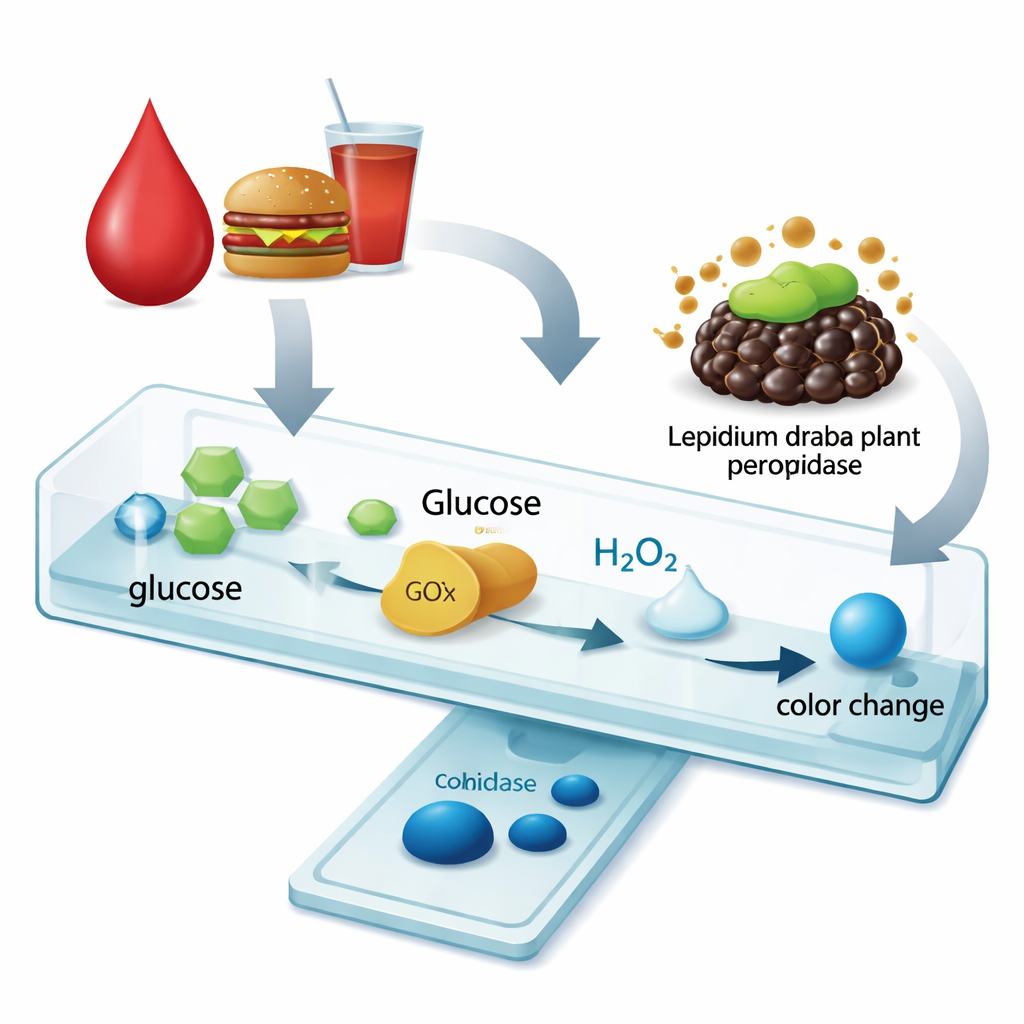
A plant helper inspired by horseradish
Many medical tests rely on enzymes—proteins that speed up chemical reactions. A workhorse in diagnostic labs is horseradish peroxidase, used to turn invisible chemical changes into clear color shifts you can see with the naked eye. The researchers worked with a close plant cousin of this enzyme, called Lepidium draba peroxidase, produced in bacteria so it can be made in large amounts. On its own, this free enzyme is powerful but delicate: it loses activity with heat, storage, and repeated use, which limits its value in industrial sensors and clinical kits.
Turning enzymes into magnetic tools
To protect and reuse the enzyme, the team attached it to iron oxide nanoparticles—tiny grains of magnetic material—coated with a natural polymer called chitosan, which is derived from shellfish shells. Chitosan provides a soft, biocompatible layer full of chemical “handles” that can grab onto enzymes. Using a small cross‑linking molecule, glutaraldehyde, they formed strong covalent bonds between the enzyme and the coated particles. The scientists then fine‑tuned how much cross‑linker they used, how long the reaction ran, and how much support material they added, settling on conditions that gave the best balance between how much enzyme stuck and how active it remained.
Checking structure, strength, and staying power
After immobilization, the team confirmed that the enzyme really sat on the particles using several structural tools that read out bond vibrations, crystal patterns, and surface shape. More importantly for real‑world use, the immobilized enzyme behaved better than its free form. It grabbed onto its dye substrate more readily and converted it to colored product far more efficiently—up to 11‑fold higher catalytic efficiency in some tests. The attached enzyme also tolerated a broader range of acidity, kept higher activity across useful temperatures, and withstood heating at 50 °C for far longer. Its half‑life at that temperature more than doubled, and after two months in the fridge it retained roughly twice as much activity as the free enzyme. Because the particles are magnetic, they could be pulled out of solution with a magnet and reused; even after 11 reaction cycles, about 40% of the initial activity remained.
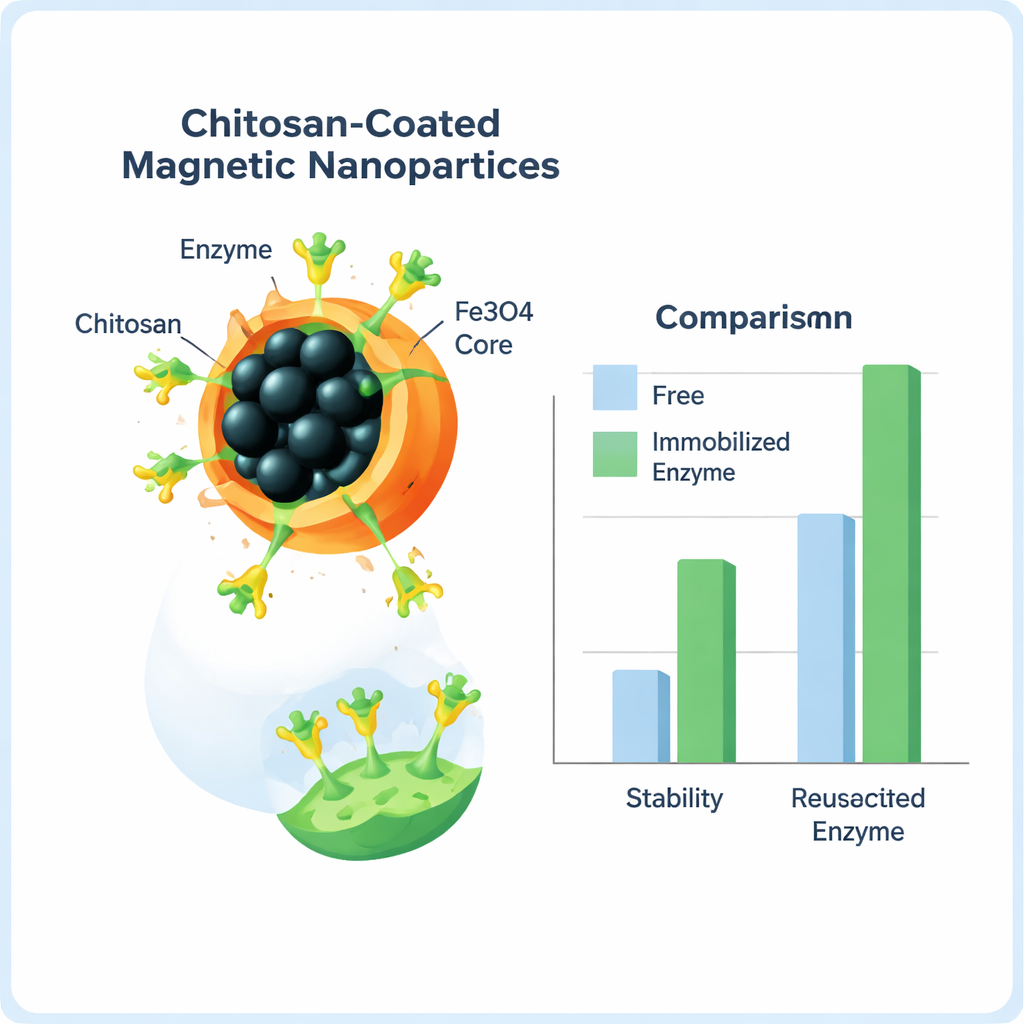
Sharper color change for glucose tests
To see whether this tougher enzyme actually improves a practical test, the researchers built a simple color‑based glucose assay. First, a standard glucose‑oxidase enzyme converts glucose into hydrogen peroxide. Then the Lepidium draba enzyme, either free or immobilized on the magnetic chitosan beads, uses that hydrogen peroxide to turn a colorless dye deep blue. With the immobilized form, the useful measurement range for glucose widened dramatically—from covering only 0.1 to 1 millimole per liter with the free enzyme to 0.1 to 10 millimoles per liter when immobilized. At the same time, the reaction time needed for the assay dropped to about one‑third, while the minimum detectable glucose level stayed very low and clinically relevant.
What this means for everyday health
By anchoring a plant enzyme onto chitosan‑coated magnetic nanoparticles, the authors created a robust, reusable, and highly sensitive color‑based glucose sensor component. For a layperson, this means future test strips, lab kits, or even smart packaging for foods could become more stable, more accurate over a wider sugar range, and potentially cheaper because the active enzyme can be recovered and reused. While further work is needed to boost how much enzyme the particles can hold and to extend the approach to other blood markers like cholesterol or urea, this study shows how nanomaterials and natural polymers can work together to upgrade familiar biochemical tools into tougher, cleaner, and more versatile diagnostic systems.
Citation: Sepahi-Baghan, M., Asoodeh, A. & Riahi-Madvar, A. Covalent immobilization of Lepidium draba peroxidase on chitosan-coated magnetic nanoparticles and its application in glucose biosensing. Sci Rep 16, 7035 (2026). https://doi.org/10.1038/s41598-026-37542-7
Keywords: glucose biosensor, enzyme immobilization, magnetic nanoparticles, colorimetric detection, peroxidase