Clear Sky Science · en
Topical treatment of diabetic foot ulcers using a novel quercetin-loaded hyaluosome gel nanoformulation
Why stubborn foot wounds matter
For many people with diabetes, a small sore on the foot can turn into a stubborn ulcer that refuses to heal. These diabetic foot ulcers are painful, difficult to treat, and can ultimately lead to amputation. Doctors urgently need treatments that can calm inflammation, fight infection without overusing antibiotics, and help damaged skin rebuild itself. This study explores a new gel containing a plant-derived compound called quercetin, packed into tiny soft particles designed to slip into the skin and accelerate the healing of diabetic foot wounds.
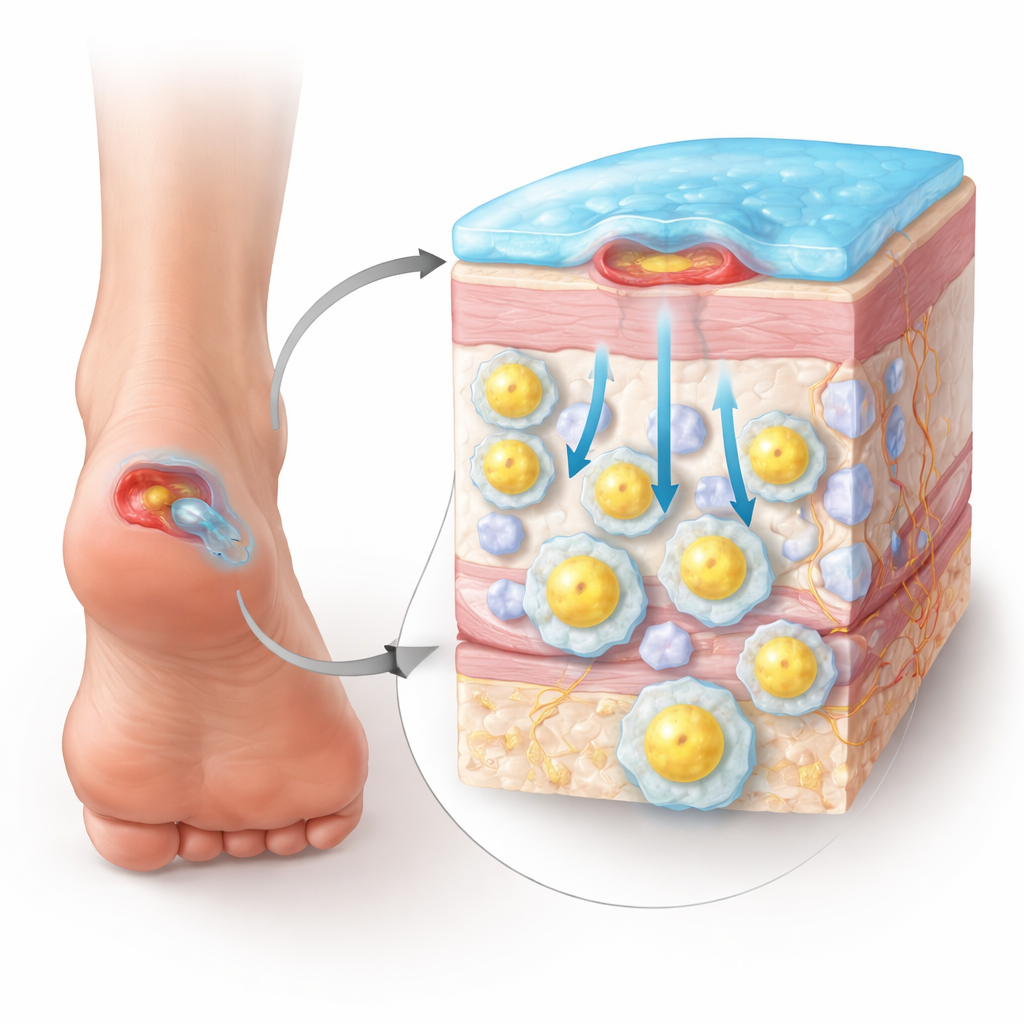
A plant molecule with untapped promise
Quercetin is a natural substance found in apples, onions, tea, and many other foods. In laboratory studies it can act as an antioxidant, reduce inflammation, and slow the growth of microbes—three properties that are very attractive for treating chronic wounds. But in its usual form, quercetin does not dissolve well in water, breaks down easily, and has trouble passing through the outer layers of the skin. As a result, very little of it reaches the damaged tissue when simply applied as a standard cream or gel, limiting its real-world usefulness.
Tiny carriers that help medicine sink in
To solve this, the researchers built a “smart” delivery system called a hyaluosome: a soft, fat-based bubble combined with hyaluronic acid, a sugar-like molecule that holds water and is already used in skin fillers and moisturizers. They loaded quercetin into these nano-sized vesicles and mixed them into a clear hydrogel. Tests showed that the particles were uniform and very small—about one-thousandth the width of a human hair—and carried a stable electrical charge that prevented clumping. The formulation trapped nearly 90% of the quercetin, released it slowly over many hours, and remained smooth, mildly acidic, and easy to spread, all important features for a product intended for fragile, irritated skin.
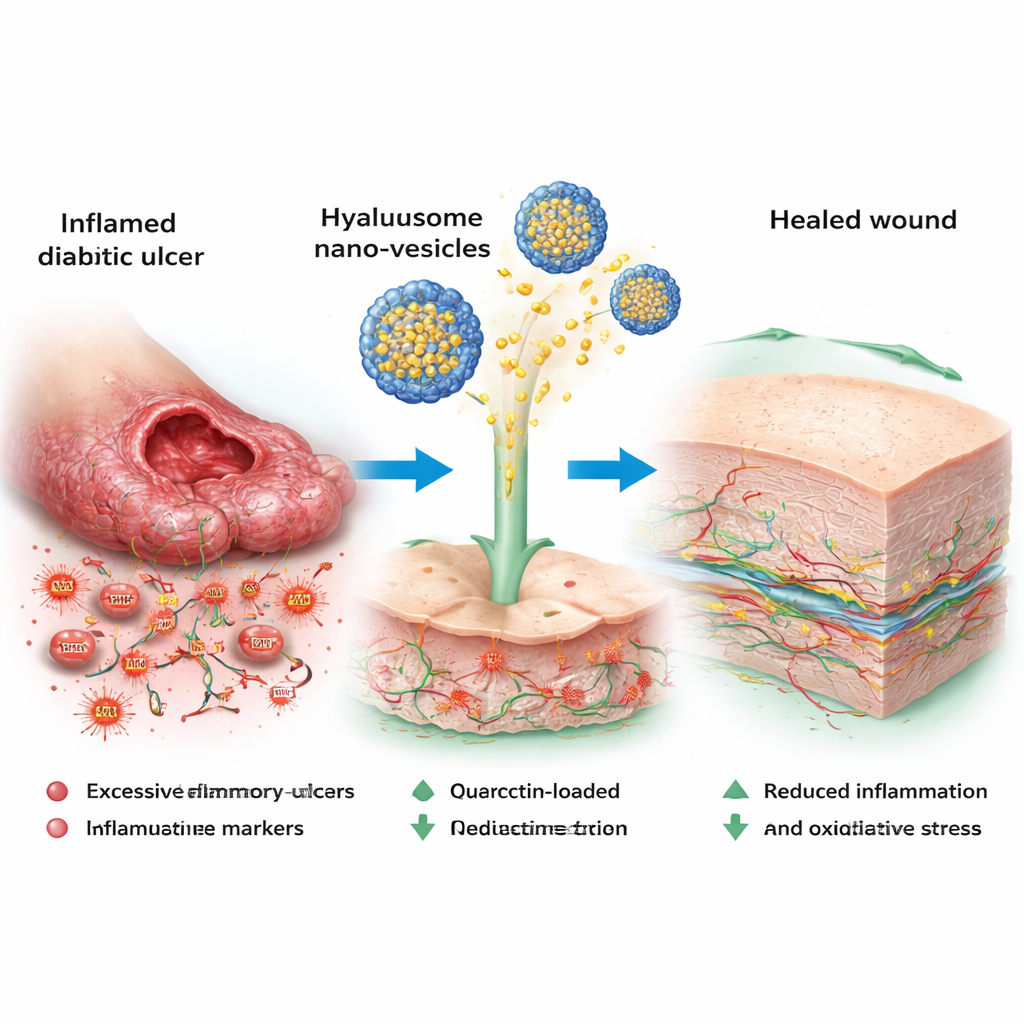
Putting the gel to the test in cells and animals
The team first checked how the new gel behaved on human skin cells in culture. Compared with plain quercetin, the nano-gel was more effective at boosting cell activity and helping fibroblasts—the cells that lay down new tissue—migrate into an artificial scratch wound. Then they moved to a rat model that closely mimics human type 2 diabetes and diabetic foot ulcers. Animals were fed a high-fat, high-sugar diet and given a low dose of a diabetes-inducing drug, then a small full-thickness wound was created on the hind foot. Rats were divided into groups receiving no treatment, standard quercetin gel, the new quercetin–hyaluosome gel, or a commonly used antibiotic cream.
Faster closure and calmer, stronger skin
Over nearly two weeks, the quercetin–hyaluosome gel group showed the fastest and most complete wound closure—about 96% healed by day 13, outperforming both the plain quercetin gel and the antibiotic cream. Microscopic and molecular tests revealed why. In untreated diabetic ulcers, inflammatory messengers such as IL‑6, IL‑17, and TNF‑α were high, antioxidant defenses were weak, and enzymes that chew up the tissue’s scaffolding were overactive. With the nano-gel, these inflammatory signals dropped toward normal, protective antioxidants recovered, and the balance between tissue-degrading enzymes and their natural blockers was restored. Histology confirmed smoother, more organized collagen fibers, new blood vessels, and fewer inflammatory cells, while immune staining showed strong suppression of NF‑κB, a master switch for chronic inflammation.
What this could mean for people with diabetes
In plain terms, the study shows that packaging a familiar plant compound into a modern nano-gel can turn a promising but impractical ingredient into a powerful wound-healing tool. By helping quercetin reach deeper skin layers and release gradually where it is needed, the hyaluosome gel both soothes long-standing inflammation and supports the rebuilding of healthy tissue. Although these results come from cell cultures and animal models, they suggest a path toward a future, non-antibiotic, topical treatment that could help diabetic foot ulcers heal faster, reduce the risk of infection and amputation, and ultimately improve quality of life for people living with diabetes.
Citation: Amer, M.S., El-Nesr, K.A., El-Ela, F.I.A. et al. Topical treatment of diabetic foot ulcers using a novel quercetin-loaded hyaluosome gel nanoformulation. Sci Rep 16, 7180 (2026). https://doi.org/10.1038/s41598-026-37537-4
Keywords: diabetic foot ulcers, wound healing, quercetin, nanogel, topical therapy