Clear Sky Science · en
Trace metal pollution and ecological effects on five crops around a typical manganese mining area in Chongqing, China
Why metals in our food matter
Rice, corn, peanuts, soybeans and sweet potatoes form the daily diet for millions of people in China and beyond. But in regions where metal-rich ores are mined and smelted, invisible traces of those metals can ride dust, water and soil into the very crops we eat. This study looks closely at farmland surrounding a major manganese mining area in Chongqing, China, to answer a simple but urgent question: which common crops there are safest to eat, and which quietly deliver a higher dose of toxic metals to our bodies?
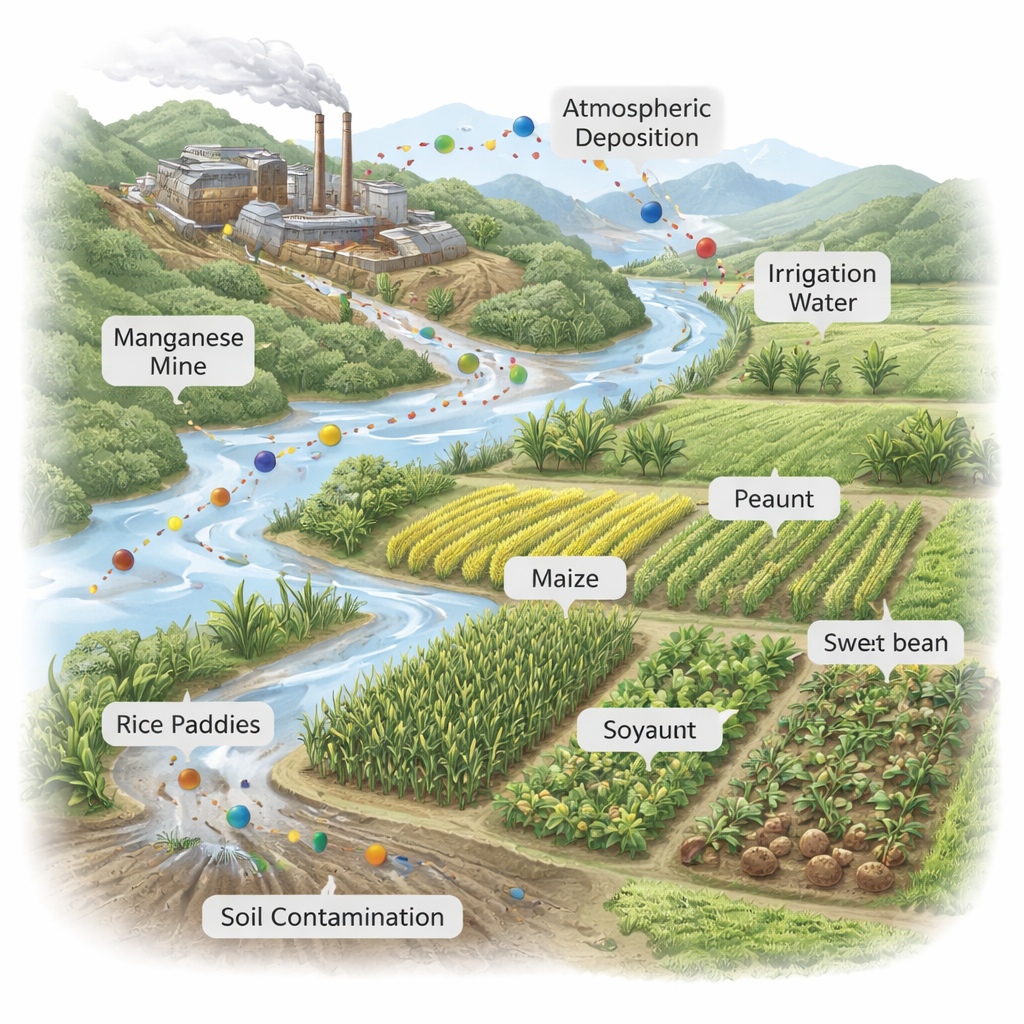
A mining hub next to dinner plates
Xiushan County lies in China’s so‑called “Manganese Industry Golden Triangle,” where mining and smelting of manganese ore underpin much of the local economy. The same activities, however, release a cocktail of trace metals—including manganese, cadmium, chromium, arsenic and lead—into the air, rivers and soils. Researchers sampled soils and five major crops grown along two rivers near mines and smelters: rice, maize, peanut, soybean and sweet potato. For each plant they separated roots, stems, leaves, shells and edible parts, and measured metal levels with high‑precision instruments. They also compared these levels with food safety standards and used health‑risk models based on U.S. Environmental Protection Agency methods to estimate long‑term risks for adults and children.
Where the metals go inside each plant
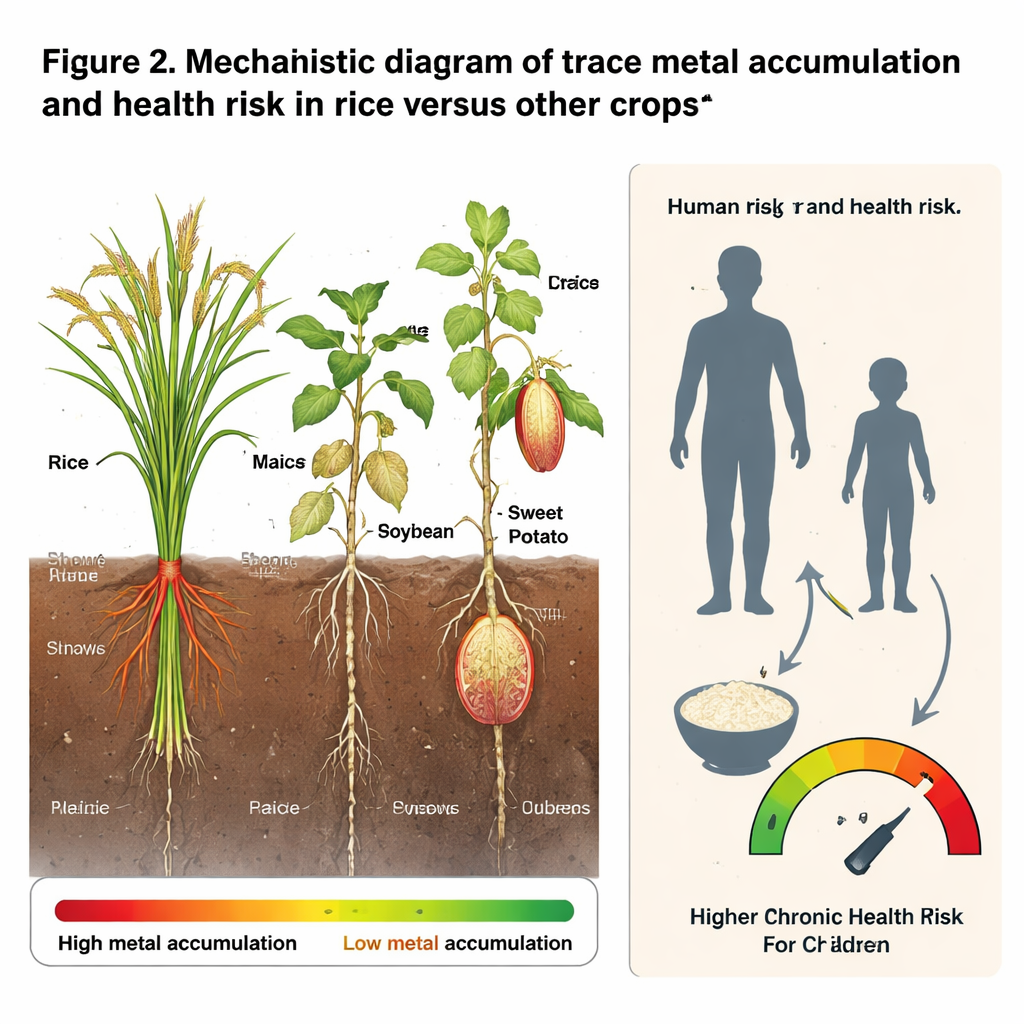
The scientists found that most metals did not rush straight into the parts people eat. Instead, they tended to build up in roots and leaves—acting almost like a buffer to protect seeds and storage organs. Manganese was, unsurprisingly, the most abundant metal in all crops near the manganese mines, and rice plants stored much more of it than the other species. Rice also stood out for chromium and arsenic: whole plants contained higher amounts of these two toxic elements than maize, peanut, soybean or sweet potato. By contrast, cadmium and zinc concentrated most strongly in peanuts and soybeans. Even so, the edible portions of nearly all crops showed relatively low “bioconcentration factors,” meaning only a small fraction of the metal present in soil ended up in the food on the plate.
Rice emerges as the weak link for food safety
When the team translated these measurements into pollution indices, rice consistently ranked as the most contaminated crop. Chromium and arsenic levels in rice grains were high enough that, when compared to Chinese food standards, their combined pollution score far exceeded what is considered safe. Other crops fared better: although their roots and leaves sometimes contained troubling amounts of metals such as nickel and lead, the parts people actually consume generally stayed within regulatory limits. Sweet potato, in particular, showed the lowest overall contamination—even though its edible root grows directly in soil that contains these metals—suggesting that this crop is relatively good at keeping contaminants away from its storage tissues.
Health risks hit children hardest
To understand what these numbers mean for real people, the researchers estimated how much metal an average adult or child would ingest through each crop over many years. For sweet potato, maize, peanut and soybean, the combined health‑risk scores stayed below the level considered hazardous for both age groups. Rice told a different story. Because it is eaten in large quantities, especially in southern China, and because its grains contain elevated chromium and arsenic, long‑term rice consumption in this mining area could cause chronic health problems. The models suggest adults already face a meaningful risk from chromium in rice, while children—who eat a lot relative to their body weight—face chronic toxic effects from arsenic exposure, even though the measured arsenic level in grain is below the official food limit.
What this means for farmers and families
From a layperson’s perspective, the study’s message is straightforward: in this manganese mining region, rice is the riskiest staple, while sweet potato, peanut, soybean and maize are comparatively safer choices. The authors argue that reducing trace metal pollution at its source—by better controlling dust, wastewater and tailings from mines and smelters—is essential. In the meantime, switching some fields from rice to lower‑accumulating crops, improving irrigation water quality, and using soil treatments such as biochar could cut the amount of toxic metals that reach people through food. For families living near such industrial zones, paying attention to which crops come from which fields can quietly but significantly lower long‑term health risks, especially for children.
Citation: Zhang, Y., Li, X., Kong, F. et al. Trace metal pollution and ecological effects on five crops around a typical manganese mining area in Chongqing, China. Sci Rep 16, 6660 (2026). https://doi.org/10.1038/s41598-026-37535-6
Keywords: manganese mining, trace metals in crops, rice contamination, food safety, arsenic and chromium