Clear Sky Science · en
Comparison of two Metop-3MI instrument models and implications for on-ground testing in multi-unit space missions
Why testing twin space cameras matters
Weather forecasts, climate records, and air‑quality alerts increasingly rely on fleets of satellites that carry almost identical cameras. Building several copies helps cover more of Earth and keep data flowing for decades. But there is a catch: carefully testing each camera on the ground is slow and expensive. This study asks a simple but crucial question with big practical consequences: if two instruments are built to be twins, can engineers fully test just one and reuse those results for the others without harming the science?
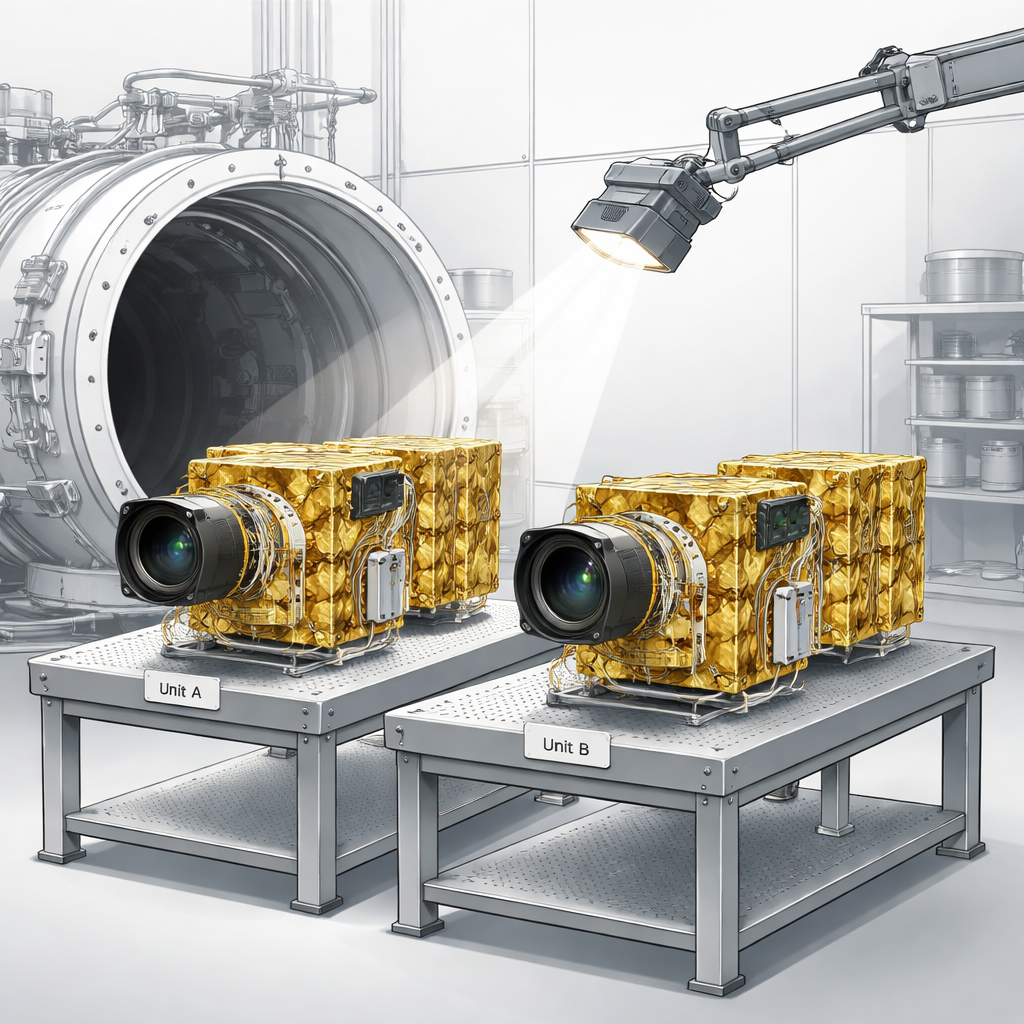
Two “identical” eyes on Earth
The paper focuses on 3MI, a sophisticated camera flying on Europe’s Metop Second Generation weather satellites. 3MI looks at clouds and tiny airborne particles called aerosols from multiple angles, colors, and polarizations (the orientation of light waves). These details are essential for climate monitoring and weather prediction, but they push the instrument’s accuracy demands to the limit. Three copies of 3MI are being launched one after another to guarantee a long, stable record. The authors compare two of these units: an early prototype intended to fly (PFM) and a later flight model (FM2). On paper, they are built to the same design; in practice, tiny differences in manufacturing, alignment, and cleanliness can change how they see light.
Inside a space‑like test lab
To make sure the instruments work as expected, both 3MI units were tested in a three‑meter‑wide chamber that mimics the vacuum and temperatures of space. Various light sources and telescopes, called collimators, shine controlled beams into the camera at many angles and colors. The team measured how each pixel lines up with a direction on the sky, how sharply images are formed, how the detector responds to bright and dim light, how sensitive it is to polarization, and how evenly it sees a uniformly bright scene. Most demanding of all, they mapped “stray light” — unwanted reflections and scatter that smear bright features over dark regions, potentially hiding faint atmospheric signals. For 3MI, characterizing stray light required about 17,000 measurements and more than 50 days inside the chamber, dominating the entire ground‑test campaign.
When small differences become a big deal
At first glance, the two cameras behaved reassuringly alike: both met their formal performance requirements. Image sharpness, for instance, was similar enough that the more detailed test done on one unit could stand in for the other. However, the story changed once the authors looked at the level of precision needed to turn raw images into trustworthy numbers. The mapping between pixels and viewing angles differed by more than the allowed error, meaning each unit would misplace clouds and aerosols on Earth in its own subtle way unless calibrated separately. Pixel‑by‑pixel sensitivity, polarization response, and the overall gain converting counts to physical brightness also diverged beyond the tight tolerances needed for high‑quality climate data, even though these differences were tiny in absolute terms.
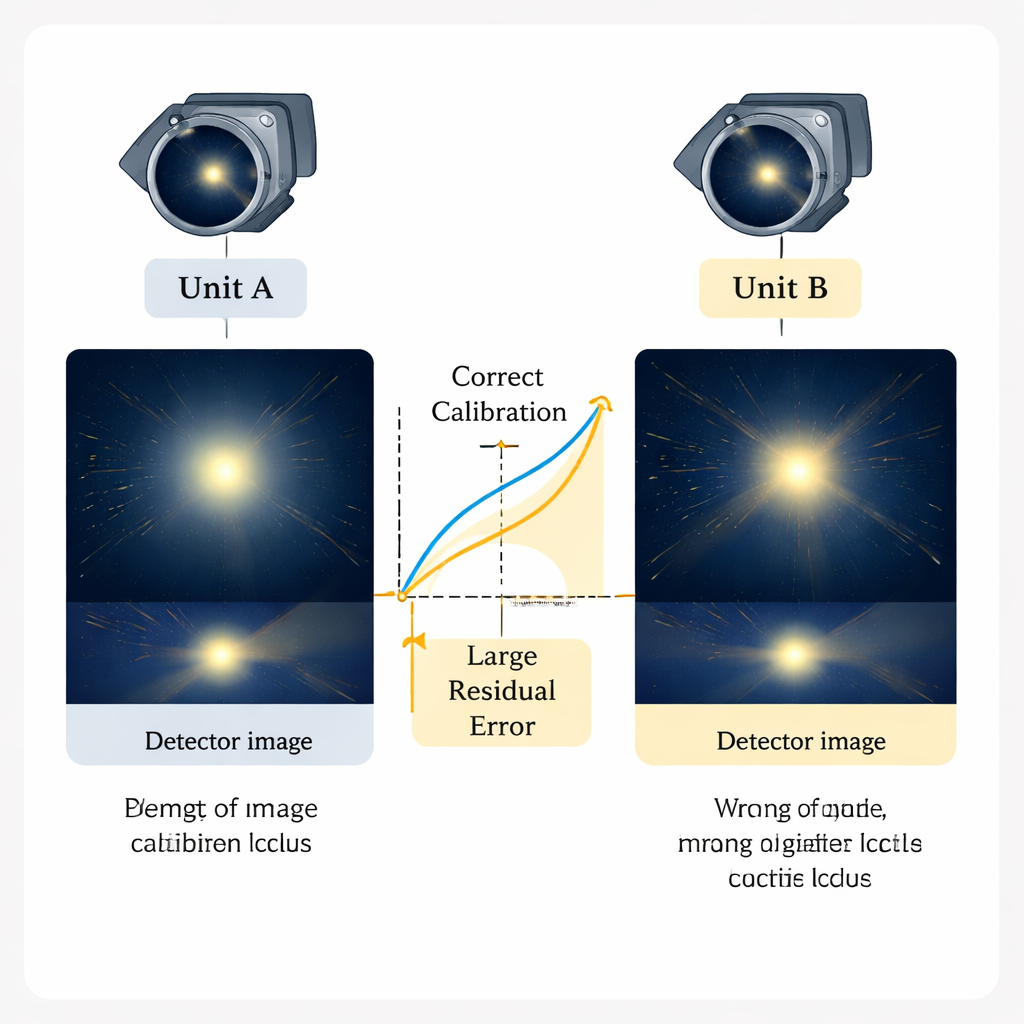
Stray light: the unforgiving troublemaker
The starkest contrast appeared in stray light. By shining point‑like beams and building up detailed maps, the team showed that one unit had more scattering close to the main image and distinctive streaks hinting at microscopic contamination, while the other had stronger “ghosts” farther out. When the researchers tried using the stray‑light calibration from one camera to correct images from the other, the results were poor: instead of suppressing unwanted light by almost a factor of 100, as required, the correction improved things by at best a factor of 10 and sometimes hardly at all. In other words, even seemingly minor changes in surface roughness or dust between “identical” instruments are enough to ruin the sophisticated software that cleans up their images, unless each unit has its own detailed calibration.
What this means for future satellite fleets
The authors conclude that for demanding missions like Metop‑3MI, you cannot skip careful calibration for each instrument, especially for stray light, if you want consistent, scientifically reliable records over many years. Some simpler checks — such as basic image sharpness tests — might be streamlined or done on only a subset of units to save time and money. But the fine‑grained measurements that convert camera counts into real physical quantities must be repeated for every copy. For growing satellite constellations, real savings will come not from avoiding calibration, but from smarter ways of doing it: more automated facilities and new techniques that extract more information from fewer measurements. Only then can large fleets of “identical” space cameras deliver the precise and stable view of our planet that modern climate and weather science demands.
Citation: Clermont, L., Michel, C., Chouffart, Q. et al. Comparison of two Metop-3MI instrument models and implications for on-ground testing in multi-unit space missions. Sci Rep 16, 6256 (2026). https://doi.org/10.1038/s41598-026-37529-4
Keywords: satellite calibration, stray light, Earth observation, multi-unit instruments, space imaging