Clear Sky Science · en
Temperature-driven shifts in foraging behaviour during larval development in a dragonfly
Why baby dragonflies matter in a warming world
As the planet heats up, even the smallest freshwater hunters are forced to change the way they live and feed. Dragonfly larvae—fierce underwater predators that one day become the familiar flying adults—play a key role in pond and lake food webs. This study asks a deceptively simple question with big ecological implications: how does water temperature, together with food supply and growth, change the way young dragonflies hunt?
Watching tiny predators learn to hunt
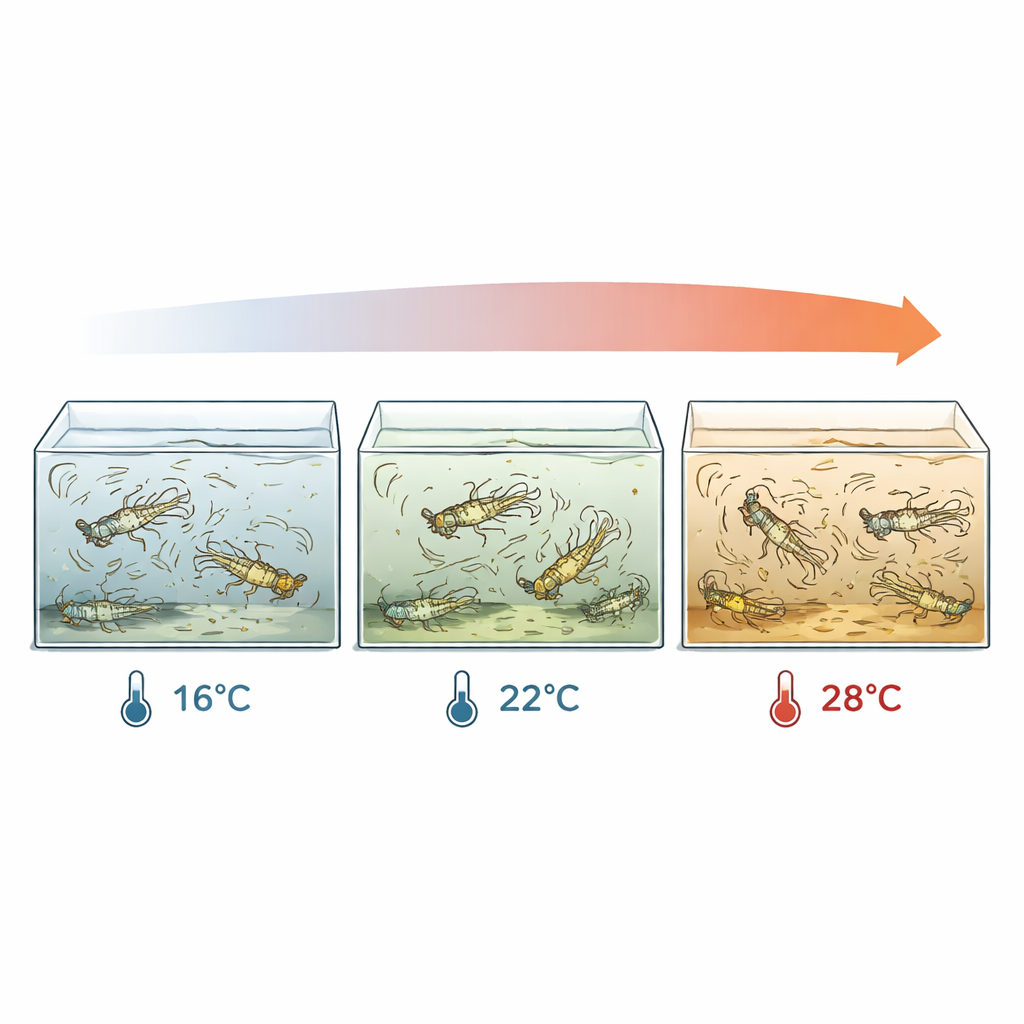
To explore this, researchers raised hundreds of larvae of the common dragonfly Sympetrum striolatum from the moment they hatched. The larvae were kept at three constant water temperatures—cool (16 °C), moderate (22 °C) and warm (28 °C)—to mimic conditions from typical ponds to heat‑stressed ones. In small dishes, the team then offered them live brine shrimp at either low or high densities, sometimes alone and sometimes next to a similarly sized rival larva. Under a microscope, they counted how often each larva struck at prey, how many prey it actually captured, and how often those strikes succeeded, repeating these observations over five weeks as the larvae grew.
Heat speeds things up, but only with enough food
At first, warmer water clearly made the young larvae more active hunters. In the earliest week, those at higher temperatures launched more attacks and captured more prey, likely because warmer bodies burn energy faster and need more food. High prey density amplified this effect: when food was abundant, larvae at warm temperatures struck and captured far more often than those in cooler water. But by the fifth week a twist emerged. At low food levels, the oldest larvae actually struck and captured less often at the highest temperature. This suggests there may be an optimal temperature window for hunting: when it is very warm but food is scarce, larvae either cannot or will not keep up intense foraging, possibly because of stress or the cost of constant activity.
Growing up changes hunting more than the environment
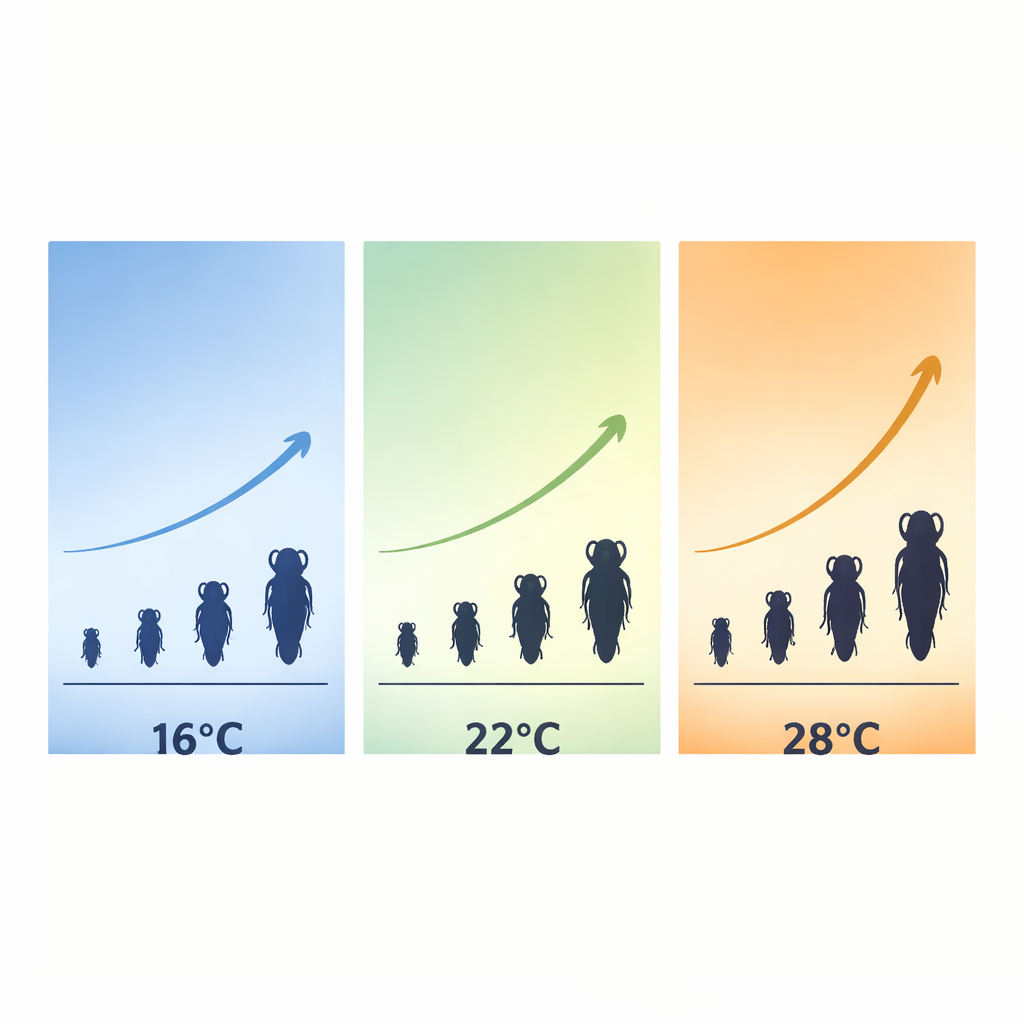
As the larvae aged and increased in size, their hunting behaviour changed dramatically. Older and larger individuals struck at prey more often and became far more efficient hunters. Capture success—how many strikes ended with a meal—rose steadily over time at all temperatures, climbing above 90% by week five and approaching perfection in many cases. Analyses showed that these life‑history traits, age and body size, explained more of the variation in hunting behaviour than external factors like food density or the presence of a rival. Once larvae reached a head width of about 2 millimetres, their success rates stopped increasing strongly, suggesting a developmental threshold beyond which further growth brings little added accuracy.
Warming comes with a survival cost
Temperature did not just alter behaviour; it also changed who survived. Larvae kept in the coolest water had the highest survival, with nearly half making it through the rearing period. At 22 °C and especially at 28 °C, far fewer larvae survived, and at the warmest setting many died early on. These deaths occurred even though the warmest temperature was still below what the species can theoretically tolerate. The authors suggest that high temperatures may sharply increase energy needs; if the diet is limited or unbalanced, small larvae at warm temperatures may simply run out of resources or suffer more from stress and cannibalism.
What this means for ponds, predators and climate change
For a non‑specialist, the key takeaway is that climate warming will not just make dragonfly larvae hunt more; it will change when and how they do so as they grow. Early in life, warmth boosts activity and hunting success, but it also raises the risk of dying, especially if food is not plentiful. As larvae age and gain experience, their hunting becomes extremely precise, and these developmental changes can outweigh the direct effects of temperature or competition. The study highlights that to predict how freshwater communities will respond to climate change, scientists must look beyond temperature and food alone and consider the full life story of organisms—from fragile hatchlings to competent predators.
Citation: Hogreve, J., Johansson, F. & Suhling, F. Temperature-driven shifts in foraging behaviour during larval development in a dragonfly. Sci Rep 16, 5258 (2026). https://doi.org/10.1038/s41598-026-37523-w
Keywords: dragonfly larvae, foraging behavior, water temperature, ontogeny, climate change ecology