Clear Sky Science · en
Mathematical modelling of ion diffusion and state of charge prediction in sodium ion batteries with time series analysis
Why better batteries matter to everyday life
From phones and laptops to electric cars and grid-scale storage, modern life increasingly depends on rechargeable batteries. Lithium-based batteries dominate today, but lithium is relatively scarce and costly. Sodium, in contrast, is cheap and plentiful—think ordinary table salt. This study explores how sodium-ion batteries could be made safer, longer-lasting, and more reliable by combining physics-based mathematics with modern artificial intelligence to track how much energy a battery really has left, known as its state of charge.
From lithium to sodium: a promising alternative
Lithium-ion batteries have powered the portable electronics boom thanks to their high energy density and long life. Yet concerns about resource availability, cost, and sustainability have spurred interest in sodium-ion batteries, which work in a similar way but use far more abundant sodium. Sodium-ion technology is still maturing and must overcome hurdles before large-scale deployment. One of the biggest challenges is accurately estimating the state of charge (SOC)—essentially the battery’s “fuel gauge.” Poor SOC estimates can shorten battery life, reduce driving range in electric vehicles, and even pose safety risks. Traditional methods infer SOC mainly from voltage measurements, which can be noisy and misleading under real-world conditions.
Watching ions move inside the battery
To build a more faithful “fuel gauge,” the authors start from the microscopic physics of sodium-ion motion inside the battery’s solid electrodes. They model how sodium ions diffuse in and out of tiny spherical particles that make up the electrode material, using a classical diffusion equation. By rewriting this equation in a dimensionless form, they highlight a few key parameters that control how fast ions move and where they accumulate during charging and discharging. Instead of relying purely on heavy numerical simulations, the team applies a semi-analytical technique called the Laplace-based Hermite Collocation Method (LT-HCM) to obtain compact formulas for the ion concentration profiles. These solutions are then checked against a well-known numerical scheme, the finite difference method, and show excellent agreement, giving confidence that the diffusion model is accurate. 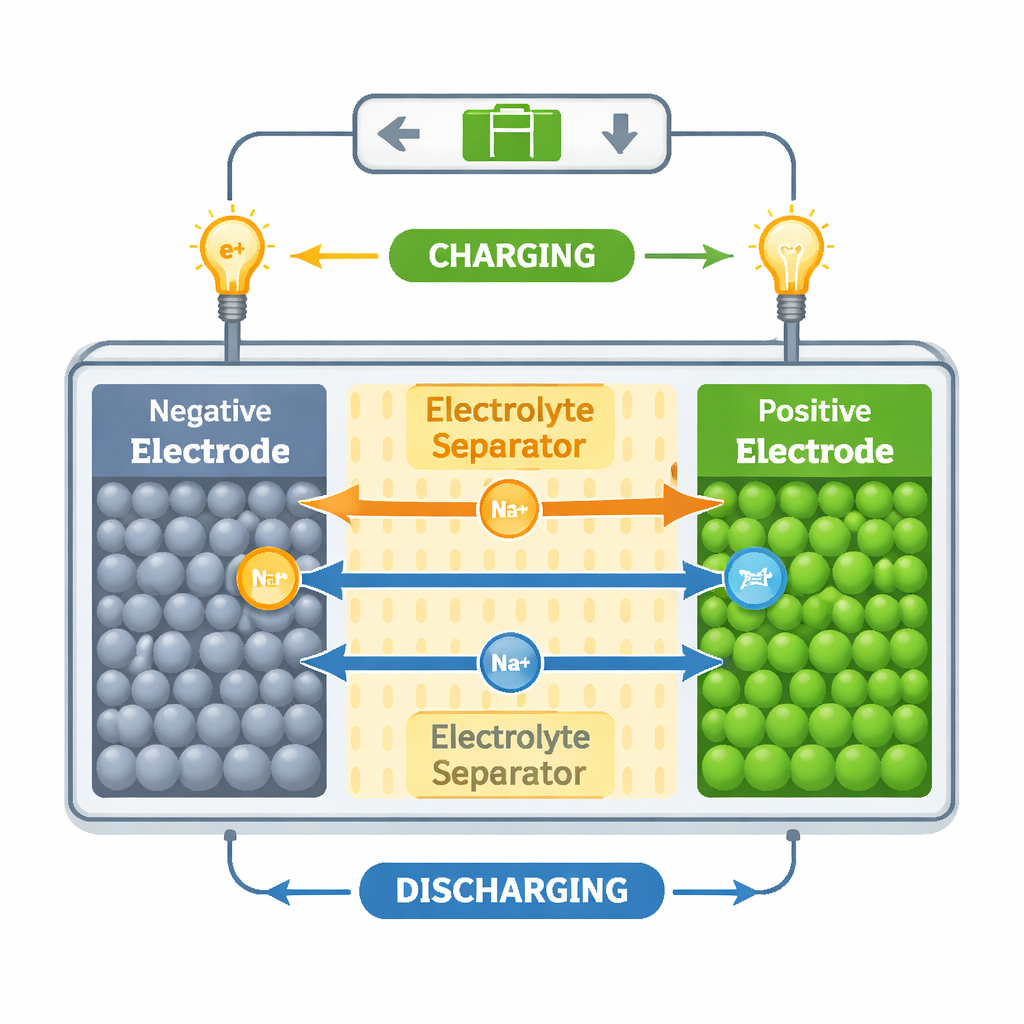
Teaching a neural network to read the battery’s “vital signs”
Armed with this physics-based model, the researchers generate a large, clean dataset showing how ion concentrations and SOC evolve over time under different charging conditions. They then feed these time series into several machine learning approaches—including support vector regression, Gaussian process regression, and gradient-boosted trees—but focus on long short-term memory (LSTM) networks, a type of recurrent neural network designed to handle sequences. The LSTM learns to map the evolving ion concentrations to SOC at both the negative and positive electrodes. By training and testing on separate data splits, and monitoring how the error falls during training, they show that the LSTM captures the subtle, long-term trends in diffusion that simpler models miss. Among all tested methods, the LSTM delivers the lowest prediction errors for SOC. 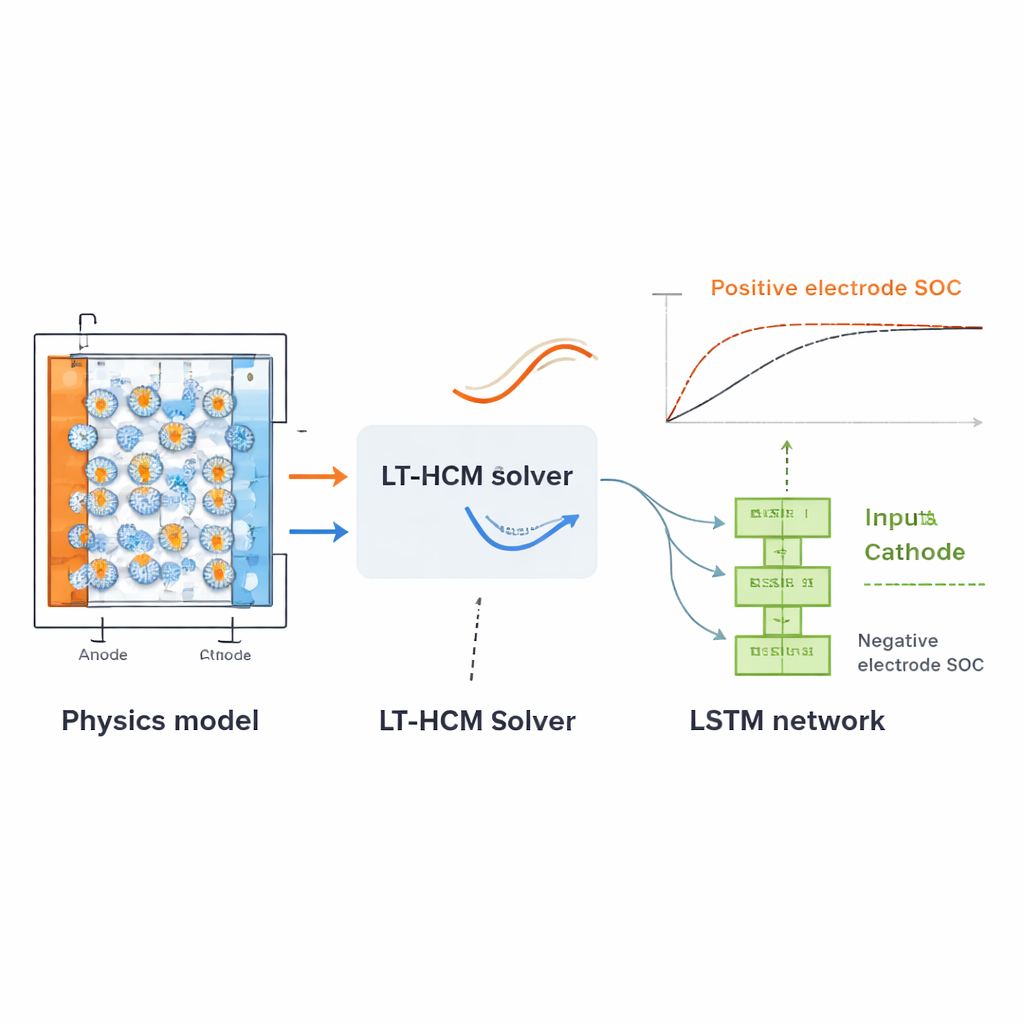
What the models reveal about battery behavior
The combined physics-and-AI framework offers a detailed picture of how sodium ions rearrange themselves inside the battery during charge and discharge. At the start of charging, ions slowly enter the negative electrode, building up more strongly near the surface before gradually spreading inward. Under higher current, ions pile up faster, creating sharper concentration gradients and higher internal resistance. As the battery nears full charge, diffusion slows, resistance rises, and SOC growth levels off—features that both the LT-HCM solutions and the LSTM predictions reproduce. During discharge, the reverse happens: SOC falls steadily, then drops more sharply when one electrode approaches depletion and the other saturation, signaling the practical limits of usable capacity.
A clearer, smarter fuel gauge for sodium-ion batteries
For non-specialists, the key message is that combining mathematical descriptions of how ions move with learning algorithms that recognize time patterns yields a much sharper and more reliable battery “fuel gauge.” Instead of inferring SOC from voltage alone, this hybrid method reads deeper into the battery’s inner workings, tracking ion concentration and charge distribution directly. The result is highly accurate SOC prediction with modest computing effort, which could help sodium-ion batteries operate more safely, last longer, and be better integrated into electric vehicles and renewable energy systems—bringing a more sustainable battery future closer to reality.
Citation: S., S., Srivastava, N. & Hristov, J. Mathematical modelling of ion diffusion and state of charge prediction in sodium ion batteries with time series analysis. Sci Rep 16, 7534 (2026). https://doi.org/10.1038/s41598-026-37522-x
Keywords: sodium-ion batteries, state of charge, battery modeling, machine learning, LSTM