Clear Sky Science · en
A field polymerizing hydrogel enables simultaneous antimicrobial, hemostatic, and analgesic delivery in traumatic wounds
Stopping Bleeding and Infection in the Field
Serious injuries often happen far from hospitals—on battlefields, in the wilderness, or after earthquakes and storms. In these situations, a simple bandage is not enough: wounds may bleed heavily, become infected, and cause intense pain long before a patient reaches surgery. This study describes a new type of smart dressing—a powder that turns into a soft gel with just clean water—that can be mixed and applied on the spot to help stop bleeding, fight germs, and numb pain all at once.
A Powder That Turns Into a Protective Gel
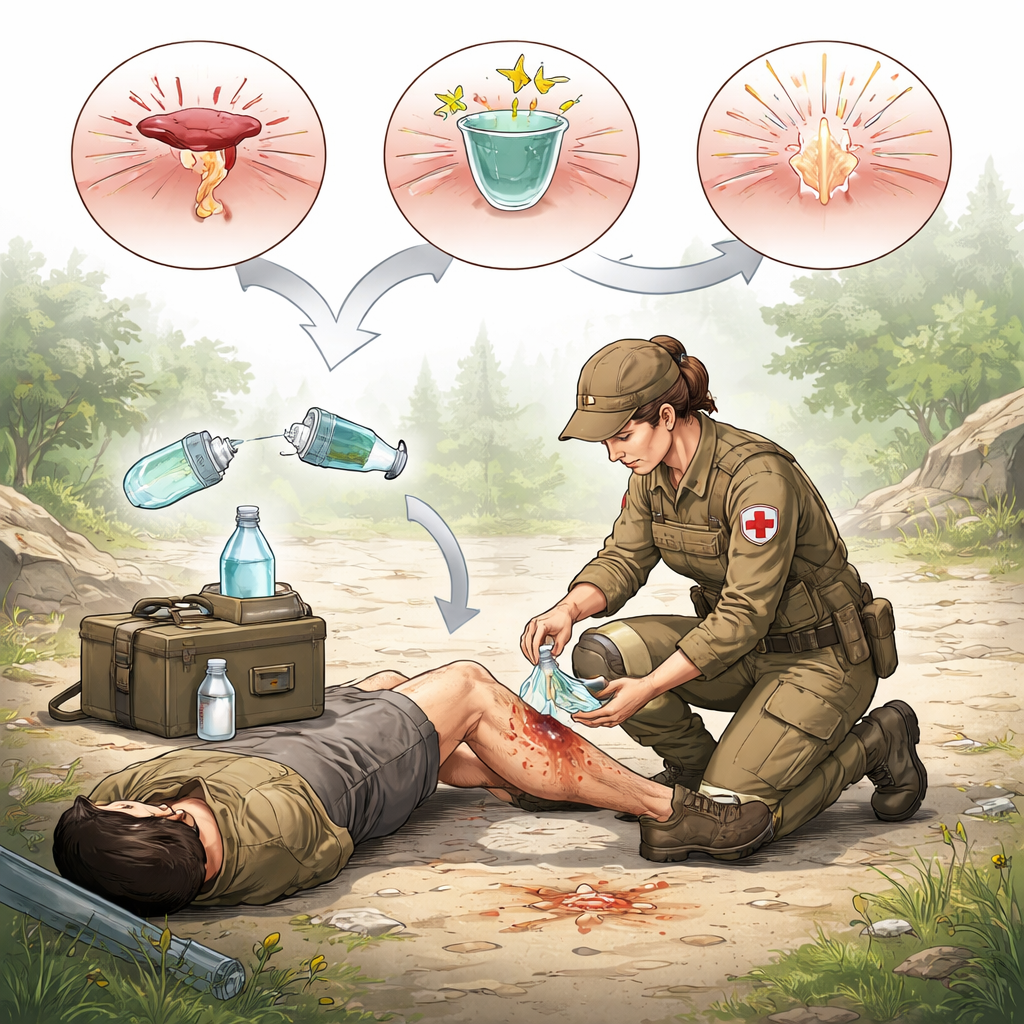
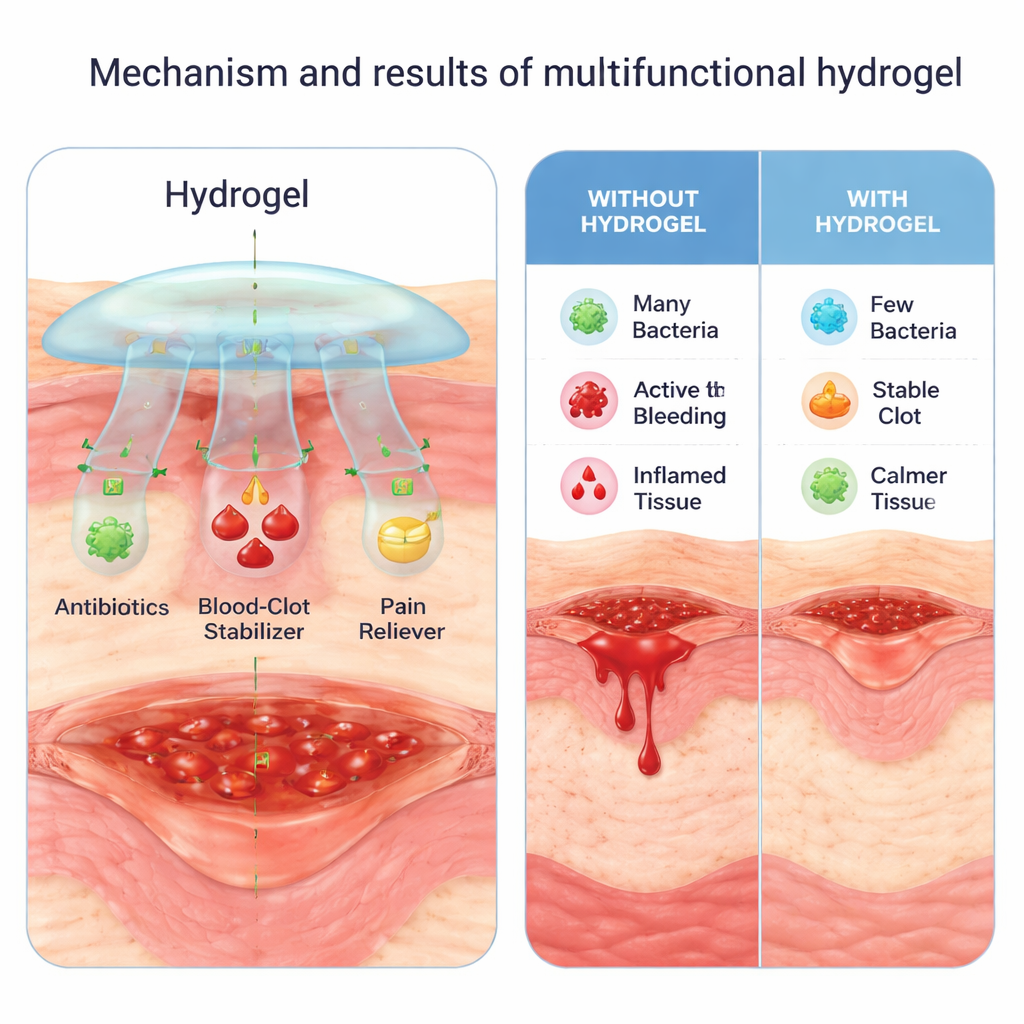
The researchers built their dressing from a water-loving plastic network called a hydrogel. It starts out as a lightweight powder that can be carried in a small kit. When mixed with potable water, it quickly hardens into a clear, rubbery pad that molds itself to the shape of a jagged, open wound. Inside this gel, four common hospital medicines are pre-loaded: two antibiotics (vancomycin and tobramycin) to control a wide range of dangerous bacteria, tranexamic acid to help stabilize blood clots, and lidocaine to reduce pain. Because the gel forms directly on the wound, these drugs are delivered right where they are needed most, instead of relying only on pills or injections that spread through the whole body.
Designing the Gel to Release Medicine Over Time
To make the dressing practical for real-world emergencies, the team had to balance several demands: it needed to be strong yet flexible, work at room temperature, and release its drugs in the right order and at the right speed. Using computer models and lab tests, they tuned the internal “mesh” of the hydrogel so that smaller drug molecules escaped quickly, while larger ones leaked out more slowly. Experiments showed that tranexamic acid rushed out almost immediately, ideal for rapidly limiting blood loss. Lidocaine left the gel fast enough to give early pain relief but continued to trickle out for a couple of days. The antibiotics were released over several days, offering prolonged protection against infection without flooding the whole body with high drug doses.
Putting the Dressing to the Test in Animals
Next, the scientists checked whether the medicines still worked after passing through the gel. Lab tests confirmed that the released antibiotics could still halt the growth of common wound bacteria like Staphylococcus aureus and Escherichia coli. A blood-clotting test showed that tranexamic acid coming from the gel continued to protect clots from being dissolved too soon. The team then moved to a demanding mouse model of open fractures contaminated with three different bacterial species. Mice treated with the drug-filled hydrogel cleared the infection within days, performing as well as those treated with loose antibiotic powder. Importantly, when the researchers examined the animals’ kidneys—a key organ for clearing these medicines—they found no signs of damage or inflammation.
From Mice to Large, Complex Wounds
To see whether the dressing could handle bigger and more complicated injuries, the team tested it in sheep with large open leg wounds that were deliberately seeded with glowing bacteria to track infection. After the wounds were cleaned, some animals received only standard care, while others had a large sheet of the hydrogel placed directly onto the injured area. Two days later, sheep treated with the gel showed a striking drop in bacterial counts, while those without it had infections that worsened. Even in a case where the gel shifted out of perfect position, the treated wound still had far fewer bacteria than untreated ones, suggesting the dressing can meaningfully cut infection risk in large traumatic wounds.
A Field-Ready Tool for Tough Situations
Overall, this work introduces a portable, mix-with-water dressing that can be applied by medics, first responders, or trained laypeople to severe wounds when hospital care is delayed. By combining clot protection, infection control, and pain relief in a single, easy-to-carry powder, the hydrogel could help bridge the crucial hours after injury—reducing bleeding, lowering the chance of life-threatening infection, and making patients more comfortable until they reach surgery. While human trials are still needed, the results in both small and large animals suggest that this multifunctional gel could become a valuable new tool for military medicine, disaster response, and rural or wilderness care.
Citation: Pumford, E.A., Hamad, C.D., Enueme, A.I. et al. A field polymerizing hydrogel enables simultaneous antimicrobial, hemostatic, and analgesic delivery in traumatic wounds. Sci Rep 16, 6950 (2026). https://doi.org/10.1038/s41598-026-37521-y
Keywords: traumatic wounds, hydrogel dressing, field medicine, infection control, bleeding control